Dave Thompson April 20, 2026 1328 Views
Ever feel like you’re trying to run your SEO agency by duct-taping a dozen different tools together? You’ve got your CRM over here, a rank tracker over there, spreadsheets for project management, and another app for invoicing. It’s chaos.
This is where SEO agency management software comes in. Think of it as the central command center for your entire operation. It’s a single, unified platform designed to connect all the moving parts of your business—client management, task scheduling, SEO analytics, and financial reporting—into one seamless system.
This isn’t just about convenience; it’s about creating a single source of truth for both your client campaigns and your agency’s overall health.
What Is SEO Agency Management Software?

Imagine trying to conduct an orchestra where every musician is playing from a different sheet of music. That’s what running an agency without a central platform feels like—disjointed, inefficient, and a recipe for disaster. Good management software is the conductor’s podium, bringing every part of your agency into harmony.
This isn’t just another tool in your marketing stack; it’s the operating system for your entire business. It’s built specifically to bridge the gaps between all those separate apps, giving you a crystal-clear, real-time view of client performance and, just as importantly, agency profitability.
The Core Purpose of This Software
At its heart, this software is built to solve the scalability problem that hits almost every growing agency. When you only have a handful of clients, you can get by with manual processes. But as you grow, the administrative tasks, reporting duties, and back-and-forth communication multiply exponentially.
Without a solid system in place, this complexity quickly leads to team burnout, missed deadlines, and inconsistent results for clients. An effective SEO agency management software tackles these headaches head-on by automating the repetitive stuff and standardizing your workflows. This frees up your talented team to focus on high-impact strategy instead of getting bogged down in administrative busywork.
This software is built to transform agency operations from a reactive, manual process into a proactive, automated one. It’s about building a foundation that supports growth instead of being crushed by it.
It’s no surprise that the demand for these integrated solutions is booming. The global agency management software market was valued at around USD 6.58 billion in 2024 and is projected to hit USD 14.29 billion by 2033. This surge is all about agencies like yours needing a better way to manage everything from client projects to resource allocation. You can dig into these trends in more detail in industry reports covering agency management software growth on businessresearchinsights.com.
Key Functions Integrated into One Platform
The real magic of this software is how it combines several critical functions that agencies usually juggle with separate tools. This consolidation is its biggest superpower. The core components almost always include:
-
Client & Project Management: This is your central hub for all client data, communication history, and project timelines. It ensures everyone on your team is on the same page, all the time.
-
SEO Tool Integration: The platform plugs directly into essential tools like Google Analytics, Search Console, and other major SEO suites, pulling all your campaign data into one unified dashboard.
-
Automated Reporting: Say goodbye to manually building client reports. The software can generate professional, white-label reports automatically, saving you countless hours each month while keeping clients in the loop.
-
Task & Workflow Automation: You can create standardized workflows for recurring tasks like client onboarding, content creation, or technical audits. This is huge for maintaining quality and consistency as you scale.
-
Financial Oversight: Many platforms include features for time tracking, invoicing, and profitability analysis on a per-client basis, giving you a clear, honest picture of your agency’s financial health.
Core Features That Fuel Agency Growth

If you’re serious about scaling your SEO agency, you need a powerful engine, not just a bunch of parts duct-taped together with spreadsheets and wishful thinking. The right SEO agency management software is that engine, packing core features designed to bust through the specific, costly bottlenecks that keep agencies small. These aren’t just nice-to-haves; they are the gears that turn operational chaos into a smooth, profitable machine.
Think of these features like a pit crew at a race. Each member has a highly specialized job, but they all work in perfect sync to make the car go faster. From locking down client and project management to putting tedious reporting on autopilot, each component solves a headache every agency owner knows all too well.
Client and Project Management
An agency’s entire reputation rests on its ability to manage relationships and hit deadlines without anything slipping through the cracks. This is precisely where client and project management features become non-negotiable. They act as the central command center for your entire operation, making sure information gets to the right people and tasks get done on time, every time.
Picture this: a new client signs the contract. Without a solid system, that simple act triggers a frantic scramble of manual work—creating folders, digging up welcome email templates, scheduling calls, and assigning initial discovery tasks. A proper management platform automates this whole dance with standardized onboarding workflows, guaranteeing every single client gets the same polished, professional kickoff.
These modules are typically built around:
-
Centralized Client Profiles: One single source of truth for every contract, contact detail, communication log, and piece of historical data. No more hunting through old emails or shared drives.
-
Task Management and Milestone Tracking: You can build project templates for your core services (like a technical audit or monthly content plan) with pre-loaded tasks and deadlines. This creates a crystal-clear roadmap for both your team and your client.
-
Team Collaboration Tools: Communication channels are built right into the platform, keeping every project-related discussion tied to the specific client or task it belongs to. This puts an end to the frustrating mess of trying to piece together conversations from Slack, email, and text messages.
Critical SEO Tool Integrations
Let’s be honest, an SEO agency is powered by data. The problem is, that data lives in a dozen different places—Ahrefs for backlinks, SEMrush for keyword research, Google Analytics for traffic, and Google Search Console for performance. Without integration, your team is stuck wasting precious hours just logging in and out of different tools, copying and pasting data into a spreadsheet.
Good SEO agency management software fixes this by becoming your data hub. It uses APIs to plug directly into your go-to marketing tools, pulling all the important metrics into one unified dashboard. Suddenly, you have a complete picture of campaign performance without all the manual grunt work.
An integrated platform transforms your agency from a group of data collectors into a team of data strategists. When you stop wasting time on manual data entry, you free up your experts to do what you hired them for: analyzing trends and building strategies that get real results.
For example, you can see a client’s keyword ranking changes from your rank tracker sitting right next to their organic traffic data from Google Analytics and their latest backlinks from Ahrefs. Seeing everything in context makes it infinitely easier to connect your team’s actions to the client’s bottom line, which is how you prove your value. You can explore how these integrations work in more detail within various white-label SEO tools.
Automated Reporting and Financial Management
Manually building client reports is one of the biggest time-sucks an agency deals with. In fact, some studies show marketing pros can spend up to 10 hours every month just on reporting. This is where automated reporting features deliver an immediate, massive return on your investment.
These tools hook into your integrated data sources to generate professional, white-label reports on autopilot. You can schedule them to run weekly or monthly and customize them with your agency’s logo and branding. Instead of your team spending hours exporting charts and trying to write summaries, you deliver consistent, data-rich updates that keep clients happy and confident.
To help you visualize how these features come together to support your agency, here’s a quick breakdown of what to look for.
Table: Essential Features of SEO Agency Management Software
| Feature Category | Key Functionalities | Primary Agency Benefit |
|---|---|---|
| Client & Project Management | Centralized client database, task/milestone tracking, team collaboration tools, onboarding workflows. | Operational Efficiency: Ensures nothing falls through the cracks and standardizes service delivery. |
| SEO Tool Integration | API connections to tools like Google Analytics, SEMrush, Ahrefs, and rank trackers for data aggregation. | Strategic Focus: Eliminates manual data collection, freeing up teams to focus on analysis and strategy. |
| Automated Reporting | Customizable, white-label report generation, scheduled report delivery, performance dashboards. | Time Savings & Client Retention: Drastically cuts down on administrative hours and keeps clients informed. |
| Financial Management | Time tracking, invoicing, client/project profitability analysis, billing automation. | Increased Profitability: Provides clear insight into which clients are most profitable and where resources are being spent. |
This combination of features does more than just organize your work; it gives you the financial clarity you need to run a truly profitable business.
Finally, strong financial management tools connect the dots between your work and your bottom line. By integrating time tracking and invoicing directly into the platform, the software can calculate the profitability of every client and project. This instantly shows you which accounts are your cash cows and which might be secretly draining your resources, letting you make smart, data-driven decisions about your pricing, staffing, and overall business strategy.
Unlocking Key Benefits for Your Agency
Let’s move past a simple feature list. The real magic of SEO agency management software isn’t just what it does, but the tangible results it creates for your business. Bringing a dedicated platform into your workflow isn’t about tidying up a few tasks—it’s about fundamentally changing how your agency operates and grows. Think of it as the engine that turns operational friction into strategic momentum.
The first and most obvious win is a massive boost in operational efficiency. How many hours does your team lose every week to mind-numbing manual work? Compiling reports, updating spreadsheets, hunting down login details—it all adds up. Automating these chores gives your team back its most precious resource: time. Suddenly, your SEO experts are free to ditch the admin and focus on high-impact work like strategy, deep competitive analysis, and actually talking to clients.
Elevate Client Trust Through Transparency
A huge benefit is the ability to offer clients a clear, professional window into their campaigns. When all their data, progress updates, and messages live in a single, clean, white-labeled dashboard, clients feel involved and confident. They can log in whenever they want to see progress in real-time, which demystifies the whole SEO process and builds an incredible amount of trust.
This kind of clarity is a game-changer for client retention. You’re no longer just sending a static PDF report once a month that’s already out of date. Instead, you’re giving them a live look at the value you’re delivering every single day. This proactive approach strengthens your partnerships, cuts down on the endless “just checking in” emails, and cements your agency’s reputation as a true partner.
Drive Profitability with Data-Backed Insights
Perhaps the most critical benefit is the direct impact on your bottom line. Good SEO agency management software gives you the tools to connect your team’s day-to-day efforts directly to financial outcomes.
By layering in time tracking with project management, you get an unblinking view of where your resources are going. This data quickly shows you which clients are most profitable, which services have the best margins, and even which tasks are eating up too much time. This is how you start optimizing your pricing and doubling down on high-value work.
This data-first approach pulls your agency out of the world of guesswork. You can spot scope creep before it gets out of hand, justify your pricing with hard numbers, and make strategic calls that directly boost your profitability. It’s about managing your agency like the successful business it is. The market certainly sees the value; the global SEO software market hit USD 76.8 billion in 2024 and is expected to skyrocket to USD 299.6 billion by 2035. This explosive growth shows just how vital these platforms have become. You can find more details in this global SEO software market analysis on sphericalinsights.com.
When you get down to it, investing in the right software turns your agency’s capabilities into solid business advantages:
-
More Time: By automating the grunt work, your team gets to focus on what they were hired to do—deliver amazing SEO results.
-
Happier Clients: Radical transparency and professional reporting build the kind of trust that creates long-term partnerships and reduces churn.
-
Healthier Margins: With clear data on profitability, you can make smarter decisions that protect and grow your revenue.
How to Choose the Right Software Solution
Picking the right SEO agency management software isn’t just a purchase—it’s a strategic move that lays the foundation for your agency’s future. The right platform can unlock serious efficiency and profitability. But the wrong one? It creates frustrating bottlenecks and a bad case of buyer’s remorse.
The best place to start is by looking inward. Before you even think about scheduling a demo, you need to conduct an internal needs analysis. Get your team in a room and pinpoint the biggest headaches in your current workflow. Are you burning hours manually pulling together client reports? Is project tracking a chaotic mess of spreadsheets and forgotten Slack messages?
When you map out these specific challenges, you create a concrete checklist of “must-have” features. This transforms your search from a vague browse into a focused mission to solve real, costly business problems.
Define Your Core Evaluation Criteria
Once you know what you need, you can build a framework to evaluate potential software. Not all platforms are built the same, and what works for a small startup might completely cripple a mid-sized agency. Your criteria have to be tailored to your unique situation, but a few key areas are non-negotiable for any agency with plans to grow.
Zero in on these critical pillars:
-
Scalability: Can the software’s pricing and features grow with you? A platform that’s a bargain for 10 clients but gets wildly expensive at 50 is a short-term fix, not a long-term solution. A 2023 study found that 73% of businesses view scalability as a top priority when choosing software.
-
Integration Capabilities: Your agency already runs on a stack of tools you know and trust. The right management software should be a central hub, not another isolated island of data. Look for native integrations with the essentials, like Google Analytics, Search Console, Ahrefs, and whatever CRM you’re using.
-
White-Labeling & Reporting: How deep do the white-label options go? Your client-facing dashboards and reports are a direct reflection of your brand. You need granular control over everything from custom domains to slapping your logo on every PDF to deliver a professional and seamless client experience.
The goal isn’t just to find a tool that works, but to find one that fits seamlessly into your agency’s DNA. The best SEO agency management software should feel like a natural extension of your team, amplifying your strengths rather than forcing you to change your entire process.
Running Effective Demos and Trials
With a shortlist of contenders ready, it’s time to see them in action. Sales demos and trial periods are your chance to pressure-test the software against your actual, day-to-day needs. Don’t just sit back and watch a canned presentation; show up with a list of specific questions tied directly to the pain points you identified earlier.
Get straight to the point with questions like:
-
“Can you show me exactly how the automated reporting feature would handle a client with multiple locations?”
-
“How does your platform track project profitability for a fixed-fee retainer?”
-
“What does the onboarding process look like if we need to migrate 20 existing clients?”
This decision tree visualizes how focusing on core needs like efficiency, transparency, and profitability is the most direct path to sustainable agency growth.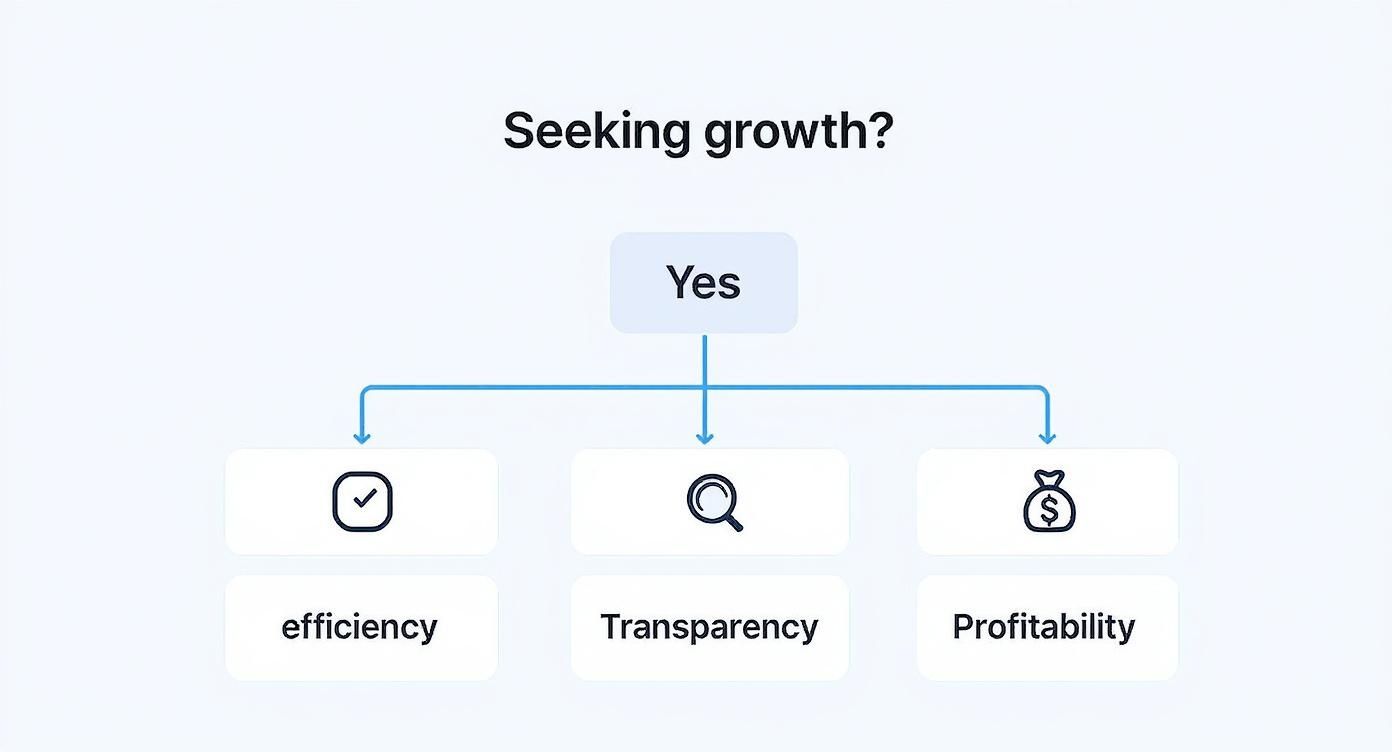
Ultimately, the right software should streamline these three key areas to support your expansion.
When you get to the free trial, treat it like you’ve already bought it. Onboard one or two of your friendliest clients and run them through your entire workflow, from assigning the first task to generating their monthly report. This hands-on approach is the only way to know for sure if the software truly fits your team’s reality, ensuring you invest in a solution that will actually empower your agency for years to come.
Measuring Real-World Impact and ROI
Theory is one thing, but tangible results are what really matter when you’re thinking about investing in SEO agency management software. The true value isn’t just about making workflows smoother; it’s about the measurable hit on your agency’s efficiency, client happiness, and, most importantly, your bottom line. Let’s move past the feature lists and look at a couple of real-world scenarios that show a clear return.
These platforms are built to turn better operations directly into financial wins. By automating tasks that you do over and over, a single piece of software can completely change your agency’s capacity for growth. It turns saved time into scalable revenue.
Scenario One: The Lean Startup Agency
Picture a small, two-person SEO startup just trying to keep up. They spend almost a third of their week manually pulling data, compiling reports, updating spreadsheets, and juggling a dozen different tools. All this administrative drag means they can only handle four clients at a time, putting a hard cap on their growth.
After bringing a management platform on board, they automate their entire reporting process. Professional, white-labeled reports now go out to clients like clockwork every month. This one change saves them 15 hours per week.
The Outcome: By slashing their admin workload by nearly 40%, the agency freed up enough time to confidently take on two more clients. This boosted their monthly recurring revenue by 50% without having to immediately hire someone new, directly pumping up their profitability.
Scenario Two: The Mid-Sized Firm Battling Churn
Now, let’s look at a mid-sized agency with 15 clients. Their biggest headache is client retention. They’re getting good results, but their reporting is all over the place, and clients often feel out of the loop on day-to-day progress. This lack of transparency leads to a client churn rate of around 25% a year, which costs them a ton of revenue and forces them into a constant, expensive hunt for new business.
They decide to adopt an SEO agency management platform that includes a solid, white-labeled client dashboard. Now, clients can log in whenever they want to see real-time ranking updates, traffic data, and a list of completed tasks. This radical transparency completely changes their client relationships.
-
Problem: High client churn because of a perceived lack of transparency and spotty communication.
-
Software Solution: Rolled out a centralized, white-label client portal showing live campaign data.
-
Measurable Result: Within a year, client churn plummeted from 25% to just 10%. This 15% improvement in retention not only stabilized their revenue but also boosted team morale since they could spend more time on strategy and less on putting out fires.
Building a Compelling Case for Investment
These examples show how the software directly affects key business metrics. Being able to put numbers to these improvements is crucial for calculating your ROI. You can track everything from billable hours you get back to increases in client lifetime value. For a deeper dive, you might be interested in our guide on four simple calculated metrics to track agency performance.
The demand for powerful tools like these is especially strong among larger companies. In fact, large enterprises made up the biggest slice of the revenue pie in the SEO software market, representing about 55.15% in 2023. This is driven by their need to manage complex, large-scale campaigns with precision and efficiency. You can discover more insights about these enterprise SEO software trends on grandviewresearch.com.
Whether you’re a small startup or a growing firm, the principle is the same—the right platform pays for itself by optimizing your most valuable assets: your team’s time and your client relationships.
Implementing Your New Agency Platform

Picking the right SEO agency management software is a huge win, but let’s be honest—the best platform on earth is useless if your team doesn’t actually use it. A successful rollout isn’t about flipping a switch and hoping for the best. It’s about a thoughtful, deliberate plan to turn that new software into your agency’s command center, not just another subscription collecting digital dust.
The key is a smart strategy that handles both the tech setup and the human element. Trust me, a phased approach almost always beats a big-bang, agency-wide launch. It minimizes the chaos and lets you build momentum one small victory at a time.
Laying the Groundwork for a Smooth Transition
Before you even touch a single piece of client data, you need to find your internal “platform champion.” This should be someone on your team who’s genuinely excited about the new software. They’ll become the go-to person for questions, troubleshooting, and training, and their enthusiasm is contagious.
With your champion in place, it’s time to get the technical side squared away. This first stage is all about configuring the platform so it feels like it was built just for your agency.
-
Data Migration: The first job is getting all your existing client info, contacts, and past campaign data into the system. A clean, accurate transfer is the bedrock for everything else.
-
Workflow Configuration: Start building out custom project templates for your bread-and-butter services, like technical SEO audits or monthly content packages. Pre-loading tasks and timelines means every project kicks off with the same level of quality and consistency.
-
Brand Customization: Dive into the white-labeling features. Add your agency’s logo, tweak the color scheme, and set up a custom domain to create a totally seamless brand experience for your clients.
Driving User Adoption and Overcoming Resistance
Once the tech is dialed in, the real work begins: getting your team on board. People naturally resist change, so you have to frame the new platform as a tool that makes their jobs easier, not just different. The trick is to show them the value right out of the gate.
A successful software implementation isn’t just about technology; it’s about changing habits. The goal is to show your team that the initial learning curve is a small price to pay for the long-term gains in efficiency and clarity.
Start small. Pick a pilot group—maybe one or two of your most adaptable teams—and let them run with the platform for a few clients. This is your chance to gather feedback, iron out any kinks in your workflows, and create some internal success stories. When other teams hear how much time the pilot group is saving, they’ll be eager to jump in.
For agencies that want to deliver a polished client experience from day one, a powerful white-label dashboard is non-negotiable. It reinforces your brand and gives clients a professional, central hub to see their campaign progress.
A Phased Rollout for Lasting Success
After your pilot group is humming along, you can start rolling the platform out to the wider team. But don’t try to unleash every single feature at once. A strategic, step-by-step plan prevents your team from getting overwhelmed and lets them master one piece of the software before moving on to the next.
-
Phase 1 (Weeks 1-2): Get all teams using the platform for basic project and task management. The only goal here is to make logging in and tracking daily work a comfortable, routine habit.
-
Phase 2 (Weeks 3-4): Introduce automated reporting and the client dashboard. This is where you get that first “wow” moment when the team sees how much time they’re saving compared to building reports by hand.
-
Phase 3 (Weeks 5-6): Now, roll out the advanced stuff like time tracking and profitability analysis. This is where the platform shifts from an organizational tool to a powerful business intelligence engine.
By following this kind of structured approach, you methodically weave the SEO agency management software into the fabric of your daily operations. Before you know it, it will become an indispensable asset that’s truly fueling your agency’s growth.
Frequently Asked Questions
It’s natural to have questions when you’re thinking about investing in a new platform for your agency. Let’s tackle some of the most common ones we hear from agency owners trying to find the right fit.
Can’t I Just Use Tools Like Trello or Asana Instead?
While tools like Trello or Asana are fantastic for general project management, they hit a wall when it comes to the nitty-gritty of running SEO campaigns. They’re just not built for the job. They don’t have the deep-level integrations you need for real campaign analysis and client reporting.
A purpose-built platform is different. It plugs directly into your essential SEO toolkit—think Ahrefs, SEMrush, and Google Analytics. This connection automates everything from rank tracking to creating specialized workflows for technical audits and link building, giving you a single, reliable source for all your campaign data.
What Does the Pricing Structure Typically Look Like?
Most SEO agency management software runs on a Software as a Service (SaaS) subscription model. The pricing is almost always tiered, and what you pay usually depends on a few key things:
-
Number of Clients or Projects: Simply how many campaigns you’re actively managing.
-
User Seats: The number of people on your team who need access.
-
Feature Access: Higher-priced plans often unlock advanced tools like API access or more sophisticated white-labeling options.
When you’re comparing options, don’t just look at the monthly fee. Think about the total cost of ownership and make sure the plan you pick can scale with you as you bring on more clients without breaking the bank.
How Big of a Deal Are White-Label Reporting Features?
For an agency, white-labeling isn’t just a “nice-to-have”—it’s a critical piece of the puzzle for building your brand and earning client trust. This feature lets you put your own branding on every client-facing dashboard, report, and email. Your logo, your custom domain, your professional touch.
A seamless, authoritative brand experience is what reinforces your agency’s value. It transforms your services from a commodity into a bespoke, high-end solution, which is absolutely key for building strong, long-term client relationships and keeping churn low. Many agencies find that sharp, branded reporting is one of the biggest factors in retaining clients.
At the end of the day, a polished, branded reporting system turns a simple data delivery into a professional statement about the value your agency provides. It’s an indispensable feature you shouldn’t overlook.
Ready to stop juggling tools and start scaling your agency with a single, powerful platform? Agency Platform gives you an all-in-one, fully white-labeled dashboard built to streamline your operations, impress your clients, and grow your bottom line. Find out why over 1,200 agencies trust our software to build their brands by starting your free trial today.