Dave Thompson October 7, 2026 16 Views
Image naming SEO is the practice of creating descriptive, keyword-rich filenames for image files to help search engines understand their content and context, improving visibility in both traditional and image search results. About 32.9% of Google search queries return image results, and images account for about 3% of all Google search clicks, which is enough to make filenames worth treating as an operational standard, not a cosmetic detail.
Many organizations still treat image names as whatever came out of a phone, camera, Canva export, or CMS upload. That's a mistake. For agencies, image naming SEO works best when it becomes a documented system tied to content production, localization, accessibility, and QA.
Foundational Rules for Image Filenames in 2026
Google's baseline guidance is still the right place to start. Its image SEO documentation recommends filenames that are “short, but descriptive,” using examples like my-new-black-kitten.jpg instead of IMG00023.JPG or image1.jpg, as summarized in this review of Google's image filename guidance. That advice holds up because the filename is one of the first durable clues a crawler gets about the image.
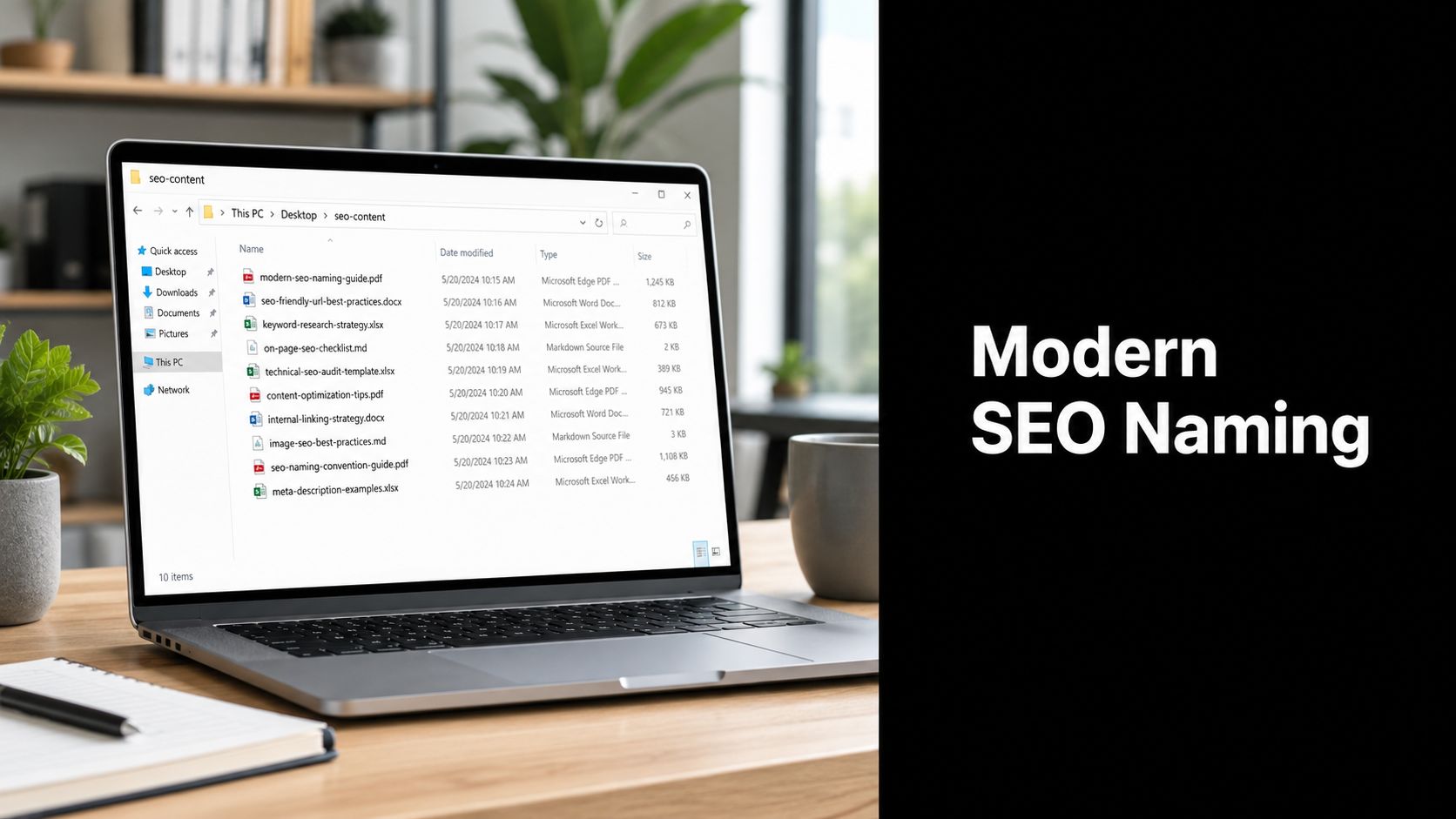
In practice, good filenames do three jobs. They describe the asset, reinforce page topic, and stay stable enough for teams to manage at scale. If you want search systems and AI answer engines to interpret a page cleanly, vague file names work against you.
What a good filename looks like
Use a filename that matches what's in the image. Keep it readable. Separate words with hyphens. Avoid filler words unless they clarify intent.
A few examples:
Good:
emergency-plumber-brooklyn-van.jpgBetter for product detail:
white-running-shoe-side-view.jpgBad:
final-v2-new.jpgWorse:
image1.jpg
Practical rule: If a teammate can understand the image without opening it, the filename is usually doing its job.
What to avoid
Three patterns create most image naming problems:
Generic exports:
IMG_8821.jpg,screenshot-4.png,hero-banner-final.jpgKeyword stuffing: filenames that repeat the same term unnaturally
Underscore-heavy naming: readable to humans, but hyphens are the cleaner standard for SEO workflows
One more point matters for 2026 workflows. Filenames should be part of the same discipline as page copy, schema, and asset management. If your content team is already adapting for AI search summaries, this fits naturally into that process. A useful reference is Agency Platform's guide to optimizing for AI and future-proofing your SEO strategy.
Developing Your Agency's Image Naming Policy
A one-off rename isn't a policy. Agency work needs a naming structure that junior staff, freelancers, designers, and developers can all follow without interpretation drift.
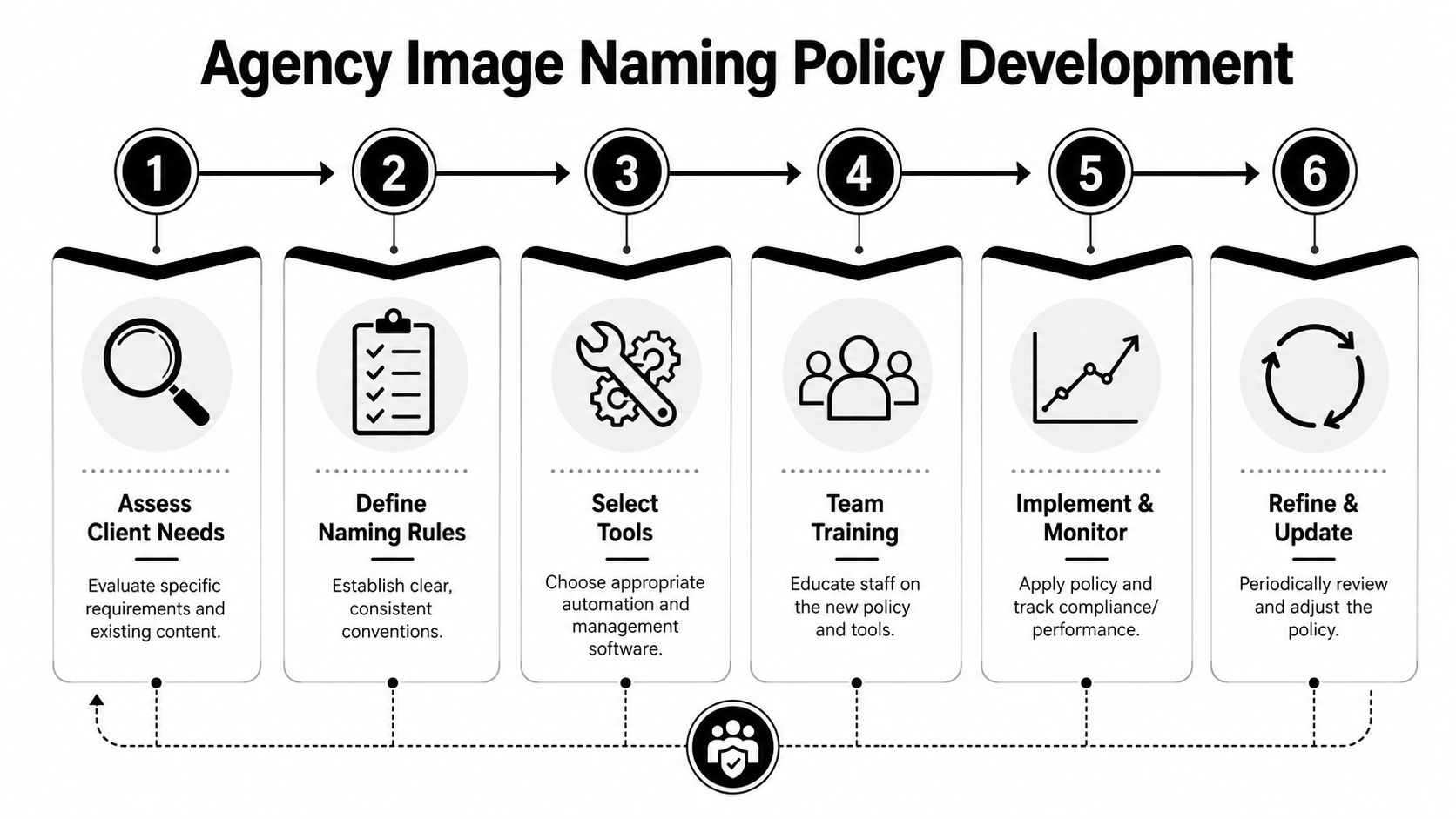
A practical workflow is to treat the filename as the first machine-readable context signal, then layer specificity in a fixed order: primary keyword, descriptive attributes, then context clues such as brand, model, or use case, as outlined in this image renaming workflow guide.
A naming template that scales
Use this template:
primary-topic + distinguishing detail + context
Examples by client type:
| Client type | Strong filename example |
|---|---|
| Local service | water-heater-repair-phoenix-technician.jpg |
| Ecommerce | leather-office-chair-brown-side-view.jpg |
| Law firm | personal-injury-lawyer-consultation-office.jpg |
| Healthcare | pediatric-dental-checkup-waiting-room.jpg |
This works because it balances precision and reuse. You're not trying to jam every query variation into the file. You're creating a clean topical signal.
Policy decisions agencies should document
Most inconsistency comes from undocumented edge cases. Write these rules down:
Primary asset rule: Give unique, highly specific filenames to the most important images on a page.
Secondary asset rule: For supporting images, use a page-level base plus a differentiator, such as angle, room, or sequence.
Localization rule: Add the location only when the image meaningfully supports local intent.
Version control rule: Keep production filenames clean. Handle internal revisions in your DAM, not in public URLs.
Teams break image naming standards when the policy depends on memory. Put the pattern in your SOP, CMS checklist, and upload QA.
What doesn't work
Don't build filenames around internal labels like homepage-feature, client-approved, or service-page-banner. Those help project management, not search relevance.
Also, don't rename everything the same way across industries. A plumber, a med spa, and a Shopify catalog need different levels of detail. The system should be fixed. The vocabulary should vary by client model.
Coordinating Filenames with Alt Text and Page Context
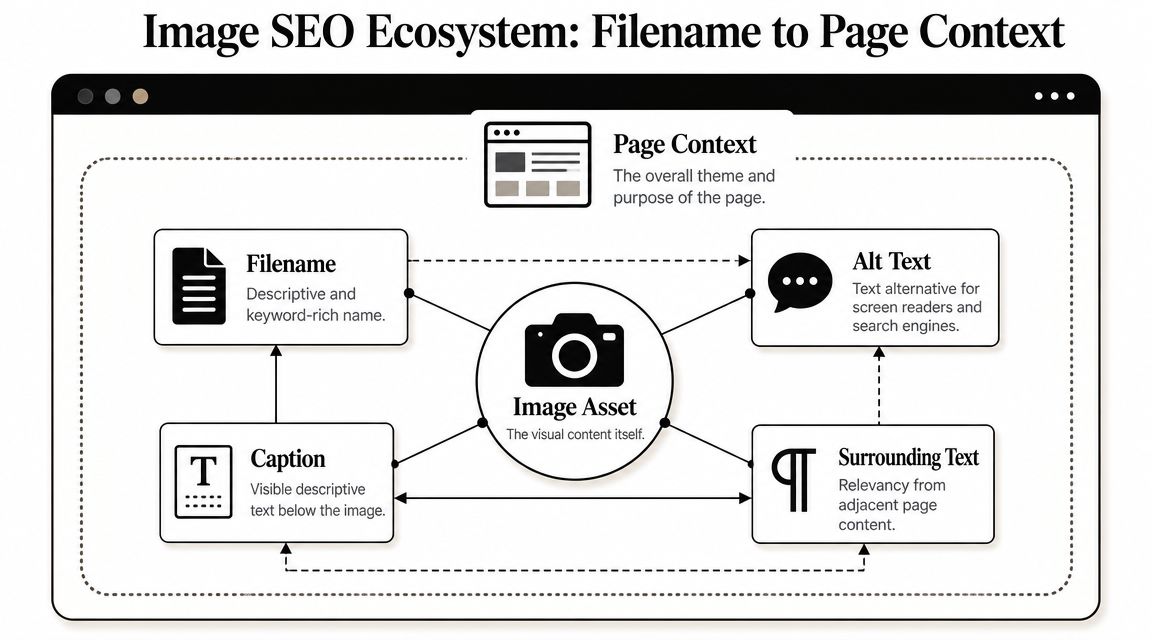
A filename alone won't carry image SEO. The strongest results come from aligning the filename with the rest of the image stack: alt text, nearby copy, structured data, and image sitemap inclusion. Google's image documentation makes that broader picture clear in its guidance on Google Images SEO and image best practices.
Practitioners cited in that same body of guidance report that image-search traffic share can move from roughly 2–3% to 8–12% of total traffic within six months when naming is systematized. Treat that as directional, not a promise. The point is that filenames work best when they reinforce context instead of operating alone.
The role of each element
Think of the stack this way:
Filename identifies what the image is.
Alt text explains the image usefully and accessibly.
Caption adds visible context when needed.
Nearby text tells search systems why the image belongs on that page.
A coordinated example:
Filename:
white-ceramic-coffee-mug-desk.jpgAlt text:
White ceramic coffee mug on a desk beside a laptopHeading nearby:
Best desk accessories for remote workParagraph nearby: discussion of workspace setup and coffee gear
That combination is coherent. It isn't repetitive.
Redundancy vs reinforcement
Bad image SEO repeats the same phrase everywhere. Good image SEO distributes meaning across elements.
Don't clone the filename into the alt text. Write alt text for accessibility first, then let it support relevance naturally.
If the filename says family-dentist-waiting-room-chicago.jpg, the alt text doesn't need to say the exact same string. It should describe the image in natural language. The surrounding copy can carry the service and location intent more elegantly than the alt text can.
Automating Image SEO for Scalable Client Workflows
Manual renaming breaks once an agency manages enough sites, enough content writers, and enough uploads across WordPress, Shopify, Webflow, and custom CMS environments. Scale requires enforcement.

There's real room to win here. Industry reporting says 32.9% of Google search queries return image results, while only 26% of websites use alt text and 36% feature oversized images, which points to a large gap in basic image optimization discipline according to this image SEO statistics roundup.
Where automation helps most
The biggest gains come from four workflow points:
Upload enforcement: Use CMS rules, media SOPs, or pre-publish checks so default filenames never reach production.
Bulk cleanup: For existing libraries, rename priority assets first, starting with high-value service pages, product pages, and evergreen posts.
Localization support: Create naming patterns that account for city or service modifiers only when they reflect the actual image.
Performance pairing: File naming should sit beside compression, dimensions, and alt text completion in the same checklist.
If a client runs event-heavy or user-generated content, intake matters too. For example, brands that need to collect wedding guest images often end up with large batches of inconsistently named uploads. That's a good reminder that image governance starts at collection, not just at publishing.
What agencies should automate and what they shouldn't
Automate structure. Review meaning.
That means you can automate lowercase formatting, hyphenation, duplicate handling, and page-based naming patterns. You still want human review for hero images, product-defining visuals, regulated industries, and any asset where location or service intent could be misleading.
A broader automation mindset helps here. Agency teams already use AI to reduce repetitive SEO work, and the same logic applies to media workflows. Agency Platform's article on using AI in SEO to automate tasks for efficiency and accuracy is a useful reference point for building that kind of process.
Image naming SEO isn't a trick. It's a quality-control system. The agencies that document it, automate the repeatable parts, and connect it to the full image stack usually outperform the ones that leave filenames to chance.
If your agency needs a white-label way to operationalize SEO workflows across multiple clients, Agency Platform gives you the branded dashboard, fulfillment support, and process visibility to turn tasks like image SEO from scattered execution into a repeatable service.