Dave Thompson April 14, 2026 1692 Views
Figuring out how to price SEO services shouldn’t feel like throwing darts at a board. It’s less about guesswork and much more about building a solid, sustainable financial model for your agency. The real key is finding that sweet spot between market rates, what it actually costs you to deliver, and the tangible value you bring to your clients.
Laying the Groundwork for Profitable SEO Pricing

Before you can even think about sending out a proposal, you have to get your own financial house in order. This goes way beyond just covering salaries. You need to dig deep into the real, all-in costs of doing business. Your pricing has to account for every single thing that makes it possible for you to deliver killer results.
And getting this foundation right is more important than ever. The demand for skilled SEO professionals is exploding. The global SEO services market is on a tear, hitting over $60 billion in 2023 and projected to climb to a staggering $106.9 billion by 2030. This boom is all thanks to the worldwide shift to digital marketing, opening up huge opportunities for agencies that know how to price their services for profit. You can learn more about the SEO industry growth and see the full data.
The Four Core SEO Pricing Structures
Most agencies build their pricing around one of four fundamental models. Each one serves a different purpose and is a better fit for certain client relationships or project scopes. Getting a handle on these is the first real step toward creating a repeatable system that fuels your agency’s growth.
I’ve put together a quick comparison table to break down the big four, helping you see at a glance which model might work best for different scenarios.
Comparing the Four Core SEO Pricing Models
| Pricing Model | Best For | Pros for Agency | Cons for Agency |
|---|---|---|---|
| Monthly Retainer | Ongoing, long-term SEO strategies and comprehensive campaigns. | Predictable, recurring revenue and strong client relationships. | Can lead to scope creep if not managed with clear deliverables. |
| Project-Based | Well-defined tasks with a clear start and end, like a site audit or migration. | Clear scope and payment terms. Easier to price for profitability. | Revenue is less predictable; requires a consistent sales pipeline. |
| Hourly Rate | Consulting, training, or small, ad-hoc tasks and quick fixes. | Ensures all time is compensated. Simple to track and bill. | Can be difficult to scale; clients may focus on hours over results. |
| Performance-Based | Clients with clear conversion goals and high-risk tolerance. | High potential for reward if goals are met or exceeded. | High risk; no payment if goals aren’t achieved. Unpredictable cash flow. |
Ultimately, choosing the right structure—or even creating a hybrid approach—comes down to the client’s specific needs and your agency’s capacity. For instance, a small local business might start with a project-based technical audit before they feel comfortable committing to a monthly retainer.
A classic mistake I see new agencies make is completely forgetting to account for “non-billable” time. All those client calls, proposal drafts, and internal strategy huddles are part of your overhead. If you aren’t factoring that time into your cost calculations, you’re already eating into your profits.
This is where white-label fulfillment can be a game-changer. Platforms like Agency Platform can dramatically simplify your cost calculations by giving you a clear, fixed wholesale price for services. It makes setting profitable retail prices so much easier, especially when you don’t have the overhead of a large in-house team to worry about.
Choosing the Right SEO Pricing Model
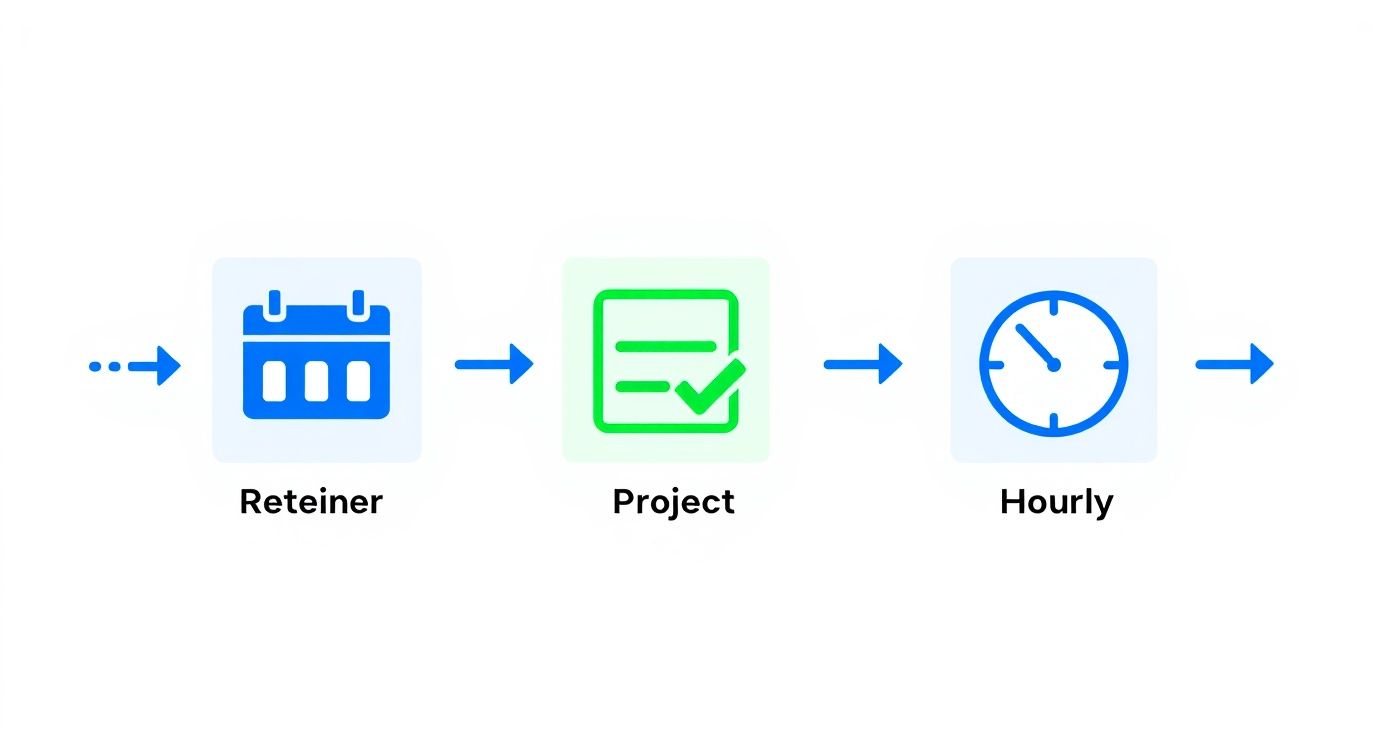
Once you’ve nailed down your costs and profit margins, the next big question is how you’ll actually charge for your expertise. This isn’t just about sending an invoice; your pricing model is the engine of your agency. It dictates your cash flow, sets the tone for client relationships, and ultimately defines how you scale.
There are four common models you’ll see in the wild. The trick is knowing which one to use for the right client and the right job. Getting this right is what separates the agencies that thrive from those that just get by. You want a win-win where the client feels they’re getting incredible value and your agency stays healthy and profitable.
The Stability of Monthly Retainers
The monthly retainer is the undisputed champion of SEO pricing, and for good reason. It’s a simple, fixed fee paid every month for your ongoing SEO work. Over 75% of SEO agencies use this model because it creates predictable, recurring revenue—the absolute lifeblood of a growing business.
Retainers are perfect for long-term partnerships where SEO is a core part of the client’s growth plan. This model gives your team the runway to plan, execute, and fine-tune a strategy over months or even years. It covers everything from creating content and building links to technical fixes and monthly reporting.
A rock-solid retainer agreement spells out exactly what you’ll deliver each month. This isn’t just paperwork; it’s a tool for managing expectations, preventing scope creep, and making sure everyone is on the same page about what success looks like.
The Clarity of Project-Based Pricing
Got a job with a clear beginning and end? Project-based pricing is your best friend. Instead of a monthly commitment, you charge a single flat fee for a very specific scope of work. It’s clean, simple, and easy for everyone to understand. This model accounts for roughly 27% of pricing structures used by SEOs, making it a popular alternative to retainers.
Here are a few real-world examples where a project fee makes perfect sense:
- A deep-dive technical SEO audit: Your client’s site is a mess, and they need a roadmap. You quote a fixed price of $3,500 to deliver a comprehensive audit with a prioritized action plan.
- A tricky website migration: The client is moving to a new domain and is terrified of losing their rankings. You charge a flat $7,000 to manage the whole SEO migration from start to finish.
- A 90-day link-building sprint: A new client wants to build authority, fast. You propose a $10,000 project to land 15 high-quality backlinks over the next three months.
The Flexibility of Hourly Billing
Hourly billing is less common for full-blown SEO campaigns, but it definitely has its place, with about 23% of agencies offering it. It’s ideal for quick consultations, one-off tasks, or training sessions where the scope is small or hard to predict. Think of it as your “on-demand” option. Maybe a client needs you for a few hours to figure out a sudden ranking drop or to train their new marketing hire.
If you go this route, don’t undervalue your time. Seasoned SEO pros often charge $150-$200+ per hour. You’re not just selling hours; you’re selling access to years of specialized expertise.
The Risk and Reward of Performance-Based SEO
And then there’s the high-stakes option: performance-based SEO. With this model, your pay is directly tied to hitting specific goals—like getting a client to page one for their money keywords or generating a set number of organic leads. When it works, it can be incredibly profitable. But if you miss your targets, you could end up working for free. It’s not for the faint of heart.
SEO pricing can be all over the map, but recent data shows that average monthly budgets typically fall between $1,500 and $5,000. Performance-based models made up around 9% of agency deals in recent years, but that number is ticking up as clients demand more accountability. If you want to dive deeper into the market, you can find more SEO pricing statistics in this research.
Because the risk is so high, structuring these deals is everything. A smart approach is to require a smaller base retainer to cover your costs, then add big bonuses for hitting performance milestones. To get a better handle on structuring these types of agreements, take a look at our guide on white-label SEO pricing models. This hybrid approach protects your cash flow while still giving you a shot at that huge upside.
Calculating Your True Costs and Profit Margins
Knowing how to price your SEO services really starts with a brutally honest look at your own numbers. True profitability isn’t just about the number on the proposal; it’s about what you actually keep after every single cost is paid.
To set prices that actually fuel growth, you have to go deeper than surface-level math. Your real cost of delivery includes not just your team’s time but also all the hidden overhead that keeps the lights on.
Identifying Every Single Agency Cost
Before you can even think about a price tag, you need a complete list of your expenses. This is a non-negotiable first step. Your overhead is everything you spend money on that isn’t directly tied to a specific client’s deliverables.
Let’s break down the usual suspects:
- Software and Tools: This is a big one. Subscriptions for must-haves like Ahrefs, SEMrush, or Moz Pro and various reporting dashboards can easily run into thousands per month. For a more integrated solution, a platform like Agency Platform bundles many of these tools, which can simplify your tech stack and cost.
- Marketing and Sales: What’s your client acquisition cost? This includes ad spend, sales commissions, and even the time and software cost of creating proposals.
- Administrative Support: Think accounting software, legal fees, project management tools like Asana, and any VAs or office staff.
- Office and Utilities: Even if you’re fully remote, you still have costs for internet, phone services, or co-working space memberships.
Calculating Your Base Hourly Cost
Now let’s turn that overhead figure into something you can actually use. The goal here is to calculate your agency’s base hourly cost—what it costs you to stay in business for one billable hour. This isn’t your client rate; it’s your absolute break-even point.
Here’s a simple formula to get you started:
(Total Monthly Salaries + Total Monthly Overhead) / Total Monthly Billable Hours = Base Hourly Cost
Let’s run a quick example. If your monthly salaries are $20,000, your overhead is $5,000, and your team has a combined 400 billable hours available each month, the math looks like this:
($20,000 + $5,000) / 400 = $62.50 per hour
This means your agency must earn $62.50 for every single billable hour just to cover its costs. Any rate you charge a client has to be significantly higher than this to actually turn a profit.
Knowing your base hourly cost is a game-changer. It takes all the guesswork out of pricing. When you know for a fact that anything below a certain number means you’re losing money, you can negotiate with confidence.
Leveraging White-Label Fulfillment for Scalable Margins
One of the biggest hurdles to scaling an agency is the ever-increasing cost of an in-house team. This is where white-label fulfillment becomes a secret weapon.
Using a white-label partner gives you instant access to a full suite of SEO services—from content and link building to technical audits—at a fixed wholesale price. You can then resell these services under your own brand without having to hire a specialist for every little thing. This model makes your cost calculations incredibly simple. A healthy margin for reselling white-label services is typically between 40-60%. To really dig into this strategy, check out our guide on how to maximize your profit with an effective SEO reseller program.
For example, if a white-label content package costs you $500, you should be pricing it for your client somewhere between $700 (a 40% margin) and $800 (a 60% margin). This approach gives you the power to scale your offerings without the massive financial risk of bloating your payroll.
How to Build and Sell Compelling SEO Packages

Selling individual SEO tasks is a tough game. The most successful agencies have all made a critical shift: they stopped selling a list of services and started offering a menu of solutions.
Building tiered SEO packages is, without a doubt, the single best way to streamline your sales process. It helps increase your average deal size and, most importantly, frames your value around what clients actually want—outcomes.
Instead of the dreaded, “So, what’s your budget?” you can pivot the conversation to, “Which of these growth plans best fits your goals for the next year?” This simple change completely repositions you. You’re no longer just another vendor; you’re a strategic partner.
Structuring Your Tiers for Growth
A tiered approach is powerful because it makes it easy for clients to self-select the plan that matches their ambition and budget. The classic three-tier model—often labeled something like “Launch,” “Growth,” and “Scale”—is a proven framework for a reason. It maps directly to a business’s natural journey.
-
Tier 1: Launch This is your entry point, built for small businesses or startups that need to get the fundamentals right. The focus here is on essential, high-impact activities that move the needle without requiring a massive investment.
-
Tier 2: Growth This package is for established businesses that are ready to get more aggressive. It builds on the foundation of the Launch tier by adding more advanced strategies, like consistent content creation and proactive link acquisition, to start capturing serious market share.
-
Tier 3: Scale This is your premium offering, designed for market leaders or companies aiming for total domination in a competitive space. This tier is all-in, pulling in sophisticated technical SEO, digital PR campaigns, and deep data analysis to drive significant, lasting growth.
This structure simplifies the decision for clients. While research shows that 49% of customers look at up to five pieces of a company’s content before making a choice, a clear, value-driven set of packages can shorten that sales cycle dramatically.
The real magic of tiered pricing is how it anchors the client’s perception of value. When they see a premium “Scale” package, the mid-tier “Growth” package suddenly looks incredibly reasonable. It naturally steers them away from the cheapest option and toward a more comprehensive solution.
What to Include in Each Package
The secret to a compelling package is making sure each tier delivers distinct, tangible value. You aren’t just piling on more “stuff” to justify a higher price; you’re offering a more powerful engine for your client’s growth.
Here’s a practical way to break down what each tier could include:
| Package Tier | Core Components | Focus / Business Outcome |
|---|---|---|
| Launch | Foundational on-page SEO, keyword research, Google Business Profile optimization, basic technical audit, monthly reporting. | Establish online visibility and capture the low-hanging fruit. Perfect for local businesses needing to get on the map. |
| Growth | All “Launch” services, plus 2-4 monthly blog posts, local citation building, and foundational link acquisition. | Increase organic traffic and start ranking for commercial keywords. Ideal for businesses ready to grow beyond their immediate area. |
| Scale | All “Growth” services, plus advanced content strategy, digital PR outreach, advanced technical SEO (e.g., Core Web Vitals), and CRO analysis. | Dominate the search results for competitive terms and become a recognized authority in the industry. |
If you want to see a real-world example of how these services can be bundled, check out these sample national SEO packages. You’ll notice a clear progression from foundational work to advanced strategies. And when you’re building your packages, using a partner like Agency Platform for white-label fulfillment means you can confidently offer a robust suite of services in your “Scale” tier without needing a massive in-house team to pull it off.
Selling the Solution, Not the Service
How you present your packages is just as important as what’s inside them. Always frame the conversation around their pain points and desired outcomes.
Instead of saying, “Our Growth package includes four blog posts,” try this: “To become the go-to resource for your customers, our Growth plan will establish your expertise with four targeted articles each month. This will attract buyers much earlier in their journey.”
This value-based selling approach immediately shifts the focus from cost to investment. When a client truly understands how each part of a package contributes to their bottom line, the price becomes a secondary concern.
Benchmarking Your Rates in a Global Market
Pricing your SEO services without looking at the bigger picture is a surefire way to leave money on the table. Knowing the going rates helps you sidestep the classic mistake of undervaluing your expertise. Market benchmarks provide a solid baseline, letting you price for profit instead of just pricing to win the next proposal.
Geographic Pricing Disparities
Your location—and your client’s location—has a massive impact on what you can charge. An agency based in the U.S. can usually command higher rates simply because of market demand and the higher cost of doing business. It’s not unusual for seasoned U.S.-based SEO pros to charge $150-$200 per hour.
On the other hand, an equally talented agency or freelancer in a different country might charge a fraction of that for similar work. This global dynamic is something you have to be aware of, as it shapes both opportunities and the competitive landscape.
Typical SEO Retainer and Hourly Rates
For most SEO agencies, monthly retainers are the bread and butter. The rates can swing wildly depending on the client’s size, their industry, and the scope of work.
Here’s a general breakdown:
- Small Local Businesses: Retainers here often land somewhere under $1,500 a month. This usually covers the essentials like local SEO, on-page tweaks, and basic reporting.
- Growing SMBs: For businesses that are ready for more aggressive growth, expect retainers between $1,500 and $5,000 per month. This tier typically brings in content creation, link building, and deeper technical SEO.
- National or Enterprise Brands: Big-league national campaigns are a different ballgame. Retainers here frequently start at $5,000+ per month and can climb much, much higher.
Recent data shows the global average for monthly SEO services sits between $1,000 and $2,500, with hourly rates averaging $50 to $100. Of course, this hides a lot of variation—U.S. services can easily cost three to five times more than those from markets like India or the Philippines. As a general rule, agencies also charge about 30% more than freelancers to account for their overhead and broader scope. For a deeper dive, check out these global SEO pricing trends.
Leveraging White-Label Fulfillment in a Global Market
This market knowledge becomes a real superpower when you work with a white-label partner. A provider like Agency Platform connects you with a global talent pool and streamlined fulfillment, all at a fixed wholesale cost. Suddenly, you can serve clients anywhere and still protect your profit margins.
By knowing the going rate for SEO in a client’s specific market, you can confidently mark up your white-label services. If a US client is used to seeing retainers in the $2,500 range, you can structure a profitable package using wholesale fulfillment that still delivers incredible value to them.
This strategic approach lets you compete effectively, whether you’re pitching a local shop down the road or a national brand clear across the country.
At Agency Platform, we simplify the most complex part of your pricing puzzle—fulfillment. Our white-label dashboard and wholesale services give you a predictable cost basis, so you can build profitable, scalable SEO packages for any niche without the overhead. Book a demo to see how you can streamline your operations and protect your margins.