Dave Thompson June 23, 2026 910 Views
White label digital marketing services are solutions delivered by a specialized third party that your agency can rebrand and sell as its own, which lets you expand service offerings without building every capability in house. The model has already moved into the mainstream: the global white-label services market is projected to reach $99.19 billion by 2026, and 73% of agencies have already integrated white-label services into their operations, according to white-label marketing industry statistics.
For agency owners, that matters because client demand keeps widening while execution keeps getting more specialized. SEO, PPC, content, reporting, local visibility, and AI-aware search strategy all require different skills, tools, and processes. A good white-label setup lets you sell with confidence, deliver under your own brand, and protect margins without turning your agency into a hiring treadmill.
What Exactly Are White Label Digital Marketing Services
White label digital marketing services are fulfillment services performed by another company but presented to the client under your agency’s brand. Your agency owns the client relationship, strategy, pricing, and communication. The partner handles some or all of the execution behind the scenes.
How the model works in practice
The simplest way to explain it is this. The white-label provider is the kitchen, and your agency is the restaurant. The client orders from your menu, trusts your brand, and expects your standard. The meal is prepared elsewhere, but the experience still belongs to you.
That distinction matters because white labeling is not the same as affiliate marketing or referrals.
-
In a referral model, you send the client elsewhere and give up control.
-
In an affiliate model, you promote another brand’s service.
-
In a white-label model, you remain the agency of record. The work is packaged, reported, and delivered as your own.
Why agencies use it
Agencies usually hit the same ceiling. Sales grows faster than delivery capacity, or clients ask for services outside the current team’s expertise. White label digital marketing services solve that gap without forcing immediate hires in SEO, paid media, content production, design, or reporting operations.
A practical setup usually includes a branded dashboard, defined turnaround times, clear scopes, and a single source of truth for account status. That’s why many agencies look for platforms built specifically for resellers, such as white-label marketing solutions for agencies.
Practical rule: If the partner strengthens your delivery while keeping your brand front and center, it’s white label. If the client sees another company’s name, it isn’t.
The model works best when the agency keeps ownership of strategy and client communication, even if the partner supports the tactical execution. That’s where agencies preserve trust and avoid becoming a pass-through reseller with no real control.
The Core Service Offerings Agencies Must Provide in 2026
The services that matter most aren’t random add-ons. They’re the channels clients repeatedly buy because they affect visibility, lead flow, and retention. In white-label fulfillment, SEO remains the most requested service, and the broader SEO market is projected to reach $122.11 billion by 2028. Beyond SEO, 60% of agencies outsource PPC campaigns for stronger ROI, according to white-label SEO and PPC market trends.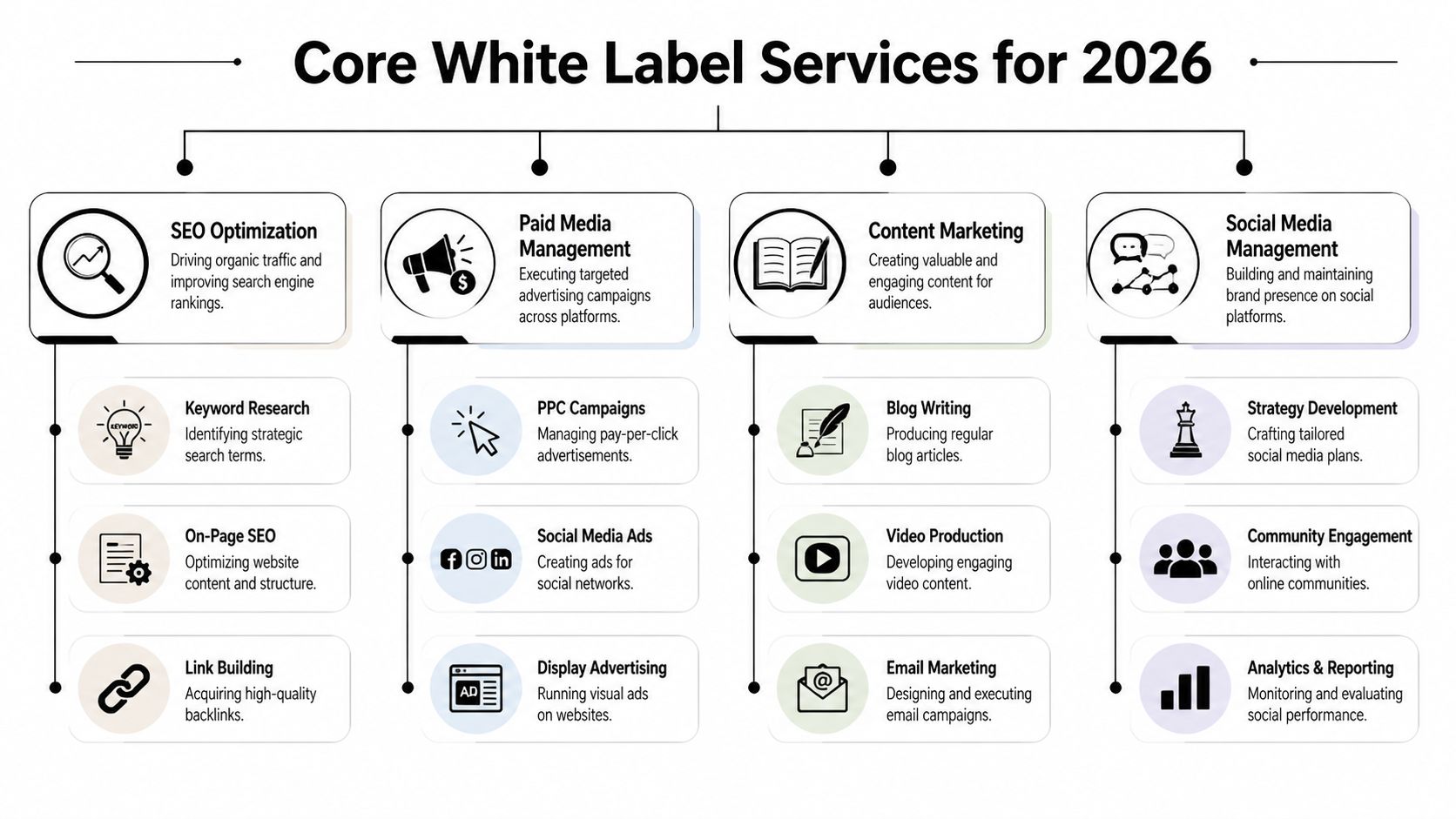
SEO still anchors the relationship
SEO remains the backbone because it supports long-term visibility and recurring revenue. For most agencies, that means local SEO, technical audits, on-page optimization, content mapping, and link acquisition. If a white-label partner can’t handle those cleanly, the relationship usually stalls early.
The AI-era wrinkle is quality. Thin content, generic briefs, and checklist SEO don’t hold up well when search engines increasingly reward clarity, expertise, and trustworthy site signals.
Paid media requires specialist execution
PPC looks easy from the outside and gets expensive fast when managed loosely. Strong white-label paid media teams bring structure to account builds, landing page alignment, search term control, budget pacing, and reporting. This is one area where specialized execution often beats a generalist internal team.
Content, social, and web support complete the offer
Clients rarely think in channel silos. They want traffic, leads, and proof that their brand looks credible everywhere a buyer checks. That’s why content marketing, social media management, and web design often become part of the same white-label mix.
A useful content operation now also includes workflow discipline around briefs, topical structure, human review, and sensible AI use. For teams refining production processes, this guide on streamlining content with AI tools is a practical read because it focuses on workflow rather than hype.
Agencies don’t need every service in house. They do need a delivery stack that feels coherent to the client.
The agencies that win in 2026 won’t be the ones offering the longest menu. They’ll be the ones offering a focused set of services that connect strategy, execution, and reporting without operational drag.
Strategic Benefits That Go Beyond Simple Outsourcing
A weak white-label arrangement is just outsourced labor. A strong one changes the economics of the agency.
White label SEM partnerships can deliver up to eight times higher ROI than in-house efforts, with 30 to 50% lower cost per acquisition, according to Conduit Digital’s analysis of white-label SEM performance. That kind of gap usually comes from specialization. Dedicated teams spend their time on campaign adjustments, platform changes, and execution details that many agencies can’t justify staffing internally.
Better scaling without constant hiring
Hiring is slow, training is slower, and utilization is never perfect. White labeling lets an agency add service capacity when sales lands, not months later. That’s useful when demand spikes unevenly across SEO, Google Ads, content, or design.
Margin improves when delivery is standardized
The biggest margin leaks in agencies usually come from custom work, underused staff, and poor scoping. White-label services can fix all three if the partner has repeatable processes. You buy wholesale delivery, package it intelligently, and keep strategic control where your agency adds the most value.
Your offer becomes wider without becoming messy
Clients don’t like hearing, “We don’t do that.” The right partner lets you keep accounts by adding adjacent services when the client is ready. That increases account depth and makes your agency harder to replace.
The best white-label relationships don’t remove your agency from the work. They remove chaos from the work.
The agencies that benefit most are usually the ones that keep sales, account management, positioning, and final quality control in house. They don’t hand off the client. They build a stronger backend.
Your Actionable Vendor Selection Checklist
A white-label partner can help you scale, but a poor one can damage client trust fast. Use this checklist before you sign anything. For a deeper framework, review key considerations when choosing a white-label SEO partner.
White Label Partner Evaluation Checklist
| Evaluation Criterion | What to Look For | Red Flag |
|---|---|---|
| Service depth | Clear capability in the exact services you plan to resell, not vague “full service” claims | Broad promises with no visible process |
| Reporting and dashboard | Brandable reports, client-safe presentation, role-based access, clear task visibility | Manual screenshots, inconsistent reporting, provider branding |
| Communication model | Defined points of contact, revision process, turnaround expectations | Shared inbox chaos or slow, unclear replies |
| Strategy support | Ability to explain why work is being done, not just ship deliverables | Execution only, with no strategic reasoning |
| Quality control | Editorial review, campaign QA, escalation path for mistakes | No documented QA process |
| Pricing clarity | Wholesale pricing that is understandable and stable enough to package | Surprise fees, vague scopes, confusing add-ons |
| Tool compatibility | Integrations with your reporting, analytics, CRM, and project stack | Requires workarounds for basic data flow |
| Brand protection | Client-facing materials that can live under your identity | Provider wants visibility with your clients |
Questions worth asking on the first call
-
Who owns revisions: If a deliverable misses the brief, how is rework handled?
-
How do they report progress: Can your account managers answer client questions without chasing the vendor?
-
What happens when priorities change: Fast-moving agencies need flexibility without breaking workflow.
-
How do they handle exceptions: Edge cases reveal more than polished sales decks do.
The strongest partners answer operational questions plainly. If every answer sounds abstract, expect friction later.
Pricing Models and Profit Margin Strategies
Most agencies don’t lose margin because white-label fulfillment is expensive. They lose margin because they price it poorly.
Fixed wholesale pricing
This is the easiest model to sell and manage. Your partner charges a fixed wholesale amount for a defined deliverable or package, and you resell it at your retail price. It works well when the scope is stable and your sales team needs a simple offer.
The risk is underpricing custom accounts. If your client needs heavy strategy, extra calls, or unusual revisions, the fixed spread can shrink quickly.
Cost-plus pricing
In a cost-plus model, you take the wholesale cost and add your markup. This is clean internally and protects margin discipline. It also helps newer agencies avoid guessing.
The downside is client perception. If your pricing logic follows your cost instead of client value, premium positioning gets harder.
Value-based pricing
This is the strongest model when your agency owns strategy and client outcomes. You don’t price around deliverables alone. You price around business value, complexity, trust, and market context. White-label fulfillment supports the work, but your client is still paying for leadership, judgment, and accountability.
Price the service around what your agency controls. Positioning, communication, and strategy are not commodity inputs.
A practical approach is to standardize the backend and customize the front end. Use repeatable fulfillment packages behind the scenes, then present them as clear client-facing offers with defined outcomes, reporting cadence, and boundaries on revisions. That protects margin without making the service feel generic.
Onboarding and Integrating Your White Label Partner
The handoff after signing is where many agency partnerships wobble. A smooth onboarding process is less about excitement and more about operational precision.
Start with systems, not promises
Before the first client account goes live, align on where work will live, how requests are submitted, who approves deliverables, and how status gets reported. If you skip that, your account managers will create their own ad hoc process. That never scales cleanly.
The most reliable setups use one dashboard for rankings, traffic, task status, reporting, and internal notes. Agencies should also decide early whether the partner is fulfillment-only or whether they’ll support strategy input during client planning.
Build internal readiness
Your sales and account teams need enablement before you pitch the service widely. They should know what’s included, what isn’t, what realistic timelines look like, and how to explain the offer without overpromising.
A simple onboarding sequence works well:
-
Define scopes clearly so sales, delivery, and account management use the same language.
-
Set approval rules for briefs, content, ads, and reports.
-
Create a reporting cadence that clients can rely on.
-
Train account managers to translate fulfillment work into client-friendly updates.
-
Launch with a limited group of accounts before scaling across the full client base.
One platform option agencies use for this is Agency Platform, which combines a brandable client dashboard, wholesale fulfillment, and integrations with 25+ marketing tools under the agency’s own identity. That kind of setup reduces the usual back-and-forth between spreadsheets, separate reporting tools, and disconnected task trackers.
Operationally, the point isn’t to make the partner visible. It’s to make the workflow invisible.
Common Pitfalls in White Label Partnerships and How to Avoid Them
The biggest mistake agencies make is thinking the hard part is choosing a provider. In reality, the hard part is managing the relationship after the contract starts.
A major operational warning sign is integration failure. 74% of agencies report workflow disruptions when onboarding white-label vendors without smooth API connections, and partners without integrated platforms can cause 25% higher client churn from data silos, according to Compass Media’s review of white-label marketing risks. The same source notes risk around vendors that lack U.S.-based, E-E-A-T-aligned strategy support.
Pitfall one: black-box fulfillment
If your team can’t see what’s happening, client communication gets shaky. The fix is simple. Require task visibility, reporting access, and documented deliverables before rollout.
Pitfall two: poor fit with your tech stack
This one creates silent damage. Data ends up scattered across Google Analytics, Ahrefs, ad platforms, spreadsheets, and email threads. Account managers lose time hunting for answers instead of advising clients.
Use this rule:
-
Check integrations early: Reporting, analytics, CRM, and project management should connect cleanly.
-
Test one live workflow: Don’t trust a demo alone.
-
Map data ownership: Everyone should know where the source of truth lives.
Pitfall three: weak strategic alignment
Some vendors can execute tasks but can’t support modern search expectations. That matters more now because SEO, content, and local search all depend on credibility, clear authorship, and useful content structure.
If the partner can’t explain the strategy in plain English, they won’t help your account team defend the work to clients.
Pitfall four: margin erosion
This usually happens when agencies overservice low-margin accounts, bundle too much into the base price, or accept unclear revision cycles. Good scopes fix most of it. Clear change-order rules fix the rest.
The healthiest white-label partnerships feel boring in the best sense. Requests are clear, data moves cleanly, reporting is consistent, and nobody scrambles before client calls.
Conclusion Scaling Your Agency in the AI-Driven Future
White label digital marketing services work when they are treated as an operating model, not a shortcut. The agencies that scale well don’t try to become expert at every channel internally. They build a delivery structure that lets them sell confidently, protect quality, and keep ownership of the client relationship.
That matters even more in AI-driven search. Clients still want rankings, leads, and visibility, but they now expect better reporting, faster execution, cleaner content operations, and strategies that hold up across search, paid media, and local discovery. A loose vendor arrangement won’t carry that weight. A structured white-label partnership can.
The practical standard is straightforward. Choose a partner that fits your stack, supports your workflow, respects your brand, and can explain the work with strategic clarity. Price the services in a way that preserves margin. Train your client-facing team before you scale. Keep reporting centralized. Keep fulfillment visible internally, even if it stays invisible to the client.
Used that way, white labeling isn’t a compromise. It’s how a modern agency expands without breaking its delivery model.
If you want a white-label setup that combines branded reporting, fulfillment support, and agency-ready workflows in one place, Agency Platform is a practical next step to evaluate.