Dave Thompson October 19, 2026 22 Views
You’ve sold the SEO engagement, promised clear reporting, and now your team has to deliver technical audits, content, local optimization, link work, and client updates without an in-house specialist. A white label SEO program solves that capacity problem by letting your agency sell SEO under its own brand while a fulfillment partner handles execution behind the scenes. You keep the client relationship, strategy, and commercial control. The provider supplies the specialist workflows, production capacity, and reporting infrastructure.
What Is a White Label SEO Program
A white label SEO program is a private-label partnership between your agency and an SEO provider. You present the service as your own, while the provider performs agreed work such as technical SEO, content optimization, local SEO, authority development, and reporting.
That’s different from ordinary outsourcing. In a visible outsourcing arrangement, the client may interact directly with the contractor or see the contractor’s name in deliverables. In a white label model, the client receives communication, reports, and recommendations through your brand. Your agency remains accountable for the relationship, even when another team completes the production.
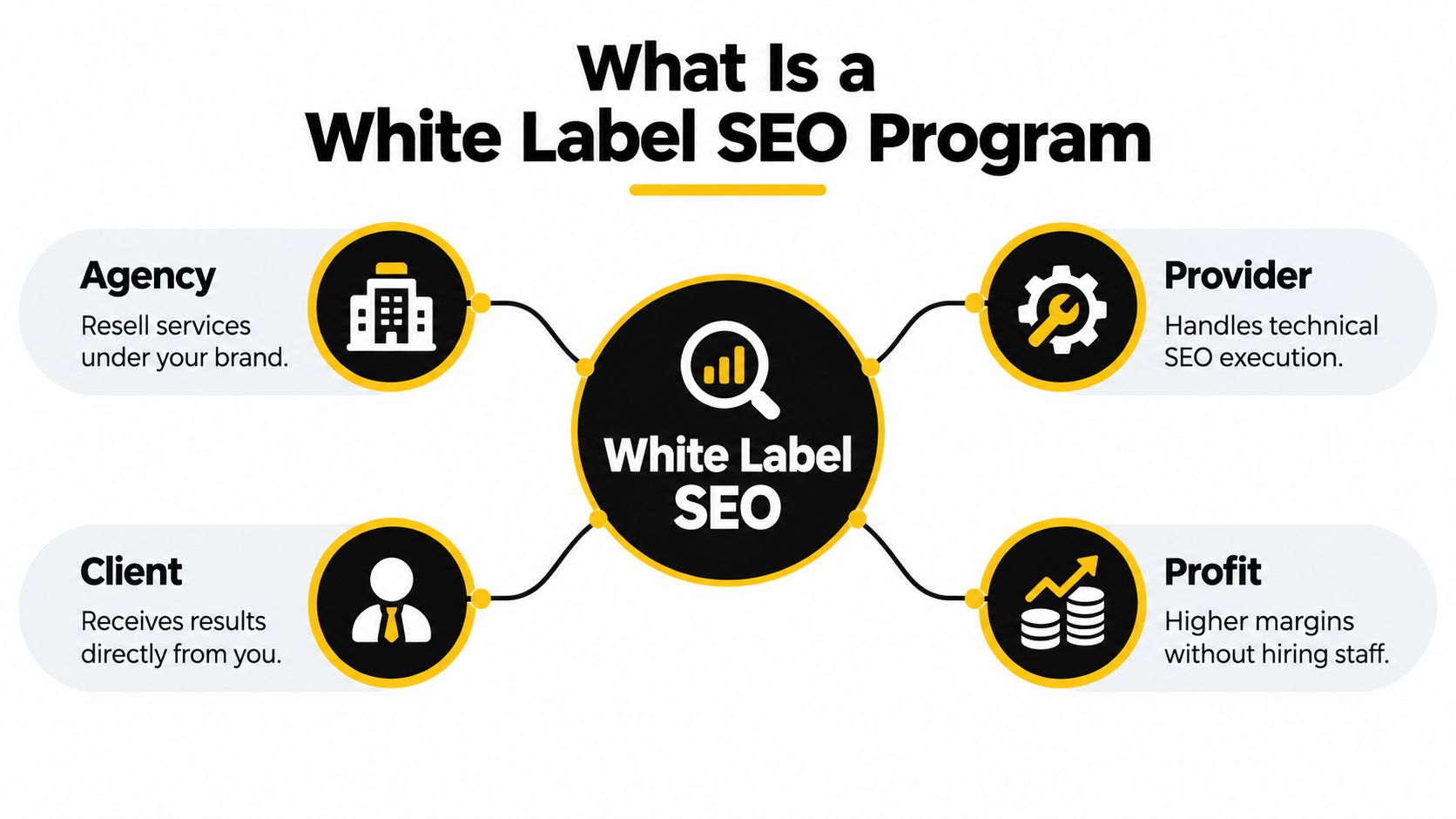
The arrangement works when responsibilities are explicit. You own discovery, positioning, pricing, approvals, and client conversations. The fulfillment partner owns execution against the approved plan. A branded dashboard, consistent documentation, and a clear escalation route make the handoff invisible to the client. Agencies evaluating this model can review white-label SEO fulfillment options before defining their own service boundaries.
Why Agencies Scale With White Label SEO
Hiring every SEO specialist internally creates fixed overhead before you know how much demand your pipeline will produce. A white label program converts much of that cost into delivery capacity you can activate as accounts arrive. You can add technical expertise, writers, local search specialists, and reporting support without managing every recruitment, training, and tooling decision.
The financial advantage isn’t only the provider’s wholesale price. Your real delivery cost also includes account management, revision handling, strategy calls, quality checks, and time spent translating technical work for clients. If you ignore those activities, a package that appears profitable can consume your margin through coordination.
Margin rule: Price the client relationship and management layer, not just the outsourced production.
White label SEO also changes what your team can sell. A web design studio can offer ongoing optimization after launch. A paid media agency can add organic acquisition without building a search department. A local marketing firm can support Google Business Profile work, review workflows, location pages, and technical fixes through one operating model.
The trade-off is accountability. You may not control every production decision, but your agency still carries the reputational risk. That makes quality control, approval rights, and service-level expectations more important than just finding the lowest fulfillment cost.
Essential Features and Technology Requirements
Start with the client experience, then inspect the technology behind it. A credible platform should support your domain, logo, email identity, user roles, branded reports, and controlled access. Clients shouldn’t have to leave your environment to review rankings, leads, tasks, or campaign progress.
A useful white label SEO workflow connects four layers:
-
Measurement: Analytics, Search Console, call tracking, conversion events, and local visibility data.
-
Execution: Audits, content tasks, technical recommendations, internal linking, and authority work.
-
Approval: Client feedback, revision history, implementation status, and documented decisions.
-
Reporting: Clear summaries that explain what changed, why it matters, and what happens next.

Security matters as much as presentation. Use role-based permissions, separate client workspaces, and a documented process for removing access when an account ends. Agencies that manage multiple brands should also manage domains and access controls through an organized system rather than scattered credentials.
Don’t treat rankings as the only KPI. Track technical health, indexed pages, qualified organic sessions, calls, form submissions, local actions, content production, and completed recommendations. For AI search, add monitored prompts, brand mentions, citation presence, answer accuracy, and assisted conversions where measurement is possible.
How to Evaluate and Choose a Provider
Evaluate a provider as if you were hiring a senior SEO director, not buying a task bundle. Ask to see sample audits, content, local reports, technical recommendations, and client-facing explanations. The work should show prioritization, not a pile of disconnected observations.
Use these decision criteria:
| Evaluation area | What strong providers demonstrate |
|---|---|
| Methodology | Clear technical, content, local, and authority processes |
| Communication | Named contacts, response expectations, and escalation paths |
| Customization | Adaptation to industry, location, competition, and client goals |
| Reporting | Business outcomes alongside rankings and task completion |
| Capacity | Honest limits and a plan for handling additional accounts |
| Ownership | Clear terms for data, content, accounts, and work product |
Run a controlled pilot before moving important accounts. Review turnaround, revision quality, factual accuracy, and how quickly the provider identifies blockers. A polished sales call proves very little if the first deliverable arrives late or requires a complete rewrite.
Your contract should define acceptance criteria, revision handling, confidentiality, subcontractor disclosure, implementation responsibilities, data access, and offboarding. The guide to choosing a white label SEO company is useful as a starting checklist, but your final decision should reflect your agency’s actual risk tolerance and client profile.
Onboarding and Fulfillment Workflows
A reliable white label SEO program starts before the first audit. Capture the client’s goals, locations, services, competitors, brand language, conversion actions, access permissions, legal constraints, and approval contacts in one intake record. Without that context, the provider can produce technically correct work that doesn’t fit the business.
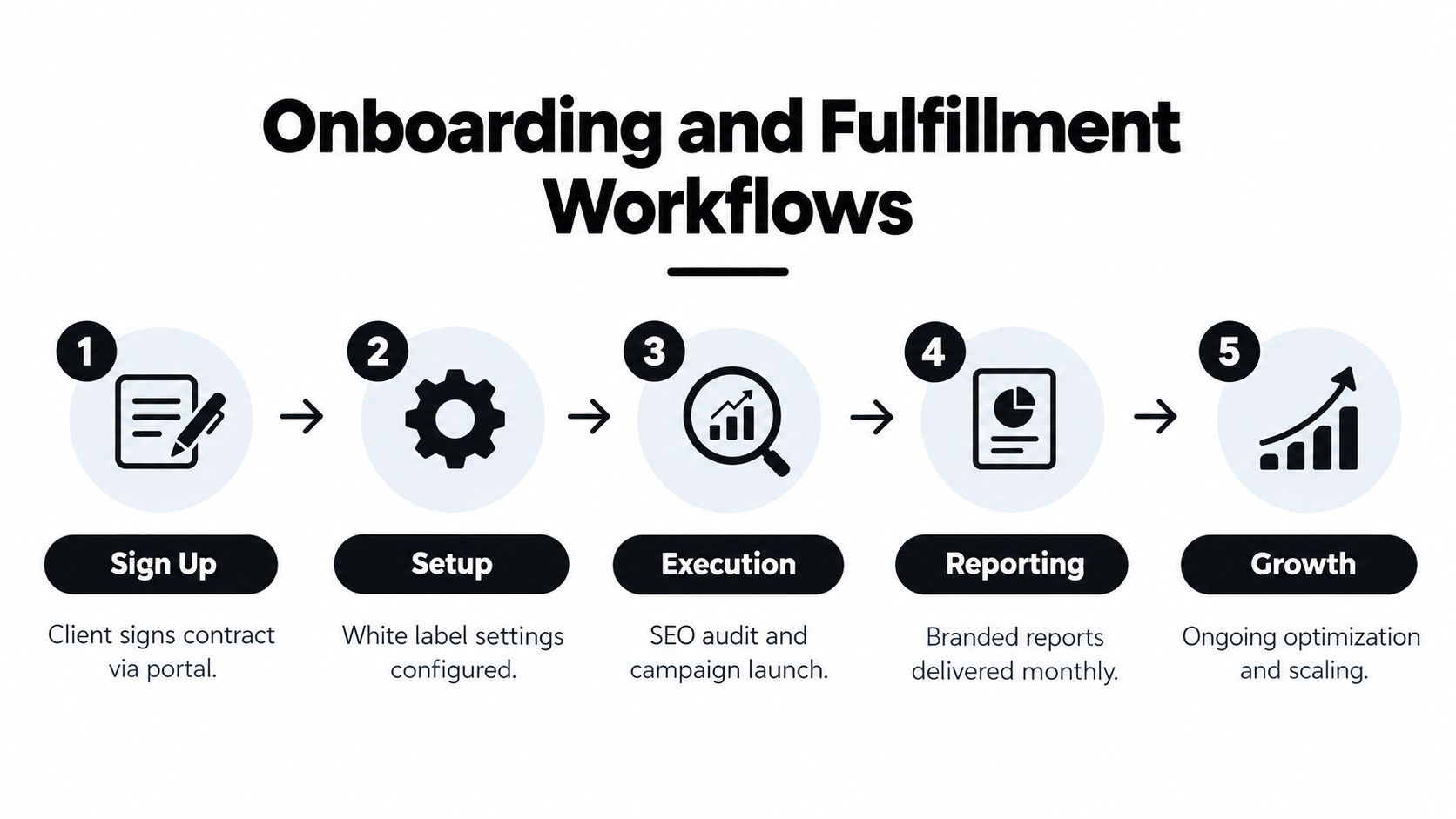
A practical operating sequence is:
-
Diagnose: Confirm goals, baseline performance, access, and constraints.
-
Plan: Approve priorities, deliverables, owners, and client-facing milestones.
-
Execute: Complete technical, content, local, and authority work through a shared queue.
-
Review: Check factual accuracy, brand voice, recommendations, and data freshness.
-
Explain: Deliver a branded report that connects activity to business outcomes.
The report should distinguish visibility from engagement and revenue. AI-generated answers may expose a brand without producing a conventional click, so a client dashboard should record what was tested, where the brand appeared, whether the answer was accurate, and whether assisted outcomes can be observed.
A report earns trust when it explains both progress and limits.
Common Pitfalls and Critical Questions
The most dangerous assumption is that invisible fulfillment means invisible responsibility. If a provider publishes inaccurate content, builds harmful links, misses a deadline, or recommends an implementation your developer can’t deploy, the client still blames your agency.
Ask direct questions before signing:
-
Incident ownership: Who investigates an error, communicates with the client, and funds remediation?
-
Rollback: Can harmful changes, content, or links be documented and reversed?
-
Blocked work: What happens when a client withholds access or rejects implementation?
-
Quality control: Which deliverables receive human review before client delivery?
-
Data ownership: Who controls analytics connections, reports, content files, and account history?
-
Offboarding: How quickly can you export data, remove branding, and transition the account?
-
Search change: How does the team respond when ranking systems or AI features alter search behavior?
Local SEO adds another operational layer. BrightLocal’s 2025 survey found that 40% of consumers use at least two websites when researching a local business, while 96% are open to writing a review. The same research reported that 89% would use a business that responds to all reviews, compared with 44% for a business that doesn’t respond to reviews. Those figures support a broader service model covering review acquisition, response workflows, platform coverage, and reputation monitoring, not just profile edits. (BrightLocal’s 2025 Local Consumer Review Survey)
Agency Platform combines branded local and national SEO fulfillment with a client dashboard for audits, rankings, traffic, leads, tasks, reporting, and AI-search visibility. If you want to offer SEO without hiring an in-house fulfillment team, visit Agency Platform to review how the program can fit your workflows and client relationships.