Dave Thompson April 23, 2026 1288 Views
Think of local SEO services as the digital equivalent of putting up the biggest, brightest sign on a busy street. It’s all about making sure that when potential customers in the immediate area are looking for a product or service, your client’s business is the first one they find.
What Are Local SEO Services and Why They Matter
Imagine your client runs the best coffee shop in their neighborhood. The espresso is fantastic, the baristas are friendly, and the ambiance is perfect. But none of that matters if someone two blocks away searches “coffee shop near me” and a competitor pops up first.
This is the exact problem that local SEO services are built to solve. Unlike traditional SEO that casts a wide net nationally or globally, local SEO is hyper-focused on a specific geographic area. It’s not just about ranking for keywords; it’s about connecting a physical business with the real people in its community who are ready to buy right now. A recent study found that nearly 50% of all Google searches have local intent, highlighting the massive audience actively seeking local solutions.
The Immediate Impact on Foot Traffic and Sales
The link between a local search and a real-world action is incredibly direct. Modern customers pull out their phones to make split-second decisions, turning a quick search into a store visit or a phone call within minutes. This behavior is precisely why local optimization is no longer a “nice-to-have” for community-focused businesses—it’s essential.
The data speaks for itself. Let’s look at how these online searches translate into real-world business.
The Impact of Local Search on Customer Actions
The statistics below paint a clear picture of how crucial local search has become for driving actual business outcomes. This isn’t just about clicks; it’s about customers walking through the door.
| Statistic | Impact on Local Business |
|---|---|
| 98% of consumers used the internet to find information about local businesses in the last year. | Virtually every local customer is using search engines to find businesses like yours. |
| 76% of “near me” mobile searches lead to an in-store visit within 24 hours. | Three out of four people searching for a local business on their phone will visit a store that day. |
| 28% of all local searches result in a purchase. | More than a quarter of all local searches directly convert into sales. |
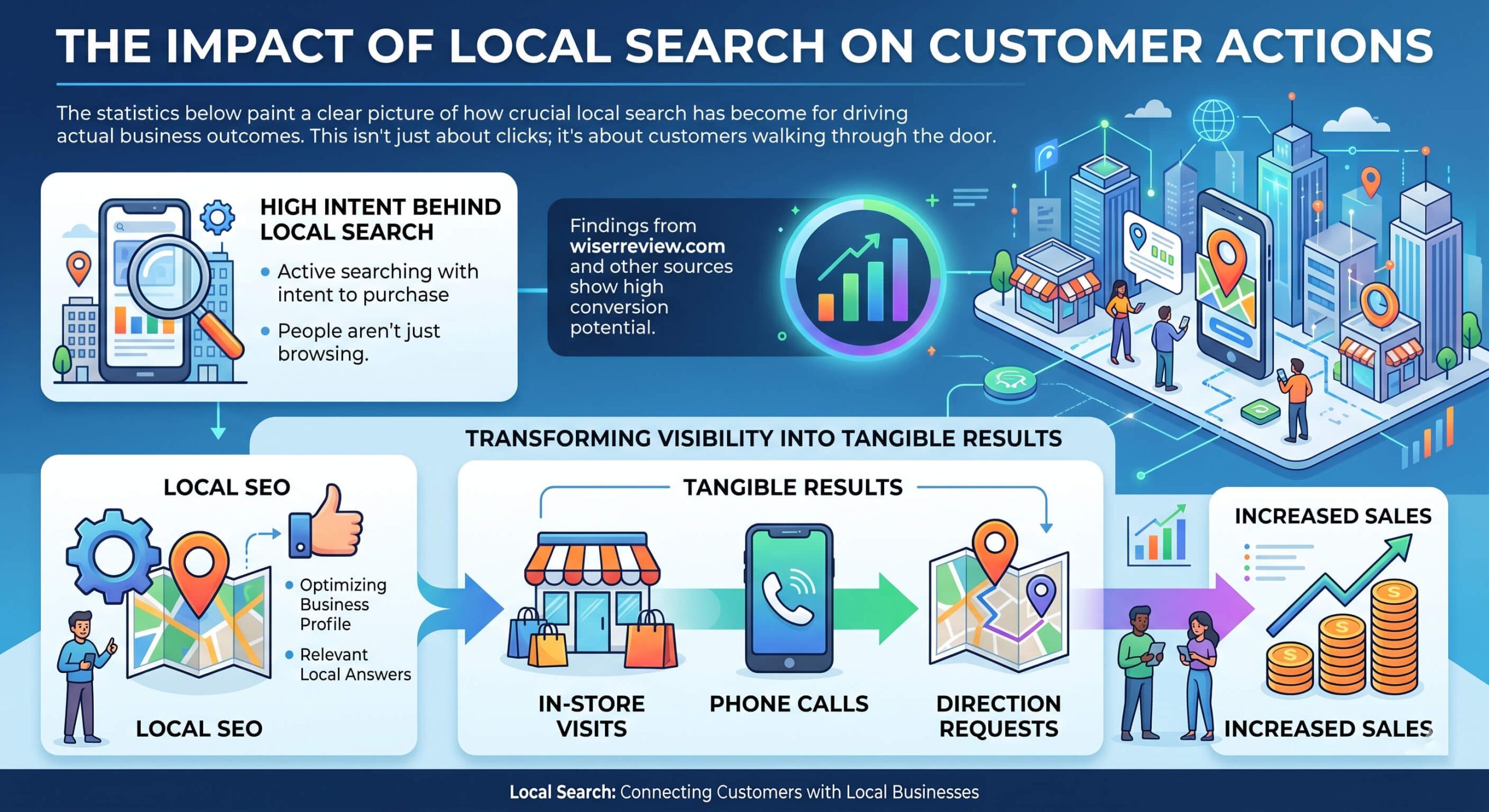
These numbers, including findings from wiserreview.com, show that the intent behind a local search is incredibly high. People aren’t just browsing; they are actively looking to make a purchase.
Local SEO is the art and science of making your business the best, most relevant answer when a potential customer asks Google for a solution in your area. It transforms digital visibility into tangible results like phone calls, direction requests, and in-store sales.
More Than Just a Map Listing
It’s a common mistake to think local SEO is just about claiming a Google Business Profile. While that’s a huge piece of the puzzle, a truly comprehensive strategy goes much deeper.
Effective local SEO services work to create a consistent and authoritative digital footprint all across the web. To really dominate a local market, you need a multi-faceted approach. For a closer look at the strategies that work—and the ones to avoid—check out our guide on the dos and don’ts of local SEO.
Ultimately, these services are a growth engine. By optimizing for local intent, your agency can deliver what every client wants: measurable results that directly boost their bottom line and make their business the go-to choice for customers in their community.
Building Your Core Local SEO Service Offering
Crafting a killer local SEO package isn’t just about checking off a long list of tasks for a client. It’s about building a strategic framework where every piece works together, like gears in a machine, to achieve local market dominance. Think of it like building a house: you need a solid foundation, sturdy walls, and a good roof to create something that stands tall and gets noticed.
In the same way, a comprehensive local SEO service is built on several core pillars. Each one has a specific, critical job in taking a local business from being virtually invisible online to being the first choice for nearby customers. If you neglect one pillar, the whole structure becomes shaky.
The infographic below shows the direct line from a local online search to a customer walking through the door or making a purchase, highlighting why every component is so vital.
This journey really drives home the high-intent nature of local searches. It’s a clear path from discovery to conversion that a well-built service can capture every single time.
Google Business Profile: The Digital Front Door
For most local businesses, their Google Business Profile (GBP) is the very first handshake with a potential customer. It’s their digital storefront, map pin, and business card all rolled into one. A neglected or incomplete profile is the online equivalent of a shop with a broken sign and boarded-up windows—it screams “we don’t care” and sends potential customers running to the competition.
Optimizing a GBP is the absolute cornerstone of any local SEO strategy. This is so much more than just plugging in the business name and address. A fully loaded profile includes:
-
Complete and Accurate Information: Every single field should be filled out with care, from business hours and service areas to wheelchair accessibility and accepted payment types. Businesses with complete GBP profiles are 2.7 times more likely to be considered reputable.
-
Strategic Category Selection: Nailing the primary and secondary categories is crucial. This is how you tell Google exactly what the business does.
-
High-Quality Photos and Videos: People buy with their eyes. Regular uploads of professional shots of the storefront, products, services, and team build immediate trust and boost engagement. In fact, businesses with photos receive 42% more requests for driving directions.
-
Consistent GBP Posts: Using Posts to announce promotions, share updates, or highlight events keeps the profile looking fresh and signals to Google that the business is active and open for business.
A well-tended GBP is a client-generating machine. You can learn more about how to leverage a Google Business Profile page to its absolute fullest and maximize that local visibility.
Local Keyword Research: Decoding Customer Intent
To attract local customers, you have to speak their language. Local keyword research is all about figuring out the exact phrases and questions people in a specific geographic area are typing into Google. It means moving beyond generic, broad terms and zeroing in on high-intent, location-based searches.
For instance, instead of just targeting “best pizza,” local research would uncover goldmines like “deep dish pizza near Wrigleyville” or “late-night pizza delivery downtown Chicago.” These longer, more specific keywords are far less competitive and are used by people who are ready to buy right now. Considering that 92% of searchers will pick a business on the first page of local search results, it’s essential to match your client’s content to what people are actually searching for.
A winning local keyword strategy isn’t about ranking for everything; it’s about ranking for the searches that actually make the phone ring, drive foot traffic, and generate sales. It’s about prioritizing relevance over raw volume.
On-Page SEO That Speaks the Local Language
Once you know what local customers are looking for, you need to make sure your client’s website reflects that. Local on-page SEO is the art of tweaking elements on the website itself to signal geographic relevance to both users and search engines.
This goes way beyond just slapping the city name in a page title. Key on-page moves include:
-
Location-Specific Service Pages: Create dedicated pages for each service in each target location (e.g., a page specifically for “Emergency Plumbing in Scottsdale”).
-
Embedding Google Maps: An interactive map on the contact page doesn’t just help users find the business; it’s another strong signal to search engines about the physical location.
-
Local Schema Markup: This is like spoon-feeding Google your client’s most important business info—address, phone number, hours—in a language it perfectly understands, which can lead to eye-catching search results.
These on-page signals work in concert to prove to Google that the business is a legitimate, relevant part of its community. This directly improves its chances of showing up in the coveted “local pack” search results, where all the action is. Each element of your local SEO package builds on the last, creating a unified force for local success.
How to Package and Price Your Services for Profit
Okay, you’ve nailed down the core services you’re going to offer. Now for the million-dollar question: how do you package and price them? This is where the rubber meets the road. It’s not just about slapping a price tag on a list of tasks. It’s about showing clients the real-world value you bring to their business, in a way they can easily understand and say “yes” to.
Getting your pricing structure right is foundational. It’s what builds predictable revenue for your agency and, just as importantly, manages client expectations right from the start. While a one-off fee for a local SEO audit has its place, the most successful agencies are built on recurring revenue. This model just makes sense for local SEO—it’s a marathon, not a sprint, and consistent effort is what brings home the wins.
Choosing the Right Pricing Model
When it comes to local SEO services, the monthly retainer is king. No contest. This model gives your agency a stable financial footing and encourages you to build long-term partnerships with clients who see you as part of their team. The global SEO services market reached $68.12 billion in 2023 and is projected to grow to $122.11 billion by 2028, a massive slice of which comes from recurring agency retainers. In fact, monthly retainers make up 62.5% of all agency spending.
That said, it’s worth noting that outcome-based contracts are picking up steam, growing at a 19% CAGR. This shows a clear trend: clients want to see performance-proven results. You can dig into more of these fascinating SEO market trends at seo.com.
While retainers are the gold standard, you have a few models to play with:
-
Monthly Retainer: Your bread and butter. A fixed fee each month for a clearly defined scope of ongoing work. Perfect for managing, optimizing, and reporting on a client’s local presence.
-
Project-Based Fee: A one-time price for a specific job with a definite start and finish. Think of things like a total website on-page overhaul or a massive citation cleanup project.
-
Hybrid Model: A smart blend of the two. Charge a one-time setup fee to cover the initial heavy lifting, followed by a smaller monthly retainer for maintenance and reporting. This can be a great way to ease new clients into a long-term relationship.
Structuring Tiered Local SEO Packages
One of the slickest ways to sell local SEO services is with a tiered packaging strategy. It’s simple, effective, and works like a charm. You’re not just selling a service; you’re offering solutions for different types of businesses, from the little guy on the corner to a multi-location powerhouse.
Presenting a few clear options immediately shifts the client’s mindset from “Should I hire this agency?” to “Which of these packages is the right fit for me?” That’s a huge psychological win.
Think of your packages as a ladder. Each step up adds more value, more services, and more impact. This makes it incredibly easy for clients to see what they get for their money and even encourages them to level up as their business grows.
Price your services based on the value and business outcomes you deliver, not just the hours you spend. A top ranking in the local map pack that drives dozens of new customers each month is worth far more than the sum of its individual tasks.
Below is a simple framework you can use to build out your own tiered packages. Tweak it, customize it, and make it your own. It provides a natural path for upselling and perfectly showcases the depth of your expertise.
Sample Local SEO Service Tiers
Here’s a look at how you could structure three distinct packages. This table helps clients self-identify which tier makes the most sense for their current needs and future ambitions.
| Feature | Essential Package (Small Business) | Growth Package (Multi-Location) | Enterprise Package (Franchise) |
|---|---|---|---|
| GBP Optimization | Full setup & core optimization | Advanced optimization & weekly Posts | Multi-location management & API integrations |
| Keyword Research | 10 target keywords | 25 target keywords & competitor analysis | 50+ keywords & intent modeling |
| On-Page SEO | Title, meta, & header optimization | Service & location page creation | Advanced schema & internal linking strategy |
| Citations | Top 20 directories & NAP consistency | 50+ directories & ongoing management | Hyperlocal & industry-specific citations |
| Reputation Mgt. | Review monitoring & response templates | Proactive review generation campaigns | Centralized multi-location review dashboard |
| Reporting | Monthly performance dashboard | Bi-weekly reports with KPI analysis | Custom analytics & executive summaries |
By laying out your offerings like this, you create a clear value proposition for each tier, making the sales process smoother and more effective for everyone involved.
Measuring Success and Proving Client ROI
Running a brilliant local SEO campaign is only half the battle. The other, and frankly more important, half is proving its value to your clients in a way they actually understand. It’s all about translating your hard work into real business results that hit their bottom line.
When you can do that, you stop being just a vendor and become an indispensable growth partner.
Clients don’t really care about keyword rankings for their own sake; they care about the customers and sales those rankings bring in. Your monthly report needs to be more than just a data dump—it should tell a compelling story of progress and, most importantly, profit. This is where we move past vanity metrics and zero in on the Key Performance Indicators (KPIs) that truly matter to a local business owner.
Key Performance Indicators That Matter
To really show the impact of your local SEO services, you have to track the metrics that represent real customer actions. These KPIs are the bridge between your optimization efforts and your client’s business goals.
Focus your reporting on these core areas:
-
Google Business Profile (GBP) Insights: This is ground zero for high-intent customer actions. You need to be tracking clicks-to-call, direction requests, and website clicks that happen right on the GBP listing. An increase here is a direct line to more leads.
-
Local Organic Rankings: Keep a close eye on rankings for those money-making, geo-specific keywords like “emergency plumber in Scottsdale.” Getting into the top 3 spots for these terms has a massive correlation with more visibility and traffic.
-
Map Pack Visibility: Track how often your client’s business shows up in that coveted Google “map pack.” Since it’s often the first thing people see for local searches, being there is a huge win. More than 60% of consumers say they are more likely to use a business that appears in the local pack.
-
Conversion Tracking: Fire up Google Analytics and track actual goal completions. This means form submissions, appointments booked, or online sales that came directly from your local search traffic.
These are the numbers that paint a clear picture of how your work is generating real-world phone calls, foot traffic, and leads.
Crafting Compelling Client Reports
A great report doesn’t just show data; it gives it context. It tells a story. You need to structure your reports so they’re easy to digest, highlighting the “so what?” behind every number. I always recommend starting with a high-level executive summary that calls out the big wins before you dive into the nitty-gritty.
Visuals are your best friend here. A simple line graph showing a steady, month-over-month increase in clicks-to-call is way more powerful than just a number in a spreadsheet. Always connect your actions to the results. For example, if you optimized their service pages in May, make sure you show the corresponding jump in organic traffic to those pages in June.
The ultimate goal of reporting is to eliminate any doubt about the value of your services. By connecting every action to a measurable business outcome, you transform your monthly update from a simple report into a powerful client retention tool.
Calculating and Proving ROI
Now for the final piece of the puzzle: calculating the Return on Investment (ROI). This is where you connect your efforts directly to revenue, making the value of your local SEO services completely undeniable. A simple framework is all you need to make this point crystal clear.
First, you’ll need to work with your client to figure out their Average Customer Lifetime Value (CLV) and their typical Lead-to-Close Rate.
Here’s a simple example:
-
Your local SEO efforts generated 50 clicks-to-call last month.
-
The client tells you their lead-to-close rate is 20%, which means you brought them 10 new customers.
-
Their average customer lifetime value is $500.
-
10 new customers x $500 CLV = $5,000 in generated revenue.
If your agency’s monthly retainer is $1,500, you can now clearly show them a $3,500 profit and a fantastic ROI from your work. This simple math changes the entire conversation. Suddenly, your agency isn’t a cost center; you’re a profit generator.
What’s Next for Local SEO?
The world of local search never sits still. To really deliver for your clients, your agency needs to look past today’s tactics and get ready for how people will search tomorrow. It’s not just about small tweaks; it’s about big shifts in how customers find businesses right in their own neighborhoods.
Think about it: people are asking their smart speakers for directions, searching with their phone’s camera, and expecting instant, conversational answers. Getting your clients ready for these changes isn’t just a good idea—it’s how you’ll give them a serious edge over the competition.
The Rise of Voice and Conversational Search
The biggest change we’re seeing is the move from typing to talking. Voice search isn’t some far-off concept anymore. It’s part of daily life for millions of people using Alexa, Siri, and Google Assistant to find what they need while on the move. This completely changes the game for local businesses.
Voice search is huge for local SEO, with 58% of consumers now using it to find local business information. Even more telling is that 46% of them are doing this every single day. These aren’t just one or two-word searches, either. They’re full, conversational questions. Check out the complete research on these local SEO statistics from Brightlocal.com.
To grab this kind of traffic, your strategy needs to answer the real questions customers are asking. That means:
-
Going after long-tail, question-based keywords: Instead of just “coffee shop,” you need to optimize for “what time does the closest coffee shop open?”
-
Building out detailed FAQ pages: Give straight answers to the most common questions about hours, services, and location.
-
Using structured data (Schema): This helps search engines understand your client’s site and pull answers directly into search results.
Visual Search: The Next Frontier
Just like voice changed how we ask for things, visual search is changing how we find them. With tools like Google Lens, people can now search with their camera. They can point it at a building, a product, or a menu and get information instantly. For a local business, a single, well-optimized picture can become the front door for a new customer.
This makes high-quality, geotagged images more critical than ever. Every single photo you upload to a client’s Google Business Profile or website is a potential search result waiting to happen. Optimizing file names and alt text with descriptive, local keywords helps Google see what’s in the picture and show it to the right people.
In the evolving landscape of local search, your client’s most valuable asset is trust. Demonstrating expertise, authority, and trustworthiness is no longer a suggestion—it’s the price of entry for top-tier visibility.
E-E-A-T in a Local Context
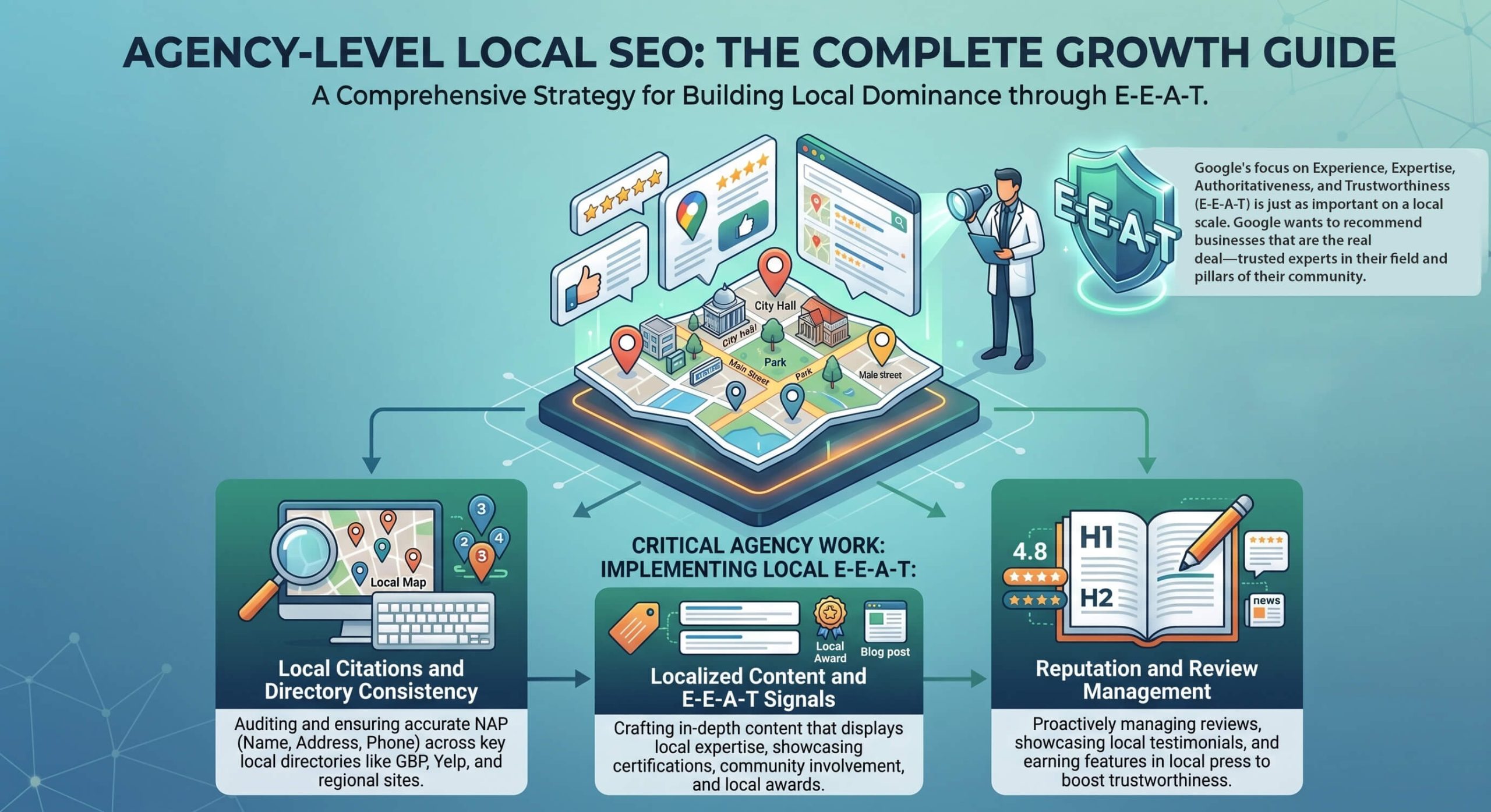
Google’s focus on Experience, Expertise, Authoritativeness, and Trustworthiness (E-E-A-T) is just as important on a local scale. Google wants to recommend businesses that are the real deal—trusted experts in their field and pillars of their community.
For your local SEO services, this means building a digital reputation that’s about more than just keywords and listings. It’s about showing off real-world expertise with detailed blog posts, highlighting local awards, getting featured in local news, and actively managing customer reviews. Every one of these signals tells Google that a business is a reliable, authoritative choice, which directly impacts its ability to rank in a crowded local market.
Scaling Your Agency with White-Label Solutions
As your agency grows and you start bringing on more clients, you’ll eventually hit a wall. Suddenly, you’re spending more time managing fulfillment than you are selling, and the idea of hiring, training, and retaining a full-time team of local SEO experts feels… overwhelming. It’s expensive, it’s a huge time sink, and it pulls you away from growth.
This is the exact point where a white-label partnership stops being a “nice-to-have” and becomes a game-changing strategy for growth.
Think of a white-label provider as your agency’s highly skilled, on-demand fulfillment department. They’re the specialists executing the expert-level local SEO services—everything from Google Business Profile optimization to citation building—while you present all the work and reports to your clients under your own brand. It’s the fastest way to expand your capacity without the headaches of overhead.
This model frees you up to focus on what you’re best at: building great client relationships and closing new deals. Instead of getting buried in the day-to-day tactical work, you can confidently say “yes” to more clients, knowing the backend is being handled by a team of pros.
Choosing the Right White-Label Partner
Here’s the thing: not all white-label providers are the same. Picking the right partner is absolutely critical. You’re not just hiring a vendor; you’re trusting them with your agency’s reputation and your clients’ results. The goal is to find a seamless extension of your team.
Here’s what you should be looking for:
-
Transparent Reporting: Your partner must provide a fully brandable dashboard. You and your clients need to see real-time progress. This kind of transparency isn’t just a feature; it’s the foundation of trust.
-
Proven Expertise: Don’t just take their word for it. Look for a provider with a solid track record and case studies that show real, measurable results for local businesses. You want to see the kind of success stories you can deliver for your own clients.
-
Clear Communication: A dedicated account manager and straightforward communication channels are non-negotiable. When you have a question or need to collaborate on strategy, you need to know you can get a quick, helpful response.
A strong white-label partnership is built on trust and alignment. Your provider’s success should be directly tied to your clients’ success, creating a true win-win-win scenario for everyone involved.
Integrating a Reseller Solution for Profitability
Bringing a white-label solution into your agency is a direct line to better profitability. By taking advantage of a provider’s wholesale pricing, you get total control over your retail prices and, more importantly, your margins. This completely removes the unpredictable costs of in-house staff, like salaries, benefits, and endless software subscriptions.
For instance, if a white-label local SEO package costs your agency $500 per month, you can comfortably resell it to your client for $1,500. Right away, you’ve secured a healthy profit margin without lifting a finger on the fulfillment side. This structure lets you offer comprehensive local SEO services at a competitive price while keeping your business profitable.
If you want to see exactly how these partnerships work in the real world, it’s worth exploring how white-label SEO programs drive success for agencies in greater detail.
At the end of the day, white-labeling isn’t just about outsourcing tasks. It’s a strategic move that unlocks scalable growth. It gives you the power to take on more opportunities, expand your service offerings overnight, and build a more resilient and profitable agency without the usual growing pains.
Answering Your Questions on Local SEO Services
When you start talking about local SEO services with clients, you’re bound to run into a few recurring questions and, let’s be honest, some healthy skepticism. That’s a good thing. Having solid, experience-backed answers ready to go is how you build trust and show you know your stuff. It’s the foundation of a great partnership.
Let’s walk through some of the most common questions agencies get hit with every day.
How Long Does It Take to See Results from Local SEO?
This is the big one, isn’t it? It’s usually the very first thing a client wants to know. The most important thing here is to set clear, realistic expectations from day one: local SEO is a marathon, not a sprint.
Sure, there are some quick wins. A well-executed Google Business Profile optimization can start showing flickers of life in just a few weeks. But for the kind of stable, meaningful improvements in rankings and traffic that actually move the needle? You’re typically looking at a three to six-month timeframe.
Think of it like building a reputation for a new shop in town. First, you hang your sign (that’s your GBP optimization). Then, you get listed in the local business directories so people know where to find you (citations). Soon, people start talking about you and leaving reviews. Each step builds on the last, cementing your presence and authority over time. It’s a gradual, cumulative process.
The rise of AI and Google’s Search Generative Experience (SGE) could accelerate results. AI-powered tools can help pinpoint hyper-local keywords and optimize content faster, potentially shortening the timeframe to see initial traction.
Is Local SEO Really Worth the Investment?
Absolutely, and you don’t have to take my word for it—the numbers speak for themselves. The real beauty of local SEO is how efficiently it connects a business with customers who are ready to buy. This isn’t like casting a wide, expensive net with traditional advertising. We’re targeting people who are actively looking for a solution right now.
Consider this: 46% of all Google searches are seeking local information. These aren’t just people browsing aimlessly; they have a need and they’re searching for a local business to fill it. When clients invest in local SEO, they’re placing themselves directly in the path of these high-intent customers. Their marketing budget stops being just an expense and starts becoming a direct line to new revenue.
Why Do I Need Ongoing Services?
Some clients see SEO as a “set it and forget it” task. It’s our job to explain why that’s a recipe for falling behind. The local search landscape is constantly shifting—competitors are getting smarter, search engine algorithms are always being tweaked, and customer habits change.
Ongoing local SEO services are non-negotiable for a few key reasons:
-
Algorithm Updates: Google is always tinkering with how it ranks local businesses. An ongoing strategy means your client’s site stays optimized and doesn’t get left behind after an update.
-
The Competition Never Sleeps: Your client’s top competitor isn’t taking a break. It takes continuous effort to not only climb the rankings but also defend your spot at the top.
-
Keeping Things Fresh: Search engines love activity. Regularly adding new photos, content, and GBP Posts signals that a business is active, open, and relevant to customers.
-
Managing Your Reputation: Responding to new reviews and engaging with customers is a continuous process. It’s how you build trust and show you care, which has a massive impact on your authority over time. On average, businesses have 39 reviews on Google, and this number is always growing.
Can We Just Focus on Google?
While it’s true that Google is the 800-pound gorilla in the room, putting all your eggs in one basket is a risky play. A truly robust local SEO strategy looks beyond Google. Citations on directories like Yelp, industry-specific portals, and even local blogs are incredibly important.
Every time your client’s Name, Address, and Phone Number (NAP) appears consistently across the web, it’s like a vote of confidence. These citations help search engines triangulate and verify the business’s legitimacy and location. This strengthens its overall digital footprint and, in turn, makes its Google ranking even stronger and more resilient. A diverse online presence is a powerful one.
Ready to scale your agency’s local SEO offerings without the overhead? Agency Platform provides the white-label software and fulfillment services you need to deliver expert results under your own brand. Discover how our all-in-one dashboard can streamline your operations and boost your profitability at https://www.agencyplatform.com.