Dave Thompson July 6, 2026 2096 Views
A common agency bottleneck shows up right after sales starts working. New SEO deals come in, clients ask about technical fixes, local visibility, content production, reporting, and now AI Overviews and E-E-A-T, but the delivery team is still built for a simpler version of SEO.
White label SEO services solve that staffing and fulfillment gap. An agency can sell and manage SEO under its own brand while a specialist partner handles execution behind the scenes. That matters more in 2026 than it did a few years ago because search has become broader, more technical, and more dependent on coordinated systems instead of isolated tasks.
The economics are part of the appeal, but they are not the whole story. The core advantage is operational. A good white-label partner gives an agency production capacity, specialist coverage, reporting discipline, and a faster path to revenue without adding full-time headcount for every function.
I’ve seen the model work best when the agency keeps control of positioning, client communication, and account strategy, then plugs a partner into fulfillment through one integrated platform. That setup protects margins, reduces delivery delays, and makes it easier to adapt as AI-driven search keeps changing what clients expect from SEO.
What Are White Label SEO Services?
White label SEO services are SEO deliverables completed by a specialist provider and presented to the client under the agency’s brand. The provider stays behind the scenes. The agency owns strategy, communication, pricing, and the client relationship.
That distinction matters. Good white label arrangements aren’t just outsourcing cheap tasks. They’re a production model for agencies that want to sell advanced SEO without building a department for every discipline.
The timing also makes sense. SEO isn’t only rankings work anymore. Agencies now have to deal with local visibility, technical performance, content quality, entity signals, and search experiences shaped by AI systems. That raises the bar for fulfillment.
Practical rule: White label SEO works best when the agency keeps control of positioning, client communication, and account strategy, while the partner handles repeatable execution.
A lot of agency owners make the same early mistake. They treat white label SEO as a shortcut. It works better as an operating system. When the workflows, reporting, and quality checks are set up correctly, it becomes a reliable way to expand services without creating delivery bottlenecks.
How The White Label SEO Partnership Model Works
The cleanest way to think about the model is this. Your agency is the front of house. The white label provider is the kitchen. Clients see your brand, your process, and your recommendations. The fulfillment happens in the background.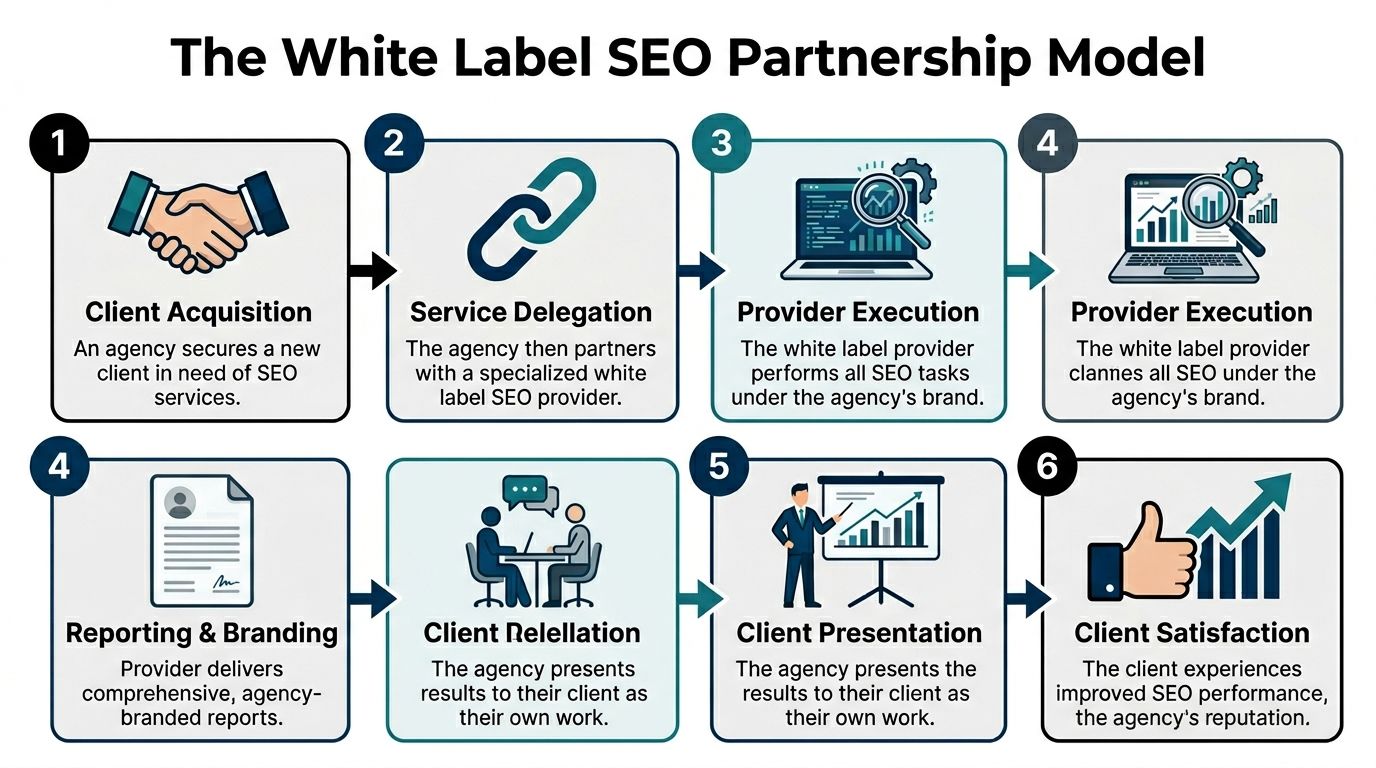
The workflow in practice
-
You sell the engagement
The client signs with your agency because they trust your positioning, niche expertise, or broader marketing offer. -
You scope the work
Experienced agencies protect margin at this stage. They define deliverables clearly, set review cycles, and avoid promising custom work for a fixed monthly fee unless the partner can support it. -
The provider fulfills under your brand
That can include audits, on-page work, local SEO, content, link outreach, and reporting. The client never needs to interact with the provider directly unless you’ve designed the relationship that way. -
You review before delivery
This step separates strong agencies from sloppy resellers. Never forward deliverables untouched. Review recommendations, translate technical details into business language, and tie work back to client goals. -
You present results as part of your service
The client should experience one brand, one system, and one accountable team.
Why the dashboard matters
The technology layer is what makes white label SEO scalable instead of chaotic. A brandable dashboard lets the agency centralize rankings, traffic, leads, and task status without exposing the fulfillment structure. That’s important because clients don’t pay only for labor. They pay for clarity.
A dashboard also reduces the operational drag of status emails and manual reports. That sounds small until you’re managing multiple accounts and trying to keep retention stable.
If your agency is also tightening the top of funnel while expanding delivery, this guide on ReachInbox on lead generation is useful because it frames outsourcing as a system design decision, not just a staffing decision.
The partner should feel invisible operationally, but highly visible in your internal process documentation.
What doesn’t work
A weak white label setup usually breaks in one of three places:
-
Loose scoping means the provider and the agency define success differently.
-
No QA layer leads to bland deliverables that don’t match your brand standards.
-
No reporting structure forces account managers to rebuild updates manually every month.
The best partnerships are boring in the right way. Clear handoff. Clear accountability. Clear client reporting.
Core Components of a Modern White Label SEO Program
A modern white label SEO program has to produce work that holds up in two environments at once. It has to rank in traditional search results, and it has to feed the credibility, structure, and clarity that AI-driven search features now reward. For agencies planning for 2026, that changes what belongs in the delivery stack.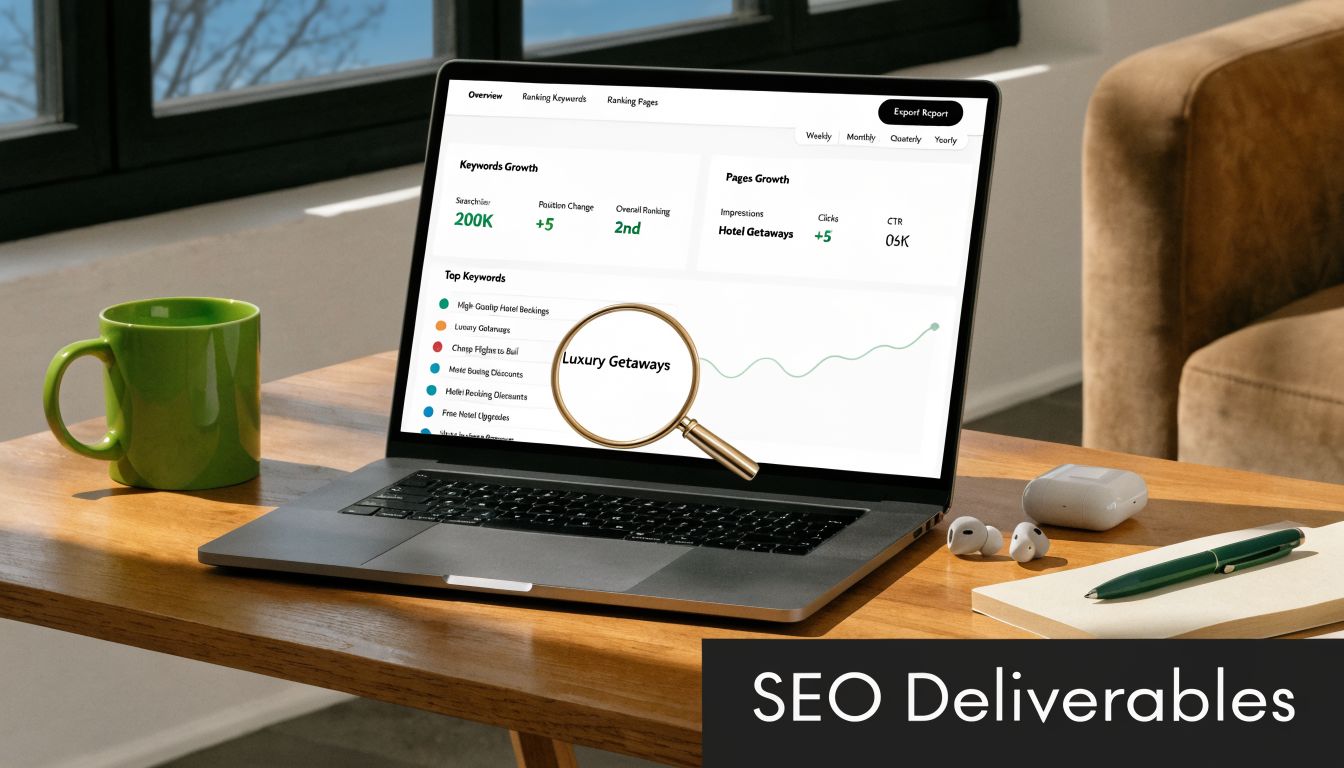
Local SEO that supports real visibility
Local SEO still drives outsized results for service businesses, but only when it is maintained like an operating system instead of a one-time setup. Google Business Profile work, citation cleanup, local landing pages, review generation, and service-area alignment all need ongoing attention.
The details decide whether a campaign gains traction. Categories have to match the actual offer. NAP data has to stay consistent across listings. Local pages need clear service intent, schema markup, internal links, and duplicate control. Agencies that want a useful margin on local SEO also need a repeatable process for these tasks, not a loose collection of freelancers.
That point matters even more for multilingual and regional campaigns. Teams that support local outreach or listing management often add capacity with Spanish-speaking Virtual Assistants because language coverage helps with citations, reviews, and local market coordination.
Technical SEO tied to crawlability, speed, and index control
Technical SEO is where weak white label programs usually get exposed. Clients may not ask about crawl depth, canonicals, log patterns, or rendering issues, but those problems can suppress performance for months if nobody owns them.
A strong provider goes beyond a surface audit. The work should include crawl diagnostics, indexation review, sitemap checks, redirect cleanup, internal linking analysis, structured data validation, and page speed improvements tied to actual templates. Core Web Vitals still matter, but the bigger operational question is whether the partner can prioritize fixes in the order that produces business impact.
I have seen agencies lose time and margin here by buying cheap audits that list 80 issues without saying which five matter first. Good white label technical SEO reduces noise. It turns findings into a fix queue your account team can explain to clients without sounding like translators for a developer.
Content built for E-E-A-T and AI retrieval
Content fulfillment has changed fast. A modern program needs briefs, drafts, and editorial controls that support E-E-A-T signals, entity relevance, and direct-answer formatting. That is the type of content more likely to survive AI Overviews and other summary-driven search experiences.
Word-count production lines do not hold up well anymore.
Pages perform better when they reflect real service expertise, include specific evidence, answer likely follow-up questions, and connect tightly to the rest of the site. In practice, that means subject matter input, stronger editorial review, author and business credibility cues, and internal linking planned at the brief stage instead of added later.
Authority building with stricter quality thresholds
Links still matter, but the standard has risen. Agencies need placements that fit the client’s market, support topical relevance, and strengthen the site’s authority profile without creating risk.
That usually means fewer low-value placements and more selective outreach, digital PR, citation work, and asset-driven link acquisition. It also means the provider should be clear about what they will not do. If a partner cannot explain placement standards, outreach methods, or how links fit the content strategy, the agency is buying activity instead of authority.
Reporting and platform infrastructure
The delivery model matters as much as the deliverables. By 2026, agencies that stitch together separate vendors for content, links, local SEO, and reporting will feel the drag in account management, QA, and retention.
An integrated platform model solves a real operational problem. It keeps tasks, deliverables, rankings, traffic trends, and client reporting in one system, which makes white label fulfillment easier to control and easier to present under your brand. It also gives agency owners cleaner visibility into margin by service line, especially when packaging SEO across local, technical, and content retainers. For agencies comparing pricing structure against delivery scope, this white label SEO pricing breakdown for agencies is a useful reference point.
The strongest white label SEO programs are no longer built around isolated tasks. They are built around integrated execution, clearer proof of expertise, and reporting that helps agencies defend retainers in a search market shaped by AI.
The Business Case ROI Margins and Scalability
A common agency scenario looks like this. Sales closes three new SEO retainers in one month, then delivery hits a wall because strategy, content, technical fixes, and reporting all compete for the same in-house hours. White label SEO changes that equation when the partner is built into your operating model instead of treated as overflow labor.
Margins improve when fulfillment is standardized
The financial appeal is straightforward. Agencies buy fulfillment at a wholesale rate, package it under their own brand, and keep the spread. For a practical view of how agencies structure those offers, this white label SEO pricing breakdown for agencies shows how wholesale costs, deliverables, and resale pricing fit together.
In practice, margin comes from control. Standard scopes reduce revision loops. Shared SOPs cut account management time. Branded reporting lowers the amount of manual explanation your team has to do every month.
That matters more in 2026 than it did a few years ago.
AI Overviews, stronger scrutiny around E-E-A-T, and higher client expectations have made SEO delivery harder to fake and more expensive to patch together. Agencies that still rely on separate freelancers for content, links, local work, and reporting usually lose margin in the handoffs. Agencies with an integrated white-label partner protect margin because the work is coordinated before it reaches the client.
Profitability depends on labor efficiency, not just markup
A healthy SEO account is not merely a pricing exercise. It is a capacity exercise. If every new retainer forces you to hire another strategist, editor, or technical specialist, growth gets expensive fast.
White label SEO breaks that pattern. You can add accounts without increasing payroll at the same rate, which keeps operating profit steadier as revenue grows. That is one of the clearest reasons agency owners use the model after the first few client wins. It creates room to sell more while keeping the core team focused on sales, strategy, and retention.
Support roles also become easier to staff. Some agencies pair outsourced SEO fulfillment with lean internal admin support for reporting coordination, client follow-up, and multilingual communication. In that setup, hiring Spanish-speaking Virtual Assistants can support account operations without adding specialist SEO headcount.
Scalability comes from repeatable delivery
The trade-off is simple. In-house teams give you direct oversight, but they also bring recruiting delays, utilization swings, training cost, and management overhead. Referrals avoid delivery work entirely, but they cap revenue and weaken your position with the client. White label SEO keeps the client relationship, preserves pricing control, and gives the agency a delivery engine that can absorb growth.
The agencies that scale this well usually make one shift early. They stop selling custom SEO every time and start selling defined packages tied to a repeatable fulfillment process.
That operating discipline matters even more as AI-driven search changes what clients expect from SEO. Agencies now need faster production, tighter reporting, and clearer proof that the work supports visibility in both traditional rankings and AI-generated results. White label SEO produces strong ROI when the partner is not just cheap labor, but part of an integrated platform model that helps the agency protect margins, expand capacity, and defend retainers as search keeps changing.
Choosing Your White Label SEO Partner A Buyers Checklist
Most agencies don’t fail with white label SEO because the model is flawed. They fail because they choose a provider built for commodity fulfillment instead of one built for modern search.
What to verify before signing
Use this checklist when vetting providers:
-
AI search readiness
As AI search captures 25% of queries in major markets, backlinks remain a 28% ranking factor, and only 15% of top white label agencies offer specific AI Overviews strategies, according to this white label SEO analysis. If a provider has no answer here, they’re behind. -
Reporting transparency
Ask to see the actual dashboard, not a sales mockup. You want branded reporting, live visibility, task tracking, and role-based access. -
Scope clarity
Get specific on what is included each month. Audits, revisions, content rounds, citation work, link outreach, and turnaround times all need written definitions. -
QA expectations
Ask who reviews deliverables before they reach your team. A partner without editorial or strategic review will create downstream client problems. -
Support structure
You need responsive communication, especially when clients ask hard questions about rankings, technical issues, or local visibility.
What to ask in the sales call
A good provider should be able to answer these directly:
| Checkpoint | What a strong answer sounds like |
|---|---|
| AI-era strategy | They explain how they adapt content, technical SEO, and authority work for AI-driven search behavior |
| Local SEO depth | They can discuss GBP, citations, local pages, schema, and duplicate control without speaking in generalities |
| Technical capability | They explain audit methodology, not just tool screenshots |
| Brand protection | They show how reports, dashboards, and communication stay under your agency brand |
For a broader evaluation framework, this guide on choosing the right white label SEO company is worth reviewing.
If a provider sells every service to every niche with the same process, expect generic work.
Implementation Roadmap Integrating a White Label Partner
A white label relationship usually succeeds or fails in the first few weeks. The issue isn’t fulfillment quality alone. It’s operational fit.
Phase one setup and brand controls
Start with the client-facing layer. Set up your branded dashboard, reporting templates, user roles, and approval flow. Decide what clients can see in real time and what your account managers interpret before delivery.
Then lock down internal SOPs. Define intake forms, brief formats, revision rules, and escalation paths. This prevents every account manager from reinventing the process.
Phase two sales enablement
Your sales team needs to know what they’re selling. That means packaging, timelines, likely outcomes, and common limitations. Don’t let sales promise custom SEO strategy on every account if the fulfillment plan is standardized.
A simple internal enablement stack usually includes:
-
Offer sheets that define inclusions and exclusions
-
Call scripts for explaining local SEO, technical SEO, and reporting
-
Objection handling for questions about timelines and deliverables
Phase three client onboarding and communication
Introduce the service as a natural extension of your agency. Clients don’t need a lecture on your backend structure. They need confidence that someone is managing the work end to end.
Use kickoff calls to gather access, business priorities, service areas, and known technical issues. Then set expectations early. SEO gains are built through execution quality and consistency, not one audit deck.
Phase four performance monitoring
Track work completion, ranking movement, traffic patterns, lead quality, and recurring technical issues inside one review rhythm. Monthly reviews work well when they connect actions to outcomes and next steps.
What helps most is consistency. Same reporting cadence. Same language. Same account review process. That’s how a white label partner starts to feel like part of the agency instead of an external vendor.
Frequently Asked Questions for Agency Owners
| Question | Answer |
|---|---|
| Will white label SEO hurt my brand? | It can if you choose a poor provider or skip QA. It won’t if you control communication, review deliverables, and present a consistent branded experience. |
| Are margins still good if I resell fulfillment? | Yes, when pricing is disciplined and scope is controlled. The model works best when you package services well and avoid overservicing small accounts. |
| Should clients know I use a partner? | That’s a business choice. Most agencies position the service as part of their delivery team and keep the vendor invisible. The key is accountability, not disclosure theater. |
| What should stay in-house? | Keep client strategy, sales, account management, and final QA in-house. Those functions shape retention and protect brand trust. |
| Is white label SEO only for small agencies? | No. Smaller firms use it to add capability. Larger agencies use it to expand capacity, enter new service lines, or handle specialized fulfillment without adding fixed overhead. |
| How do I handle clients asking about AI search? | Your provider should have a clear answer on content structure, authority signals, technical readiness, and how they adapt to AI-influenced search experiences. If they don’t, that gap will show up in sales calls and renewals. |
If you’re evaluating a partner and want a model that combines white-label fulfillment with a fully brandable dashboard, Agency Platform is built for agencies that need local SEO, national SEO, reporting, and client visibility under their own brand.