Dave Thompson May 29, 2026 924 Views
A local seo service provider is no longer just an outsourced vendor for citations and map listings. For agencies, it’s an operating partner that helps you win in a search environment where 46% of all Google searches have local intent and “near me” queries have surged over 900% in the past two years, making local visibility too large and too dynamic to manage casually (SOCI local SEO statistics). The right partner protects your margins, supports your brand, and adapts to AI-driven local search without forcing you to build a local SEO department from scratch.
Why Your Agency Needs a Modern Local SEO Partner
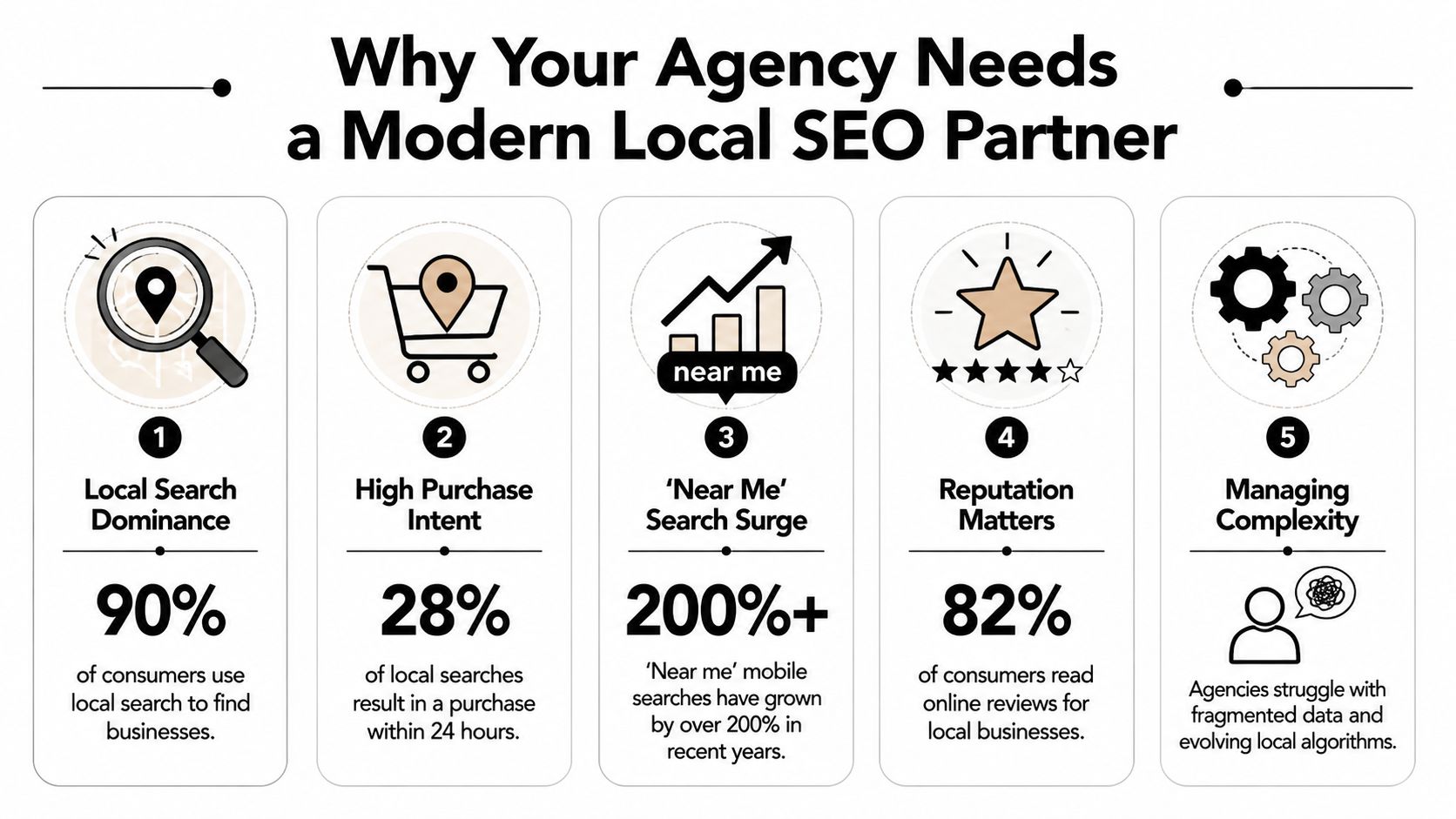
Local search has changed faster than many agencies’ fulfillment models. A lot of local queries now end on the search results page itself, where users pull a phone number, hours, directions, reviews, or service details without ever visiting the site. That shifts the job from “drive clicks” to “own the decision point.”
A modern provider needs to optimize the full local surface area: Google Business Profile, reviews, citations, local landing pages, schema, and neighborhood relevance. If they only talk about rankings and traffic, they’re behind.
For teams building service pages, category pages, and GBP descriptions, strong local SEO keywords research matters because local intent is fragmented by city, neighborhood, service type, and urgency. The providers worth hiring understand that “plumber,” “emergency plumber,” and “water heater repair” each behave differently across zip codes.
What success looks like now
The useful metrics are practical:
-
Search visibility in target areas rather than broad vanity rankings
-
Calls, bookings, and direction requests from local search surfaces
-
Map pack presence for high-intent service terms
-
Review quality and response cadence that influence conversion
-
Citation accuracy so Google sees one consistent business identity
Practical rule: If a provider reports only sessions and keyword positions, you’re not getting a local SEO partner. You’re getting partial fulfillment.
A platform model can help here because agencies need repeatable workflows, not one-off heroics. White-label systems that combine fulfillment, ranking visibility, reporting, and client-facing dashboards reduce handoff problems. For agencies offering local SEO as a productized service, white label local SEO services are often easier to scale than stitching together freelancers, software, and internal project management.
What doesn’t work anymore
Three old habits keep agencies stuck:
-
Treating GBP as a setup task when it needs ongoing management
-
Building one city page and hoping it ranks everywhere
-
Measuring local SEO like traditional organic SEO
The agencies that keep clients longest usually stop selling “traffic” and start selling market coverage, lead flow, and local trust signals.
Core Criteria for Evaluating SEO Providers
The most overlooked filter is the reseller model. 68% of agencies plan to expand white-label services, which makes wholesale fulfillment, brand control, and margin flexibility central buying criteria, not side features (Trust Signals on affordable local SEO services).
A provider should be judged on whether they fit your operating model, not just whether they can complete SEO tasks.
White-label capability has to be real
Some firms say they’re white-label, but all they really offer is silent subcontracting. That’s not enough if you want to scale.
Look for:
-
Brandable dashboards with your logo, domain, and client-facing access
-
Role-based access so clients see progress without seeing your backend chaos
-
Automated reports that your account managers don’t have to build manually
-
Wholesale pricing that leaves room for healthy retainers
If the provider can’t explain how your team, your clients, and their fulfillment team interact week to week, the model will break under volume.
Service scope needs depth, not a menu
Local SEO isn’t one deliverable. It’s a sequence.
A serious partner should cover GBP management, citation governance, service-plus-location content, on-page local optimization, review workflows, and local link acquisition. The best providers also understand zero-click search and can report value even when website clicks don’t tell the full story.
A weak provider sells listings. A durable provider manages the local entity.
E-E-A-T and AI readiness are no longer optional
You need to know who writes, who reviews, who approves, and how they avoid low-trust content. Ask whether strategists understand local service businesses, whether content reflects real services and geographies, and how the team adapts when AI-generated answers reduce site visits.
One option agencies use in this model is Agency Platform, which combines a fully brandable dashboard, wholesale fulfillment, and integrations across the reporting stack. The practical appeal isn’t hype. It’s fewer tools, cleaner handoffs, and less time spent translating fulfillment into client communication.
How to Vet Providers and Spot Critical Red Flags
The sales call should feel like due diligence, not a demo. You’re testing whether the provider has a process that can survive client scrutiny, algorithm changes, and account growth.
When vetting, ask how they handle Google Business Profile management and content creation, because marketers rank those as the most valuable local SEO services at 52-76% and 39-53% respectively (how to vet an SEO reseller service for quality and compliance).
Questions that reveal whether they know local SEO
Ask direct questions such as:
-
How do you structure service and location pages
-
How do you audit and fix NAP inconsistencies
-
How do you measure local pack visibility
-
How do you handle review generation and response workflows
-
How do you adapt reporting for zero-click searches
-
What is your process for schema and local entity signals
A good provider gives a concrete workflow. A weak one gives broad promises.
Red flags that should end the conversation
Some warning signs are immediate:
-
Guaranteed #1 rankings for local terms
-
No explanation of link sources or reliance on private blog networks
-
Thin reporting with no tie to calls, leads, map visibility, or GBP activity
-
One-page-fits-all strategy across multiple services and cities
-
No answer on AI search or E-E-A-T
If a provider can’t explain their process without hiding behind “proprietary methods,” assume the risk lands on your brand, not theirs.
Another red flag is a provider who talks only about setup work. Local SEO needs governance. Listings drift. Reviews need responses. GBP categories need refinement. Location pages age. Competitors copy what works.
What to look for in proof
Case studies matter less than the discipline behind them. Focus on whether the provider can show:
| What to review | What it tells you |
|---|---|
| Sample reports | Whether clients will understand the work |
| Task timelines | Whether fulfillment is repeatable |
| Content samples | Whether they can write for local intent |
| Citation audit process | Whether they clean data before building on it |
| Communication cadence | Whether your team will chase updates |
The best provider is usually the one that makes operations easier while protecting quality.
Understanding Pricing Models and True ROI

Pricing only looks simple from the client side. On the agency side, the question is whether the model supports margin, retention, and manageable delivery.
Optimized local SEO campaigns can deliver an average ROI of over 300% after three years, with some reporting as high as 720%. That’s why agencies need a provider that can support long-term retention, not just early setup work (Outrank’s tool to calculate your SEO ROI).
How the common models behave
A quick comparison helps:
| Model | Good for | Main limitation |
|---|---|---|
| Monthly retainer | Ongoing local campaigns | Margin gets squeezed if labor rises |
| Project fee | Cleanup work or launches | Hard to sustain recurring revenue |
| Wholesale reseller | Scalable recurring services | Requires a provider with stable systems |
Wholesale usually gives agencies the cleanest path to predictable profit because you control packaging and final pricing.
How agencies should calculate ROI
Don’t calculate ROI from rankings alone. Tie it to business outputs and agency economics.
Track:
-
Client-side outcomes such as calls, booked appointments, and qualified leads
-
Agency-side outcomes such as gross margin, retention, and account manager time
-
Operational drag from manual reporting, rework, and vendor follow-up
A local SEO service provider becomes profitable when fulfillment is consistent enough that your team spends more time growing accounts than fixing delivery gaps.
Many agencies often underprice. They compare only vendor cost against client retainer and ignore labor. If your team spends hours every month cleaning reports, translating jargon, and chasing fulfillment updates, your margin is weaker than it looks.
Onboarding Your Partner for Seamless Integration

The handoff after signing is where a promising partnership either stabilizes or starts leaking time. Onboarding should be documented, timed, and visible to both fulfillment and client service teams.
A key question for any partner is how they ensure E-E-A-T compliance and adapt to AI search, especially because 45% of local queries are now AI-influenced. If they can’t answer clearly, you’re inheriting strategic risk before the first report goes out.
What a clean onboarding process includes
Start with four assets:
-
A clear intake form covering services, locations, competitors, and primary offers
-
Access checklist for GBP, website CMS, analytics, and call tracking
-
Communication rules that define who approves what
-
Reporting cadence so clients know when they’ll see updates
Then define the order of work. For local SEO, the sequence matters. Clean up business data first, then refine GBP, then publish and optimize location-driven content, then build authority.
How to keep clients calm during transition
Clients usually don’t care which provider fulfills the work. They care whether progress is visible and whether the strategy sounds coherent.
Use a short onboarding narrative:
-
Baseline the account with rankings, GBP condition, citation health, and local page coverage.
-
Prioritize the fixes that affect trust and discoverability first.
-
Report business-facing wins such as improved visibility, calls, and booking activity.
-
Show work in progress so silence doesn’t get mistaken for inactivity.
That’s why dashboard visibility matters so much in a reseller relationship. It reduces status meetings, keeps account managers aligned, and makes your agency look organized rather than reactive.
A strong local seo service provider helps your agency do three things well: fulfill consistently, report in a way clients understand, and adapt to AI-shaped local search before clients feel the impact. If you want a white-label system built for that model, Agency Platform gives agencies a brandable dashboard, wholesale fulfillment, and the operational structure needed to scale local SEO without building everything in-house.