Dave Thompson June 2, 2026 1906 Views
Guest posting still matters because 60% of companies produce one to five guest posts per month, and posts with in-content backlinks generate 387% more referral traffic than bio-only links. SEO guest posting is the practice of writing and publishing an article on another website to secure a backlink, drive referral traffic, and build brand authority.
That definition is simple. The execution isn’t. In the AI era, agencies can’t treat guest posting like a volume game or a recycled outreach workflow. The wins now come from relevance, editorial quality, smart reporting, and a fulfillment model that stays profitable without exposing clients to junk placements.
What Is SEO Guest Posting and Why It Matters in 2026
SEO guest posting means publishing useful content on a third-party site so your client earns visibility, authority, and a contextual backlink. At its best, it supports rankings, sends qualified referral traffic, and gives search engines stronger trust signals around expertise and topical relevance.
The reason it still works is straightforward. Real publishers still need strong content, and brands still need trusted mentions in places their audience already reads. That exchange remains valuable when the content is original and the placement makes sense.
Why the tactic survived algorithm changes
Guest posting picked up a bad reputation when marketers abused it for scaled link schemes. That’s the version Google pushed back against. Quality-focused placements survived because they serve users first and links second.
The strongest placements usually share three traits:
-
Editorial fit: The article belongs on the host site and matches its audience.
-
Contextual linking: The backlink sits inside the body copy where it helps the reader.
-
Subject authority: The author brings a real point of view, not generic filler.
Practical rule: If the article would still be worth publishing without the link, it’s probably the kind of guest post you want.
What agencies should care about now
In 2026, guest posting isn’t just a backlink task. It’s part of authority building. AI summaries, answer engines, and traditional search all favor brands that appear consistently across credible sites.
That shifts the standard. A placement on a random “write for us” blog with no audience won’t help much. A placement on a relevant site with editorial standards can strengthen both discoverability and trust.
Agencies that treat seo guest posting as a brand and authority channel usually make better decisions. They pitch better sites, write better articles, and avoid the trap of buying easy placements that look good in a spreadsheet but do little for client growth.
Defining Link Quality Beyond Domain Authority
Many agencies still overvalue Domain Authority because it’s easy to explain to clients. The problem is that DA alone doesn’t tell you whether a placement has real ranking potential, real readers, or real editorial standards.
A better screen starts with Domain Rating and then moves outward into traffic, relevance, and spam risk. An Ahrefs study found a direct cause-effect relationship between targeting sites with DR 50+ and improved keyword rankings, and agencies should reject sites with a Moz spam score greater than 5% to reduce risk.
What a strong placement actually looks like
A good guest post target usually combines authority with evidence that people visit and trust the site. If a prospect has decent DR but thin content, erratic publishing, or irrelevant categories, skip it.
Use this checklist in prospect review:
| Metric | What to Look For | Why It Matters |
|---|---|---|
| Domain Rating | DR 50+ when possible | Stronger authority signals tend to support rankings better |
| Organic traffic | Consistent, niche-relevant traffic | Confirms the site has real search visibility |
| Topical relevance | Clear alignment with the client’s services and audience | Relevance improves link value and user fit |
| Editorial quality | Original articles, strong formatting, named authors | Helps separate publishers from link farms |
| Spam risk | Moz spam score under 5% | Lowers the chance of harmful placements |
| Link placement | Contextual, in-content backlink | Stronger referral and SEO value than bio-only links |
| Audience signals | Comments, shares, newsletter presence, cited contributors | Suggests real readership and editorial care |
What to ignore
A polished homepage can hide a weak site. So can inflated metrics. If a publisher sells placements across every imaginable niche, publishes shallow articles daily, or accepts obviously off-topic submissions, that’s not a relationship worth building.
Red flags show up fast:
-
Category sprawl: Legal, pets, crypto, dentistry, and SaaS on the same blog.
-
Template content: Every article reads like it came from the same generic brief.
-
Outbound link abuse: Posts exist mainly to push readers elsewhere.
-
No editorial voice: The site doesn’t appear to have standards beyond accepting submissions.
The safest links usually come from sites you’d be proud to show a skeptical client, not just a ranking tool.
What quality means for local and niche campaigns
For local SEO clients, the best opportunities often come from niche trade publications, regional business sites, local news-adjacent publications, and industry blogs with a real subscriber base. Those placements may look less flashy than broad marketing blogs, but they often produce better fit and better downstream trust signals.
That’s the essential frame for seo guest posting. Don’t ask whether a site can give a link. Ask whether it can lend believable authority.
Mastering Outreach Without Being a Spammer
Outreach fails when agencies make it about themselves. Editors don’t care that your client “would love a backlink opportunity.” They care whether you can bring a useful article to their readers without creating extra work.
That means prospecting and pitching have to stay tight. Build smaller, higher-quality lists. Personalize where it matters. Stop sending outreach that could go to any website in any niche.

A practical outreach workflow starts with niche research, content gap review, and light relationship building. If your team needs a sharper outreach process, these blog outreach strategies for high-quality backlinks are a solid reference point.
What editors actually respond to
Strong pitches are short. They show you read the site. They offer a topic that fits the publication. They make the editor’s job easier.
A useful pitch usually includes:
-
A relevant opener: Mention a recent article or recurring content theme on the site.
-
A specific idea: Offer a topic with a clear angle, not “I can write anything about SEO.”
-
Why their audience benefits: Explain the practical takeaway for readers.
-
A credibility signal: Link to prior writing samples or note direct subject experience.
-
A clean close: Ask whether they’re open to the idea. Don’t attach a bloated draft unless requested.
Bad outreach versus effective outreach
Bad outreach sounds transactional. It asks for a favor and offers little.
“Hi, we have high-quality content for your website. In return we’d like one dofollow link.”
That message tells the editor everything they need to know, and none of it helps you.
A stronger version sounds like a contributor, not a broker:
I noticed your recent pieces focus on operational growth for service businesses. I’d like to contribute an article on how agencies can vet guest post opportunities without relying on vanity metrics alone. It would cover prospect evaluation, spam filtering, editorial fit, and reporting standards in a way your audience can apply immediately.
That works because it respects the publication’s audience.
How to scale without losing credibility
You don’t need handcrafted outreach for every prospect. You do need a system that leaves room for judgment. Good agencies standardize the research steps, qualification notes, and follow-up cadence, then personalize the pitch itself.
Use shared fields in your CRM or outreach sheet for:
-
Recent article reviewed
-
Content gap identified
-
Preferred tone or format
-
Contributor page or guidelines
-
Decision maker name
-
Submission status
That structure keeps outreach repeatable. The personalization keeps it human.
Developing Content That Editors Accept and Audiences Love
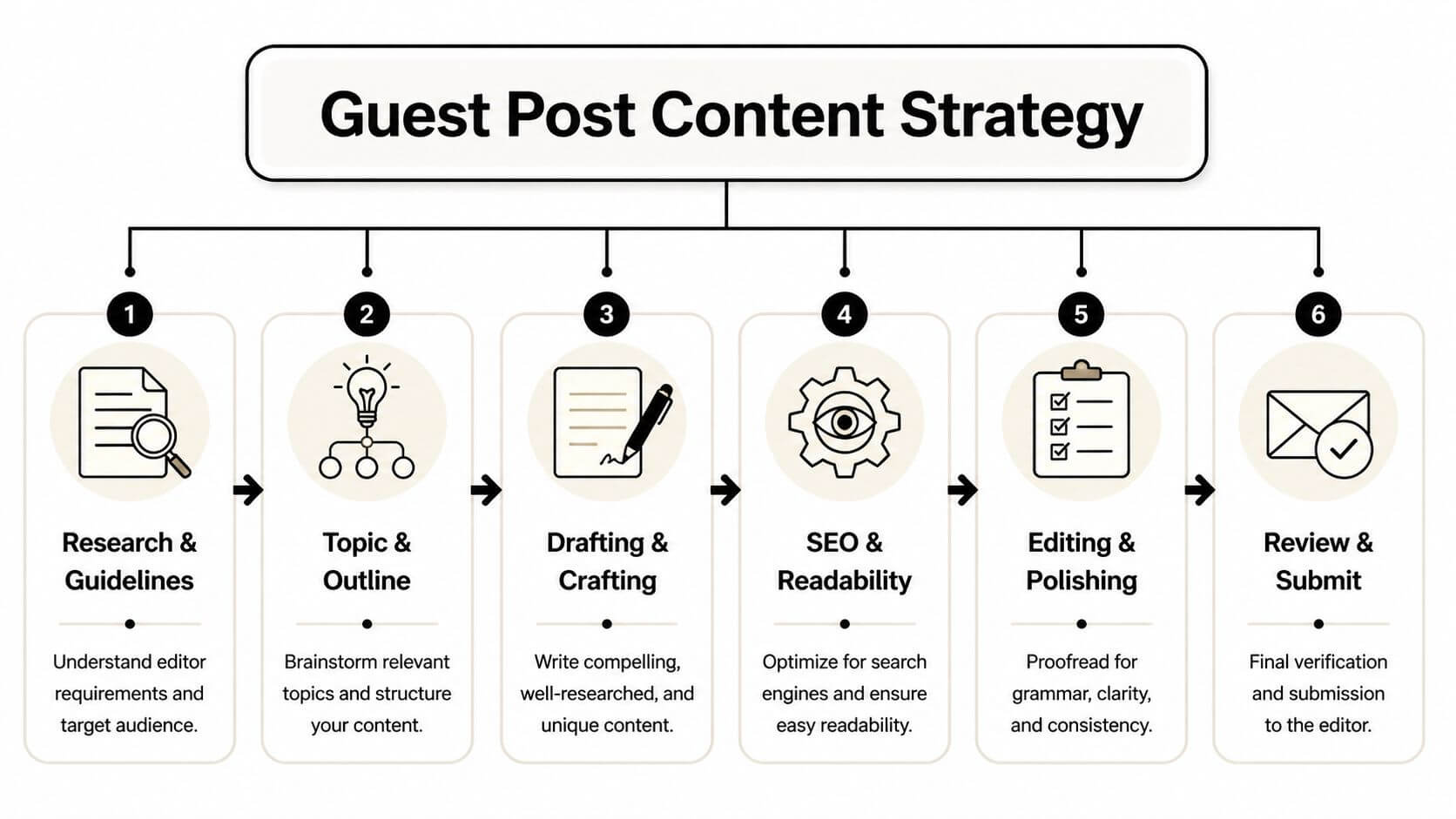
Most guest posts get rejected for the same reason they get ignored after publication. They’re written to “place a link,” not to earn attention. Editors can spot that instantly.
Strong guest content does three jobs at once. It matches the host site’s style, gives the audience something specific to act on, and supports the client’s SEO goals without sounding engineered.
What makes a draft publishable
Start by reading several recent posts from the target site. Look at structure, tone, subhead depth, examples, and how the site handles claims. Then write for that environment, not for your internal content brief.
The best drafts usually include:
-
A point of view: Editors want perspective, not stitched-together basics.
-
Useful specificity: Show process, trade-offs, and real decision criteria.
-
Natural linking: The backlink belongs inside a sentence that would help readers anyway.
-
Host-site alignment: Internal links, formatting, and terminology should fit the publication.
The easiest way to weaken a guest post
Over-optimization ruins otherwise solid articles. Exact-match anchors jammed into awkward sentences make editors suspicious and readers bounce. The same goes for generic intros, vague claims, and AI-written filler that says a lot without saying much.
Good guest content reads like a contribution to the publication. Bad guest content reads like a delivery vehicle.
Writing for human trust in an AI-heavy web
AI has raised the baseline for readable content. It hasn’t raised the baseline for original thinking. That’s why the best guest posts now lean harder on first-hand process, informed opinion, and examples that reflect lived work.
If your writers need sharper idea development, resources that help them Improve your creative skills can be useful for finding stronger angles and avoiding formulaic drafts.
A practical way to review a guest post before submission is to ask three questions:
-
Would this article stand on its own without the backlink?
-
Does it sound like the host publication, not our internal blog?
-
Would a reader learn something concrete they could apply today?
If the answer to any of those is no, the piece isn’t ready.
How to Measure and Report Guest Posting KPIs
Clients rarely ask how many pitches you sent. They ask what the placements did. That’s where many agencies struggle, especially in white-label delivery where the work spans outreach, content, links, analytics, and client reporting.
One of the biggest gaps in the market is reporting. A key unanswered question for agencies is how to measure and report guest posting success through branded dashboards, and over 70% of guest posts fail to convert due to unoptimized anchor text (guest blogging reporting and anchor text discussion).

The KPIs that matter
A guest post campaign should be measured like a portfolio, not a one-off placement. Look at combined impact over time.
Track these signals:
-
Referral traffic: Which placements send visits from the host site.
-
Linked page movement: Whether target pages improve in visibility and rankings.
-
Referring domain growth: Whether authority-building is broadening, not concentrating.
-
Lead attribution: Whether visitors from placements convert into inquiries or pipeline.
-
Anchor text mix: Whether links look natural across the campaign.
Reporting that clients can understand
Agencies lose trust when reports are either too technical or too shallow. “Built three links” isn’t enough. Neither is a giant export from Ahrefs or Google Analytics with no interpretation.
A good report explains:
| KPI | What to show the client | What it means |
|---|---|---|
| Referral traffic | Visits from each placement | Which publishers send engaged users |
| Landing page impact | Movement on the linked page | Whether the placement supports SEO goals |
| Referring domains | New linking domains over the campaign | Broader authority growth |
| Lead activity | Form fills, calls, or tracked inquiries from referral sessions | Business value beyond links |
| Anchor profile | Branded, natural, and contextual anchor examples | Risk control and conversion quality |
Clients don’t need more data. They need cleaner attribution and a reason to keep investing.
Where agencies usually go wrong
The common mistakes are predictable. They report too early, over-credit one placement, or ignore the quality of anchor text and landing page fit. Others separate fulfillment from analytics so completely that nobody can connect the guest post to traffic or leads.
The fix is operational. Build reporting into the service from the start. Tag destination URLs, log anchor choices, maintain a placement sheet, and review results at the campaign level rather than treating each post like an isolated event.
How Agencies Can Scale Guest Posting with White-Label Services
In-house guest posting sounds attractive until the operational load shows up. Prospecting takes time. Outreach requires persistence. Writing has to meet editorial standards. Reporting has to be client-ready. Most agencies can do one or two of those well. Fewer can do all of them consistently at scale.
That’s why white-label fulfillment is often the practical choice. It gives agencies a way to sell and manage seo guest posting without building a full production team around outreach, content, publisher relationships, quality control, and reporting.

The profitability question most agencies miss
Scaling isn’t just about getting more placements out the door. It’s about protecting margin while maintaining standards. That gets harder when link value changes over time.
For agencies reselling guest posting, a key challenge is long-term ROI because 40% to 60% of link value can degrade within 18 months, and white-label platforms that have managed campaigns for over 1,200 partners offer stronger fulfillment benchmarks for recurring revenue models (guest posts versus niche edits analysis).
What a strong white-label partner should handle
A real white-label solution should take pressure off the agency, not just outsource the labor. That means the provider needs a system for prospect vetting, editorial review, link policy, reporting inputs, and communication standards.
Look for partners that can support:
-
Publisher qualification: Relevance, authority, traffic, and spam review before outreach starts.
-
Content production: Writers who can match tone and follow editorial rules.
-
Process visibility: Clear status tracking from prospecting through publication.
-
Risk control: Natural anchor choices and stricter quality thresholds.
-
Reseller flexibility: Clean delivery that fits your agency brand.
Agencies expanding into verticals can also benefit from niche-specific strategy references. For example, this Gym Membership Tips guide is useful for understanding how specialized marketing positioning changes the content and outreach angle in fitness-related campaigns.
When outsourcing beats building internally
If your team is already stretched across SEO, PPC, web, and client support, guest posting becomes a bottleneck fast. Outsourcing makes sense when the opportunity cost of training and managing an internal fulfillment team is higher than the margin you’d preserve by keeping it in-house.
A practical benchmark is consistency. If your agency can’t reliably source good opportunities, produce publication-ready drafts, and report outcomes cleanly each month, a white-label model is usually stronger. The business case for that approach is clear in the benefits of outsourcing to white-label SEO services.
The Future of Authority Building in the AI Era
The future of seo guest posting isn’t more output. It’s better evidence of authority. Search engines and AI systems both reward signals that are harder to fake, including credible mentions, relevant context, editorial quality, and consistent expertise across the web.
That changes how agencies should value each placement. The question isn’t “Did we get the link?” It’s “Did we place the brand in a trustworthy environment with a useful contribution that supports long-term visibility?”
What will keep working
Three habits will stay durable:
-
Vet harder than you pitch
-
Write for the publication, not the backlink
-
Report business impact, not just link count
The agencies that win with guest posting are the ones that treat it like authority development with operational discipline.
Shortcuts will keep getting weaker. Editorial rigor, niche relevance, and measurable outcomes will keep getting stronger. That’s good news for agencies willing to run guest posting like a real service line instead of a commodity.
Agencies that want to scale authority-building without piling on software, staff, and reporting complexity should look at Agency Platform. It combines white-label fulfillment with a fully brandable dashboard, integrated reporting, and agency-ready workflows that make guest posting and broader SEO delivery easier to sell, manage, and retain under your own brand.