Dave Thompson April 7, 2026 1516 Views
Search engine optimization (SEO) is the art and science of making a website more visible in search engine results. It involves making strategic tweaks to a site’s design and content to make it more appealing to search engines like Google. The goal is to drive more—and more qualified—organic traffic to your website.
Unpacking Search Engine Optimization
Imagine a search engine as a gigantic library and your website as a single book. SEO is how you ensure the librarian (Google’s algorithm) can easily find your book, understand what it’s about, and recommend it to visitors looking for that specific topic.
Getting this right is critical, especially when you consider that 68% of all online experiences begin with a search engine. Furthermore, a recent study found that SEO drives over 1000% more traffic than organic social media.
Without a solid SEO strategy, your website is like a book buried in the back of the library—invisible to potential customers actively searching for what you offer. Good optimization means you show up at the exact moment they need you most.
The Three Pillars of Modern SEO
A winning SEO strategy is built on three core pillars that work together to boost rankings and fuel growth. Understanding how these pieces fit together is essential to grasping what search engine optimization truly is.
Here’s a quick look at how each pillar contributes to the bigger picture.
SEO Pillars at a Glance
| Aspect | Core Focus | Key Activities |
|---|---|---|
| On-Page SEO | Content and elements on your website. | Keyword research, creating E-E-A-T content, optimizing titles & meta descriptions. |
| Off-Page SEO | Actions taken outside of your website. | Building high-quality backlinks, managing brand mentions, digital PR. |
| Technical SEO | The backend and infrastructure of your site. | Improving Core Web Vitals, ensuring mobile-friendliness, schema markup. |
Let’s break these down a little further.
On-Page SEO
This covers everything you can control directly on your website. It’s about creating content that not only targets the right keywords but also genuinely satisfies user intent and demonstrates Experience, Expertise, Authoritativeness, and Trustworthiness (E-E-A-T). Think high-quality blog posts, well-optimized landing pages, and clear, compelling title tags.
Off-Page SEO
This pillar includes all the actions you take away from your website to build its authority and reputation. The primary component is backlink building—getting other reputable websites to link to yours. Each quality backlink acts as a vote of confidence, signaling to Google that your site is a credible source of information.
Technical SEO
Finally, we have the nuts and bolts. Technical SEO ensures your website’s foundation is solid so search engines can crawl and index it efficiently. This includes improving Core Web Vitals (site speed and user experience metrics), ensuring it looks great on mobile devices (over 60% of searches are on mobile), and having a clean, logical site structure.
A truly effective SEO approach must address all three pillars. If you neglect one, it’s like trying to build a three-legged stool with only two legs—your efforts in the other areas will be undermined, and your site will never reach its full potential in the search results.
Tracing SEO Evolution
SEO didn’t just appear out of thin air. It grew alongside the search engines, evolving from simple tricks into the complex, strategic discipline we know today. Understanding this journey is key to grasping why modern SEO is so focused on user experience and genuine quality.
The field began to take shape in the mid-1990s, with the term “search engine optimization” officially appearing in 1997. In the early days, tactics were crude—think meta tag manipulation and cramming pages with keywords. The game changed when Google rolled out its PageRank algorithm in 1998, making relevance and authority paramount. That single move kicked off an SEO gold rush, as detailed in this fantastic history of search marketing from Amsive Digital.
From Keywords to User Experience
Early on, much of SEO was reactive and focused on gaming the system. Marketers would stuff pages with keywords or acquire links from any corner of the web, regardless of relevance. This created a poor experience for users, often leading them to spammy, low-value content.
Google fought back with a series of game-changing algorithm updates designed to penalize websites using shady tactics and reward those that provided real value to people.
If there’s one big lesson to take from SEO’s history, it’s this: what’s best for the user is ultimately what’s best for your rankings. Trying to outsmart the algorithm is a losing game. Focusing on quality and user satisfaction is how you build results that last.
Landmark Algorithm Updates
Over the years, a few major updates completely rewrote the rules, pushing the industry closer to the user-first model we operate in today.
-
Panda (2011): This targeted sites with “thin” or low-quality content, making content depth and value critical ranking factors.
-
Penguin (2012): Penguin cracked down on manipulative link-building schemes, making it clear that high-quality, relevant links had to be earned.
-
Hummingbird (2013): This was a total overhaul of Google’s core algorithm. Hummingbird helped Google understand the intent behind a search, moving beyond simple keyword matching.
-
RankBrain (2015): With RankBrain, machine learning entered the picture. It helped Google interpret new or ambiguous queries and placed a much bigger emphasis on user signals like click-through rates and time on page.
This infographic does a great job visualizing how the core pillars of on-page, off-page, and technical SEO have grown through these key moments.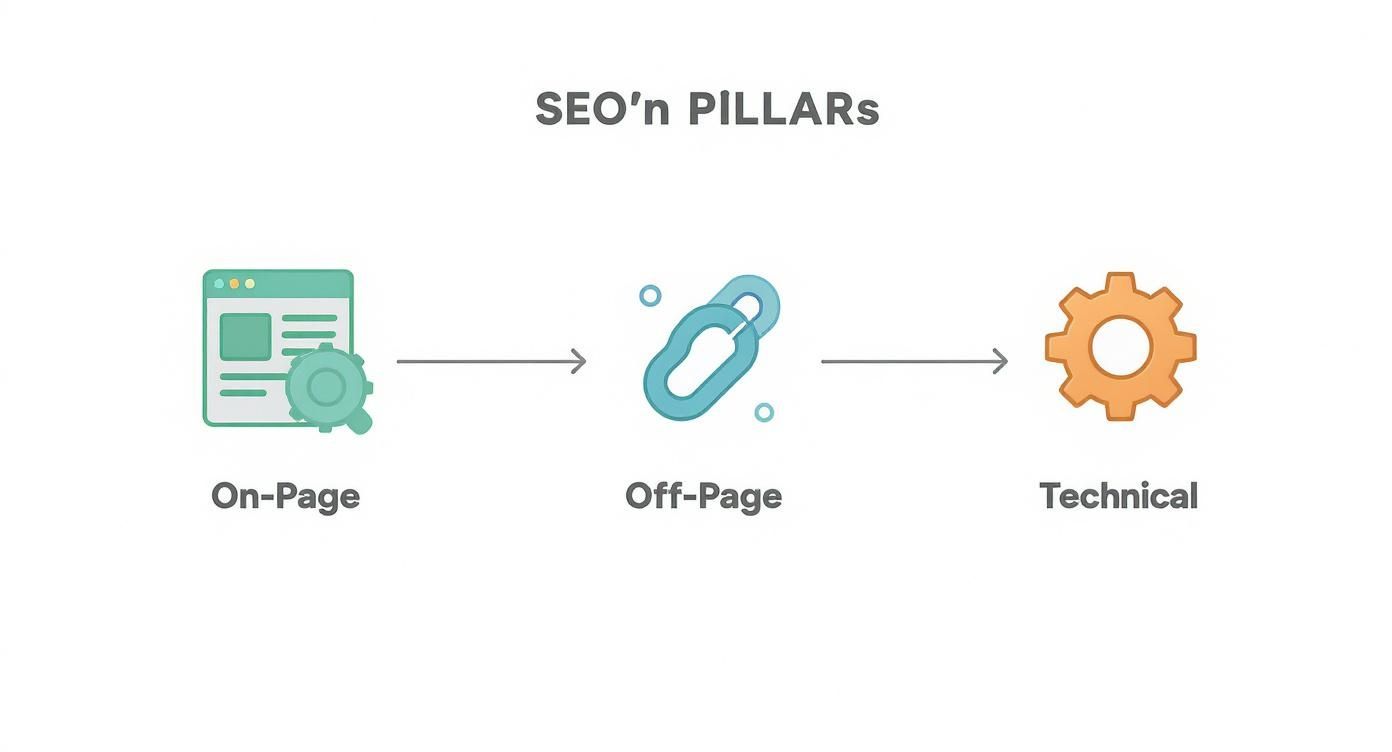
The timeline makes it obvious: we’ve moved from simple on-page tweaks to a sophisticated strategy that balances technical health, content quality, and off-page authority. This evolution is precisely why modern SEO demands a holistic approach that hits all three pillars at once. When you trace these milestones, it becomes clear that SEO isn’t just about keywords anymore—it’s about delivering a superior digital experience.
Unpacking The Three Core Components of SEO
Think of modern SEO as a three-legged stool. Each leg represents a core component, and if one is weak or missing, the whole thing topples over. To build a strategy that actually lasts, you need to understand how these three parts—On-Page, Off-Page, and Technical SEO—work together.
On-Page SEO is everything you see on the front end of a website. It’s the art of optimizing headlines, content, and images to perfectly match what users are searching for.
Off-Page SEO is about building your site’s reputation across the web. This is where you earn trust and authority through things like backlinks, mentions, and social signals.
Technical SEO is the foundation. It’s all the behind-the-scenes work that makes your site fast, easy for search engines to crawl, and mobile-friendly.
Let’s break each of these down a bit more.
On-Page SEO Essentials
On-Page SEO is all about the content and structure of your actual website pages. It’s your most direct line of communication with search engines, telling them exactly what a page is about and why it deserves to rank.
A great example is building a content cluster. Instead of writing one-off blog posts, you create a central “pillar” page on a broad topic and surround it with related articles that dive deeper. This shows Google you’re an expert on the subject.
Here’s what good on-page work looks like:
-
Optimizing titles and meta descriptions with your main keywords and a clear, compelling message.
-
Using header tags (H1, H2, H3) to give your content a logical structure that’s easy for both people and bots to read.
-
Building internal links to connect related pages, which helps guide users and spreads ranking authority throughout your site.
-
Creating genuinely helpful content that answers the user’s question so well they have no reason to bounce back to the search results.
When you nail these elements, you’re basically handing Google a perfect roadmap to your content.
Off-Page SEO Essentials
While on-page SEO is what you do on your site, Off-Page SEO is about all the promotional activities that happen off your site. Its main job is to build credibility and trust.
Think of it this way: high-quality backlinks are like votes of confidence from other reputable websites. The more you have, the more Google sees you as an authority worth ranking.
Effective off-page tactics include:
-
Finding relevant, high-authority sites in your industry for guest posts or other partnerships.
-
Earning natural mentions and citations in articles, directories, and industry publications to raise your brand’s profile.
-
Engaging with your audience on social media to drive shares, conversations, and traffic back to your site.
-
Keeping an eye on your backlink profile and fixing any broken links pointing to your site to reclaim that lost “link juice.”
These efforts are what build your site’s Domain Authority over time, giving you the power to compete for more valuable keywords.
Technical SEO Essentials
Technical SEO is the nuts and bolts. It ensures there are no technical roadblocks preventing search engines from finding, crawling, and indexing your site effectively. A poor technical foundation can sink even the best content and backlink strategy.
Your checklist for technical health should always include:
-
Improving server response times, compressing images, and using browser caching to make your site load faster.
-
Ensuring your site is mobile-friendly by testing it on different devices and fixing any clunky layout issues.
-
Creating a clean site structure with logical URLs and submitting an XML sitemap to Google.
-
Adding schema markup (structured data) to help search engines understand the context of your content, like reviews or events.
These fixes make a huge difference in both user experience and how easily search engines can do their job.
Don’t forget, Google’s updates have consistently rewarded sites that prioritize quality and user experience. The Panda update back in 2011 hit sites with “thin” content, Penguin in 2012 went after spammy link schemes, and “Mobilegeddon” in 2015 made mobile-friendliness a top ranking factor. This shift happened as mobile searches exploded from just 20% in 2013 to over 60% by 2021. If you want to dive deeper into these changes, WebFX has a great history of SEO updates.
This history lesson makes one thing crystal clear: solid technical health and mobile optimization aren’t optional anymore. They’re table stakes.
How The Three Components Work Together
When all three components fire on all cylinders, your SEO strategy becomes a powerhouse.
-
On-Page SEO creates the relevant, high-quality content that signals what you should rank for.
-
Off-Page SEO builds the authority and trust signals that prove you deserve to rank.
-
Technical SEO provides the flawless foundation that allows search engines to crawl and index it all without a hitch.
A great way to think about it is a three-legged stool. If you take away any one of the legs, the entire strategy becomes unstable and will eventually fall.
Aligning these pillars isn’t a one-time task; it’s an ongoing process that drives real, sustainable growth.
To bring this all together, here is a quick table that compares the focus and tactics for each component.
Comparison of SEO Components
| Component | Main Focus | Common Tactics |
|---|---|---|
| On-Page SEO | Content relevance and user experience | Titles, metadata, content clusters, internal linking |
| Off-Page SEO | Authority and trust signals | Backlinks, digital PR, social engagement |
| Technical SEO | Crawlability, speed, and performance | Server speed, mobile optimization, schema markup |
Mastering each of these components is how you build resilient SEO strategies that can weather any algorithm update and deliver measurable results.
Next up, we’ll dig into the tangible business benefits of SEO and show how these core elements directly fuel ROI for agencies and their clients.
Real Business Benefits Of SEO
SEO isn’t just about climbing search results—it’s a growth engine that keeps your business humming. With the right care, your visibility blooms, attracting visitors who are already interested in what you offer.
The global SEO services market is projected to reach $122.11 billion by 2028. This growth is fueled by undeniable results: around 68% of all online experiences begin with a search engine, and nearly 40% of e-commerce revenue comes from search traffic. Even more striking, SEO generates over 1000% more traffic than organic social media. You can explore more compelling SEO statistics and their impact on martech.zone.
Driving Targeted Organic Traffic
Paid ads grab attention for a moment. SEO, on the other hand, meets people exactly when they’re looking for solutions. Imagine a digital concierge who invites the right guests in, rather than a billboard that interrupts their journey.
When someone types “emergency plumber near me” into Google, they’re not browsing—they’re in urgent need. Ranking for that phrase is like having your shop’s door swing open the instant someone needs help. These clicks are high-intent, and studies show the conversion rate for SEO leads is around 14.6%, compared to just 1.7% for traditional outbound marketing.
SEO doesn’t interrupt. It answers. And in that moment of need, you build trust and authority—one click at a time.
Enhancing Brand Visibility And Credibility
Showing up on page one is like earning a perpetual VIP pass to the conversation in your industry. Every impression reinforces that your brand is the go-to expert.
Search engines act as the world’s most trusted curators. When your name appears for key queries, it’s an implied endorsement. 75% of users never scroll past the first page of search results, making that top placement a powerful signal of credibility.
Here’s how SEO cements your authority:
-
Top-Of-Mind Awareness: Frequent exposure makes your brand the first thought when a need arises.
-
Implied Endorsement: A high organic position feels like a stamp of credibility from Google itself.
-
Content Leadership: Well-crafted, optimized content positions you as an expert before prospects even click through.
Generating Sustainable And Cost-Effective Leads
Picture a snowball rolling downhill. At first, it’s small, but as it gathers momentum, it grows on its own. That’s SEO’s compounding effect.
A paid campaign stops the moment you switch off the budget. But a well-ranked article or landing page can keep pulling in leads for months—or even years—without extra spend. Over time, your cost per acquisition (CPA) drops dramatically.
This makes SEO one of the most budget-friendly strategies in your marketing mix. You invest upfront, then watch as each piece of content continues to deliver, creating a steady, scalable pipeline of qualified leads.
Debunking Common SEO Myths
The world of search engine optimization is notorious for bad advice. Persistent myths and outdated tactics can send well-meaning agencies down a rabbit hole of wasted time and frustrated clients.
Chasing these ghosts is a surefire way to drain your budget without delivering results. To build a successful SEO strategy, you have to know what not to do just as much as you know what to do. Let’s clear the air and bust some of the biggest myths still haunting the industry.
Myth 1: Keyword Stuffing Is a Viable Tactic
This is one of the oldest—and most harmful—myths out there. The idea is that cramming a page full of your target keyword will trick search engines into ranking it higher. Back in the dial-up days, this might have worked. Today, it’s a giant red flag for low-quality content that can earn you a penalty.
Modern search engines use complex natural language processing (NLP) to understand the meaning and context behind a search, not just specific words. Instead of obsessing over keyword density, the winning strategy is to create comprehensive content that genuinely answers a user’s question in a natural, readable way.
True optimization isn’t about repeating a keyword ten times. It’s about covering a topic so well that you naturally use all the related terms and phrases your audience is searching for. This is what Google rewards.
Myth 2: SEO Is a One-and-Done Setup
Another dangerous misconception is treating SEO like a one-time project. Agencies fall into this trap, thinking that once they’ve optimized some title tags and fixed a few technical glitches, their work is done. This “set it and forget it” mindset couldn’t be more wrong.
SEO is a marathon, not a sprint. It’s a continuous process of improvement and adaptation. Your competitors are always working to outrank you, and Google pushes out hundreds of algorithm updates every year. A winning campaign demands ongoing attention, including:
-
Regular content updates to keep your information fresh and relevant.
-
Consistent link building to steadily grow your site’s authority.
-
Performance monitoring to spot new opportunities and fix emerging problems.
-
Adapting to algorithm changes to stay ahead of the curve.
Myth 3: Ranking Number One Guarantees Success
Hitting that #1 spot feels like the ultimate victory, but it doesn’t automatically mean more business. The real goal isn’t just to rank—it’s to drive qualified traffic that converts. A top ranking for the wrong keyword is nothing more than a vanity metric.
Imagine a local bakery ranks first for “best cake recipes.” They might get a huge surge in traffic, but it’s from hobby bakers all over the country who have no intention of buying a cake from their shop. It’s a classic case of empty traffic.
A much smarter strategy would be to target a phrase like “custom birthday cakes in [City].” While the search volume is lower, the intent is sky-high. This keyword attracts local customers who are ready to pull out their wallets. Focusing on these conversion-focused keywords is what delivers a real return on investment.
Creating Your Agency SEO Roadmap

Knowing the theory behind SEO is one thing. Turning that knowledge into a profitable, results-driven service for your clients is another. Agencies need a structured, repeatable plan—a roadmap that guides every move from the initial audit to the final monthly report.
Think of this roadmap as your strategic framework for delivering real, measurable results. It ensures every task, from deep-dive keyword research to critical technical fixes, ties directly back to your client’s business goals. Without a solid plan, your efforts get scattered, progress grinds to a halt, and clients lose faith.
A well-defined SEO roadmap transforms abstract goals into a clear series of achievable milestones. It creates transparency for your clients and keeps your team accountable, forming the very backbone of any successful SEO partnership.
Building Your Foundational SEO Checklist
Every great campaign kicks off with a deep dive into where the client stands right now. This initial discovery phase is crucial for spotting both the quick wins and the long-term opportunities that will drive growth. Your first steps should always involve a thorough audit that covers all three pillars of SEO.
This audit isn’t just about digging up problems; it’s about setting a baseline. By documenting the starting point, you can clearly show the incredible value you’re delivering over time.
Your foundational checklist should nail these core tasks:
-
Comprehensive Site Audit: Fire up tools like Screaming Frog or Semrush to crawl the entire site. Your mission is to hunt down technical gremlins like broken links, sluggish page speed, and indexing errors that are secretly holding the site back.
-
Keyword Research and Opportunity Analysis: Don’t just settle for the obvious head terms. Dig deeper to uncover long-tail keywords and question-based queries that signal serious user intent. This is how you build a list of ranking targets that actually convert.
-
Content and SERP Analysis: Get a real feel for their existing content. Is it high-quality? Is it relevant? Where are the gaps? Then, analyze the search engine results pages (SERPs) for your target keywords to understand exactly what kind of content Google is rewarding right now.
-
Backlink Profile Audit: Carefully examine the client’s current backlink profile. You’re looking for toxic links that need to be disavowed and powerful, high-quality links you can replicate. This gives you a clear picture of their current domain authority.
Mapping Content to the Customer Journey
Once you’ve got the lay of the technical land and identified your keyword opportunities, it’s time to align your content creation with the client’s business goals. This is where you map specific keywords to the different stages of the customer journey—awareness, consideration, and decision.
For instance, a keyword like “what is search engine optimization” is perfect for someone in the awareness stage. But a query like “best white-label SEO platform for agencies” is coming from a user who is much, much closer to making a purchase.
A successful content map doesn’t just chase keywords; it answers the user’s underlying questions at each step of their journey. This approach builds trust and naturally guides prospects toward becoming customers.
Here’s a simple framework to get this done:
-
Group Keywords by Intent: Organize your massive keyword list into thematic clusters based on what the user is trying to do (informational, navigational, commercial, transactional).
-
Assign Keywords to Funnel Stages: Match each of those clusters to a stage in the marketing funnel. For example, “how-to” keywords belong at the top of the funnel, while “brand vs. brand” comparisons are squarely in the middle.
-
Plan Content Formats: Figure out the best format for each stage. Blog posts and guides are fantastic for building awareness, whereas case studies and detailed comparison pages are killer for the decision stage.
Setting KPIs and Tracking Performance
The final, crucial piece of your roadmap is measurement. Without clear Key Performance Indicators (KPIs), you can’t prove your ROI, and the engagement is dead in the water. Your roadmap must spell out exactly what success looks like and how you’re going to track it.
Choose KPIs that tie directly to the client’s actual business goals, not just vanity metrics. Sure, keyword rankings are important, but they don’t pay the bills.
Focus on metrics that show tangible business impact:
| KPI Category | Primary Metrics to Track | Tools to Use |
|---|---|---|
| Visibility | Keyword Rankings, SERP Visibility, Impression Share | Google Search Console, Semrush, Ahrefs |
| Traffic | Organic Sessions, New vs. Returning Users, Top Landing Pages | Google Analytics 4, Matomo |
| Engagement | Bounce Rate, Time on Page, Pages per Session | Google Analytics 4, Hotjar |
| Conversion | Goal Completions, Conversion Rate, Lead Quality | Google Analytics 4, CRM Data |
This structured approach takes SEO from a mysterious art and turns it into a predictable science. With a clear roadmap in hand, you can confidently guide clients toward sustainable organic growth, proving your value every single step of the way.
Frequently Asked Questions
When you’re navigating the world of SEO, a few questions always seem to pop up. Getting straight answers is the first step toward building a strategy that actually works and avoids the common traps many agencies fall into. Let’s tackle some of the most common queries we hear.
On-Page SEO vs. Off-Page SEO
The easiest way to think about the difference is to imagine your client’s website is a house.
On-page SEO is everything you do inside the house to make it welcoming and easy to navigate. This includes all the factors you can control directly on the website itself, like the quality of the content, how keywords are used, the structure of title tags, and your internal linking strategy. It’s all about getting your own house in perfect order.
On the other hand, off-page SEO is everything you do outside the house to build its reputation around town. The biggest part of this is earning high-quality backlinks from other reputable websites. Think of these links as endorsements or votes of confidence from trusted neighbors. The better your reputation, the more people will want to visit.
How Long Does SEO Take to Show Results?
Let’s be clear: SEO is a marathon, not a sprint. While you might see some small wins in a few weeks, the kind of significant results your clients are looking for—like ranking for competitive keywords and seeing a real jump in organic traffic—typically take anywhere from four to twelve months to materialize.
This timeline isn’t set in stone. It can be influenced by all sorts of things, like the website’s age, its existing authority, how stiff the competition is, and how consistently you’re putting in the work. But unlike paid ads that vanish the moment you stop paying, the value you build with SEO compounds over time.
A study from Ahrefs found that only 5.7% of pages manage to rank in the top 10 within a year of being published. Patience and consistent effort are the name of the game.
Essential Tools for Tracking SEO Performance
You can’t manage what you don’t measure. To keep track of your progress and prove your value to clients, you need the right tools in your arsenal. Google gives you two powerful and free platforms that are absolutely non-negotiable:
-
Google Search Console: This is your direct line to Google. It’s essential for monitoring your site’s overall health, tracking which keywords you’re ranking for, and spotting technical issues before they become major problems.
-
Google Analytics 4 (GA4): This is where you go to understand what visitors are actually doing on the site. Use it to analyze user behavior, see where your organic traffic is coming from, and measure how your SEO efforts are contributing to real business goals, like leads and sales.
When you’re ready to dig deeper into competitor strategies and backlink profiles, paid tools like Semrush or Ahrefs are the industry standard.
Ready to scale your agency’s SEO services without all the overhead? Agency Platform offers a complete white-label solution, giving you everything from a fully brandable client dashboard to expert fulfillment. Find out how we can help you deliver incredible results under your own brand at https://www.agencyplatform.com.