Dave Thompson June 8, 2026 702 Views
A website audit is an in-depth analysis of a website’s performance, structure, usability, and content, designed to identify issues hindering its visibility in search engines and AI-powered discovery systems. In practice, that means checking whether real people, search crawlers, and AI systems can access, trust, and choose your site.
That matters because search visibility is still brutally competitive. With over 3.5 billion Google searches happening daily and up to 99% of users staying on page one, a weak site isn’t just underperforming. It’s getting ignored. Modern audits have expanded well beyond broken links and missing title tags. They now test whether a site is technically crawlable, commercially usable, content-rich enough to earn trust, and structured clearly enough for AI-driven discovery.
What Is a Modern Website Audit
A modern website audit is no longer a narrow SEO checklist. It’s a full diagnostic of how a website performs across technical SEO, content, usability, conversion paths, and trust signals.
It measures whether a site can be understood and chosen
In 2026, a modern website audit is described as a thorough analysis of a website’s performance, structure, usability, and content for both human users and AI-powered discovery systems, with tools now covering Core Web Vitals, technical issues, and JavaScript rendering for complex web apps. That shift reflects a broader reality documented in this modern website audit overview, which also notes that SE Ranking has been trusted by 1.5 million SEO professionals since 2013.
That’s the biggest change in what is website audit means today. The old version asked, “Can Google crawl this site?” The current version asks a harder question: “Can search engines, AI systems, and visitors all make sense of this site fast enough to trust it?”
A good audit looks at the site as a system. It checks architecture, internal links, templates, page quality, speed, trust elements, structured data, and whether key pages are positioned to win visibility.
Practical rule: If an audit ends with a spreadsheet of errors but no business priorities, it wasn’t complete.
It’s now tied to AI search readiness
AI discovery systems reward pages that are easy to parse, clearly structured, and aligned with intent. That changes how agencies should evaluate websites. A page can be technically indexable and still fail because it’s vague, thin, or hard to extract into an answer format.
That’s why modern audits often include checks for structured summaries, entity clarity, author trust cues, and semantic coverage. If you want a deeper look at that shift, this piece on AI-powered SEO audits is a useful reference.
Why Audits Are a Critical Business Function Not Just an SEO Task
Most businesses still treat audits as cleanup work. That’s a mistake. An audit is a visibility review, a conversion review, and a risk review at the same time.
Poor visibility is a business problem
When a site fails to rank, it loses traffic opportunities before sales teams, paid media, or CRO can help. The scale of that problem is clear in Neil Patel’s write-up on technical SEO site audits, which notes over 3.5 billion Google searches daily, up to 99% of users focusing on page one, and tools capable of crawling 1,000 pages in under 2 minutes for faster issue detection.
For agencies, that speed matters because delays compound. If a client has indexing errors, redirect problems, or buried service pages, every week without diagnosis means missed leads and weaker campaign performance.
Audits reduce waste across teams
A proper audit also prevents bad decisions. Teams often push more content, more ads, or a redesign when the underlying issue sits lower in the stack. Sometimes the site can’t be crawled well. Sometimes templates suppress internal linking. Sometimes conversion friction cancels out ranking gains.
A strong audit creates a sequence:
-
Fix access first: Search engines can’t rank pages they can’t crawl or index.
-
Fix experience next: Visitors won’t convert on slow, confusing, or untrustworthy pages.
-
Then scale promotion: Paid, content, and outreach perform better when the foundation works.
Audits don’t just find flaws. They tell you which flaws are expensive to leave unfixed.
They should be recurring, not one-off
Most organizations should run a full audit annually, with quarterly reviews and additional audits after redesigns, new service launches, or noticeable traffic drops, as noted in the same Neil Patel reference above. In agency work, that cadence is practical. Annual audits catch structural drift. Quarterly reviews catch regressions before they become reporting problems.
The Six Core Types of Website Audits Explained
A complete website audit usually combines six audit types. Treating them as separate but connected workstreams keeps recommendations clearer and easier to execute.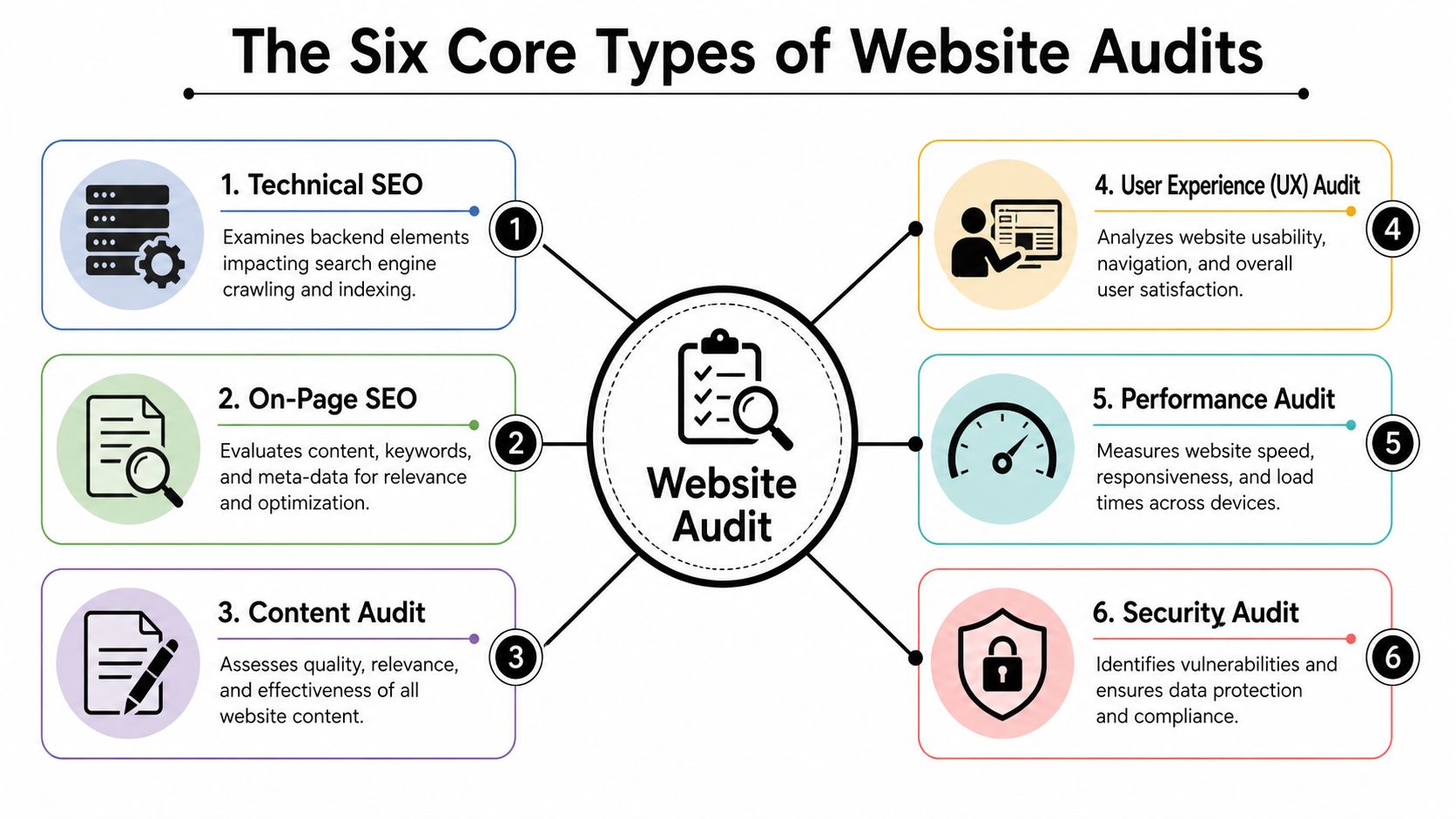
Technical SEO audit
This is the foundation. It looks for crawlability, indexability, duplicate content, canonical mistakes, redirect chains, broken links, and architecture problems.
According to this technical SEO audit guide, technical audits can uncover over 150 distinct issues, including cases where important pages sit more than 3 clicks from the homepage. That’s why experienced teams start here. A content fix won’t matter much if the page is buried or blocked.
On-page SEO audit
This checks whether individual pages communicate relevance clearly. It reviews title tags, headings, metadata, URL structure, internal anchor patterns, and alignment between page intent and query intent.
In practice, on-page problems are often less dramatic than technical ones but easier to fix. That makes them valuable quick wins.
Content audit
Content audits ask whether the site deserves to rank. They assess quality, freshness, coverage, duplication, usefulness, and how well content supports expertise and trust.
This is also where agencies should review external visibility opportunities. For product launches or new offer pages, curated resources such as directories to launch new products can help teams think more broadly about discoverability and authority support.
User experience audit
A UX audit checks navigation, clarity, mobile usability, friction points, and whether users can complete key actions without confusion. If visitors hesitate, backtrack, or miss calls to action, rankings alone won’t save performance.
Performance audit
Performance work focuses on speed, responsiveness, script weight, image handling, and front-end bottlenecks. This overlaps with technical SEO, but it deserves its own lens because speed affects both rankings and conversion behavior.
Security audit
Security checks verify HTTPS, certificate issues, unsafe resource loading, and other trust-related weaknesses. Security isn’t just IT housekeeping. Browser warnings destroy confidence fast.
The best audits don’t treat these six categories as silos. They connect them. A slow, thin, badly linked service page is one business problem with several symptoms.
Key Components Every Comprehensive Audit Should Inspect
The best audits don’t stop at categories. They inspect specific signals that influence visibility, trust, and conversion outcomes.
Technical access and indexation
A site must be reachable before it can perform. Auditors review robots.txt, XML sitemaps, crawl paths, canonical logic, status codes, and indexation patterns. If key pages are excluded or duplicated, you get wasted crawl activity and weaker search coverage.
Speed and trust signals
HubSpot’s guide to website audits is useful here because it ties technical checks to outcomes. It notes that page speed is a confirmed Google ranking factor, and that audits surface bottlenecks like unoptimized images and render-blocking scripts. It also notes that missing HTTPS is a negative ranking signal that can cause browsers to warn users away.
That’s why I treat performance and security as revenue issues, not just engineering issues.
For teams working through speed improvements, this article on Core Web Vitals as a Google ranking factor gives a practical overview of what to prioritize.
Structure, markup, and content signals
A thorough audit should inspect:
-
Internal linking: Key pages need logical paths from high-value pages and from navigation structures.
-
Schema markup: Structured data helps search engines and AI systems interpret page meaning more reliably.
-
Mobile usability: A page that works on desktop but fails on mobile still fails.
-
Content depth: Thin pages rarely perform well on competitive queries.
-
Trust cues: Clear authorship, business information, service proof, and transparent policies strengthen credibility.
| Component | Why it matters |
|---|---|
| Crawlability | Search engines can’t rank blocked or broken pages |
| Page speed | Slow pages lose visibility and create friction |
| HTTPS | Security warnings reduce trust and traffic |
| Internal links | They shape both discovery and authority flow |
| Structured data | It improves interpretability for search and AI systems |
A High-Level Guide to the Website Audit Process
Running tools isn’t the process. A real audit follows a workflow.
Start with scope and business goals
Define what success means before pulling data. Is the site losing rankings, struggling to convert, expanding into new services, or preparing for a migration? The goal changes the audit.
A lead-gen site needs different emphasis than a content publisher or a local multi-location brand. If scope is vague, the report usually becomes bloated and hard to act on.
Gather evidence from multiple systems
Use crawlers, analytics, Search Console, page speed tools, and manual page reviews together. A crawler can show you what’s broken. Analytics and behavior tools show whether those issues matter commercially.
A useful working pattern looks like this:
-
Collect crawl data: Identify structural and technical errors.
-
Review search data: Check indexing, visibility shifts, and page-level performance.
-
Audit key templates manually: Service pages, blog pages, location pages, forms, and navigation often hide recurring issues.
-
Check UX and conversion paths: Don’t assume rank equals results.
If you only use one tool, you usually get one version of the truth.
Prioritize fixes by impact and effort
Many audits fail here. They list everything with equal weight. That’s not strategy.
Use a simple decision model:
-
High impact and low effort: Fix immediately.
-
High impact and high effort: Plan with developers and stakeholders.
-
Low impact and low effort: Batch with maintenance work.
-
Low impact and high effort: Usually defer.
Implement and monitor
An audit creates a backlog, not a result. Results come after implementation, re-crawling, and monitoring. That means assigning owners, validating fixes, and watching indexation, engagement, and conversion trends after changes go live.
Common Audit Findings and Their Strategic Fixes
Most audit reports contain recurring patterns. The valuable part isn’t spotting the issue. It’s tying the issue to the right fix.
Content and usability gaps are now major blockers
One of the most important shifts in recent audit work is that not all ranking barriers are technical. This 2026 website audit checklist notes that up to 40% of significant ranking barriers now come from content weaknesses and usability gaps, and that sites with indexability below 90% are often missed by next-generation AI indexing systems.
That matches what many agencies see in practice. The crawl is clean enough, but the pages still don’t win because they’re generic, hard to scan, or weak on trust and intent match.
Common patterns and what usually works
-
Indexation bloat: Too many low-value pages compete for crawl attention. Fix by consolidating thin content, improving canonical control, and removing pages that don’t serve a search or customer purpose.
-
Weak service pages: Pages describe services broadly but don’t prove expertise. Fix with clearer scope, proof elements, FAQs, and stronger internal linking from relevant support content.
-
Slow templates: Heavy scripts, uncompressed media, and bloated plugins drag down key landing pages. Fix the template, not just one page.
-
Schema gaps: Important page types lack structured data. Fix with complete Schema.org implementation where appropriate, especially for entities, organizations, services, and article content.
-
Buried priority pages: Valuable pages exist but aren’t surfaced well. Fix navigation, contextual links, and hub structures.
Minor code cleanup has value. But if the page still doesn’t answer the user’s problem clearly, rankings often stall.
What doesn’t work
Teams lose time when they obsess over low-impact warnings while ignoring weak page quality. They also waste effort when they treat every broken element as urgent. Strategy means fixing the blockers that move visibility and trust first.
How Agencies Can Scale Audits with a White-Label Platform
Manual audits are hard to scale. The work itself is valuable, but collection, formatting, screenshots, and client reporting eat margin fast.
The operational problem
Agencies need audits to sell retainers, diagnose performance, and justify strategy. But if every audit requires hand-built decks and scattered tools, delivery slows down. That creates inconsistent reporting and weak follow-through.
The demand for a better model is already clear. This overview from SE Ranking’s website audit page notes that white-label platforms are trusted by over 1,200 partners and that 70% of agencies seek white-label solutions to replace costly stacks and improve client communication.
Why integrated platforms work better
A white-label platform solves several problems at once:
-
Branded reporting: Agencies keep their identity front and center.
-
Centralized data: Rankings, tasks, traffic, and audit findings live in one place.
-
Recurring delivery: Clients can see ongoing progress instead of one-off PDF snapshots.
-
Role-based visibility: Teams, clients, and specialists can each access what they need.
This also helps with the less glamorous side of SEO delivery. Technical debt accumulates across client accounts, and agencies need a system for surfacing and sequencing it. For that mindset, Aakash Gupta on technical debt is a useful read because it frames debt as a management problem, not just an engineering annoyance.
The strategic upside
When agencies operationalize audits, they stop being pre-sales giveaways and become part of a durable service model. That improves retention because clients can see what was found, what was fixed, and what still needs attention.
Frequently Asked Questions About Website Audits
How often should you perform a website audit
A full audit should generally happen annually, with quarterly reviews and additional checks after redesigns, major site changes, or visible traffic drops.
Can you do a website audit yourself
Yes, for basic checks. You can review pages manually, run crawlers, inspect indexing, and test speed. The harder part is interpretation. Agencies usually add the most value when they prioritize findings and connect them to business outcomes.
What is the ROI of a website audit
The return comes from better visibility, cleaner indexation, faster pages, stronger trust, and fewer conversion blockers. It’s rarely one fix. It’s the combined effect of removing drag across the site.
Is a technical audit enough
No. Technical SEO matters, but a modern audit also needs to evaluate content quality, usability, and AI readiness. A site can be technically clean and still fail to earn visibility.
If your agency wants to turn audits into a scalable, branded service instead of a manual bottleneck, Agency Platform gives you a white-label system built for that job. You can centralize reporting, automate visibility into rankings and tasks, and deliver ongoing SEO under your own brand without building the operational stack from scratch.