Dave Thompson August 24, 2026 38 Views
If you’re running an agency, you’ve probably hit the same wall most owners hit with SEO. Clients ask for it, margins look attractive, but hiring a full team for strategy, technical fixes, content, and reporting creates payroll risk fast. SEO reseller services solve that by letting your agency sell SEO under its own brand while a specialist partner fulfills the work behind the scenes. Used well, it’s not just outsourcing. It’s a way to turn fixed delivery costs into variable margin while expanding recurring revenue.
What Are SEO Reseller Services and Why Do They Matter in 2026
SEO reseller services are a white-label delivery model. Your agency owns the client relationship, sets the price, controls positioning, and presents the work under your brand. The fulfillment partner handles the operational SEO.
A simple way to think about it is private-label manufacturing. The store owns the customer. The manufacturer makes the product. In SEO, the agency owns strategy, sales, and account management. The reseller partner supplies the execution layer.
Why the model matters now
This isn’t a niche play anymore. The SEO market is projected at USD 83.98 billion in 2026 and USD 148.86 billion by 2031, while small and medium enterprises held 58.40% of market share in 2025, according to Mordor Intelligence’s SEO market outlook. That’s the exact client base most agencies serve.
What changed is operational pressure. Search is harder to deliver than it was a few years ago. Agencies now need technical SEO, entity-focused content, local optimization, reporting discipline, and the ability to react when search results change. Hiring for all of that in-house is possible. It just isn’t always rational.
Practical rule: If demand is uneven, reselling usually beats hiring first. You can always bring capabilities in-house later after volume is stable.
What white-label SEO is really buying you
A good reseller partner does three things that matter to agency economics:
-
Removes staffing risk by replacing payroll commitments with service-based costs
-
Expands your offer fast so web design, PPC, and social clients can buy SEO from one vendor
-
Stabilizes fulfillment when internal bandwidth, turnover, or hiring delays would otherwise hurt delivery
What doesn’t work is treating seo reseller services as a cheap labor source. Cheap providers usually create expensive problems later. Missed deadlines, weak reporting, shallow audits, and generic content all come back to the agency because the client sees your logo, not the vendor’s.
The Core Service Offerings of a Top-Tier White-Label Partner
A real SEO fulfillment partner isn’t selling “blogs and backlinks.” The job is to operate like a search delivery team your agency didn’t have to hire.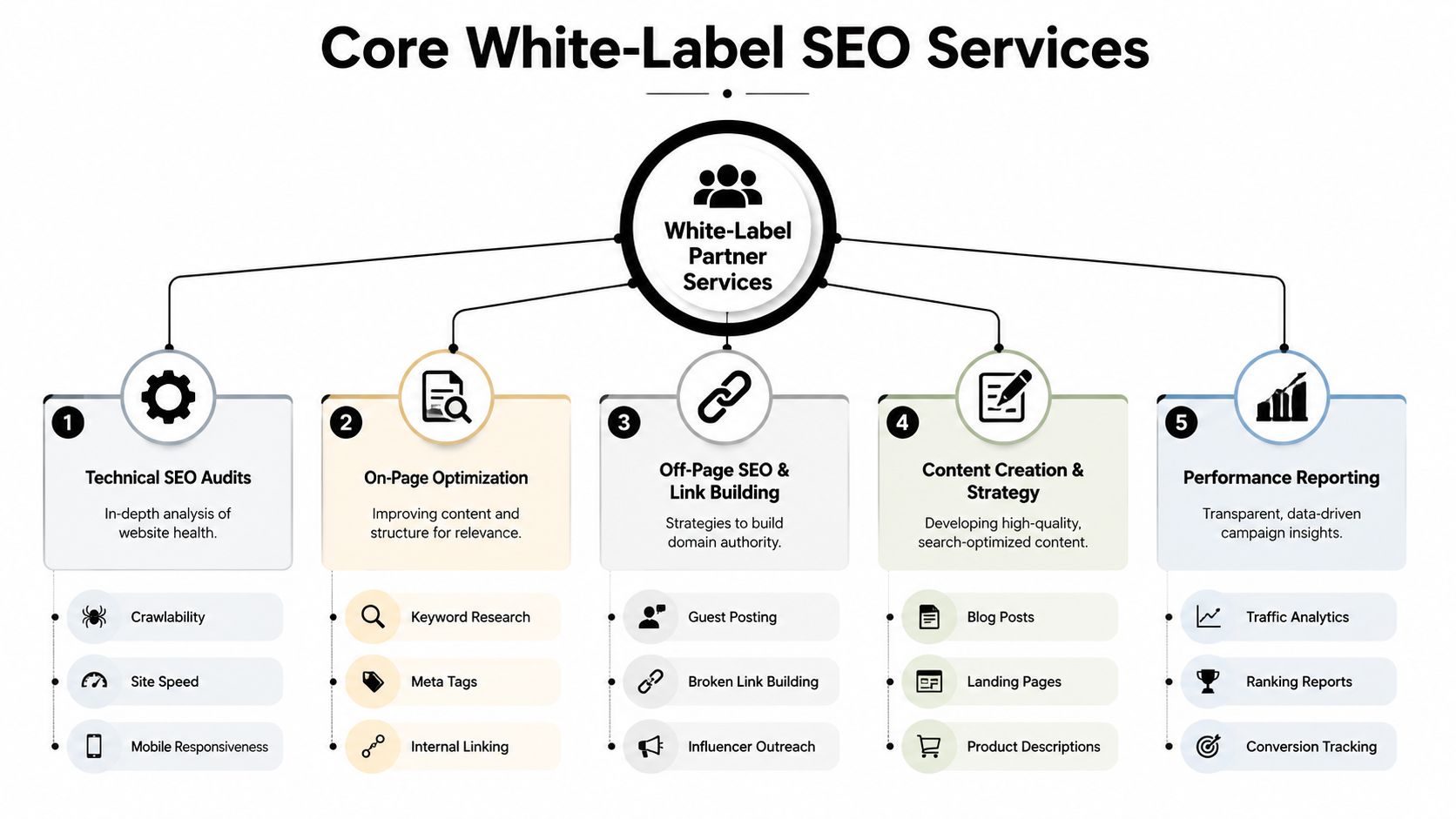
Technical SEO is the foundation
A technically strong program includes site audits, speed optimization, schema markup, and mobile UX improvements, not just keyword targeting, as outlined in Floowi Talent’s breakdown of outsourced SEO reseller work. If the site can’t be crawled cleanly, loads poorly, or sends weak structural signals, everything else underperforms.
In practice, many weak providers fail at this point. They send a PDF audit. They don’t implement or verify anything. That creates busywork, not results.
Local SEO is now core, not optional
For agencies serving home services, healthcare, legal, hospitality, or multi-location brands, local SEO shouldn’t sit in an add-on tab. It belongs inside the main offer.
That means work such as:
-
Google Business Profile management with category, service, and posting discipline
-
Citation consistency across business listings
-
Local landing pages tied to service areas and intent
-
Review workflow support so visibility connects to trust and lead quality
Content and on-page work need strategic intent
Content fulfillment should support rankings and conversions. That means keyword research, page mapping, internal linking, optimization of service pages, and content briefs that reflect search intent.
Good partners don’t just deliver pages. They connect content to opportunity. You want evidence of what was targeted, what changed, and what moved afterward.
If a reseller can’t explain why a page was created, why a page was updated, and how performance will be measured, they’re producing assets, not strategy.
Link building and reporting complete the system
Link acquisition still matters, but the true distinguishing factor is restraint and relevance. Agencies should prefer partners that focus on quality, context, and brand safety over volume promises.
Reporting has to tie the whole stack together. Useful reporting includes:
| Area | What you should see |
|---|---|
| Technical work | Findings, fixes completed, outstanding issues |
| Search visibility | Keyword movement and page-level trends |
| Traffic | Organic changes by page or section |
| Conversions | Leads, calls, forms, or tracked actions |
Structuring Your Pricing and Profit Margins for Success
Most agencies price SEO the wrong way. They start with the wholesale cost, add a thin markup, and hope volume makes it work. That’s a margin trap.
A better approach is to price around delivery complexity, account management time, and business value. The reseller fee is only one line item. Your agency still owns discovery, client communication, approvals, reporting calls, and retention.
What healthy economics look like
Agencies that add white-label SEO report average revenue increases of 35% to 50% within the first year, and successful reseller partnerships can generate profit margins of 30% to 50%, according to Map Ranking’s 2025 review of white-label SEO providers.
Those ranges are achievable when you stop selling SEO like a commodity.
Three pricing moves that protect margin
-
Bundle by outcome, not tasks. Sell local growth, lead generation support, or technical recovery. Don’t make clients compare line items.
-
Separate account management from fulfillment thinking. A cheap backend service can still become unprofitable if your team spends too much time explaining weak reports or fixing mistakes.
-
Avoid low-ticket edge cases. Small clients with high expectations compress margin faster than mid-market clients who understand retainers.
For agencies that like scenario planning, the logic isn’t unique to SEO. The same margin discipline shows up in e-commerce calculators and product businesses. Tools like these profit insights for POD entrepreneurs are useful because they train you to think in contribution margin, not just topline revenue.
A more detailed breakdown of package structure and markup strategy is covered in Agency Platform’s guide to white-label SEO pricing models before investing.
What usually goes wrong
The biggest pricing mistake is undercharging because the work is outsourced. Clients aren’t paying for your staffing model. They’re paying for results, accountability, and a managed relationship. If your agency owns trust and communication, it owns pricing power too.
The Onboarding and Reporting Workflow A Look Behind the Curtain
A reseller relationship gets tested in the first 30 days, not month six. The sale is still fresh, the client expects fast movement, and any confusion in intake or reporting turns into extra account management hours. That is where margin starts leaking.
Strong seo reseller services remove friction from delivery by turning a messy handoff into a repeatable operating system. The goal is simple. Keep strategy visible, keep communication controlled, and keep your internal team out of fulfillment triage.
What a healthy workflow looks like
The cleanest setups follow a predictable sequence:
-
Sales closes the client and sets scope clearly
-
Your account team completes intake with goals, access, and priority pages
-
The partner runs the initial audit and builds the execution plan
-
Deliverables go through quality review before anything reaches the client
-
Reports are published under your agency brand
-
Your account manager translates progress into business terms
That process sounds simple because it should be. If onboarding depends on scattered Slack messages, vague discovery notes, or missing logins, the partner works from bad inputs and your team pays for the cleanup.
The best partners also define what happens when information is missing. They have an intake checklist, a clear timeline to first deliverable, and a documented review path for strategy changes. If you need a due diligence framework, use this guide on how to vet an SEO reseller service for quality and compliance before you commit.
Reporting should reduce account load
Reporting is part of fulfillment. It is not back-office admin.
A usable white-label reporting system shows what work was completed, what changed, what needs attention, and how that maps to traffic, rankings, leads, or conversion trends. Agencies need that level of visibility because reporting is how you defend retainers, answer client questions quickly, and keep the agency in control of the relationship.
Leading Edge Info Solutions’ overview of white-label SEO resellers points to branded dashboards and transparent reporting as practical evaluation criteria. That lines up with what I see in agency operations. Weak reporting creates follow-up calls, manual explanations, and client doubt. Clear reporting protects time and trust.
A reseller relationship breaks when the client sees more detail than the agency can explain. Your reporting system should make the agency look informed, not dependent.
This is also where the financial angle becomes obvious. Hiring an in-house SEO team locks you into fixed salaries before delivery quality is proven. A disciplined reseller workflow shifts that risk into a variable cost model, but only if onboarding is standardized and reporting is client-ready. If your team still has to rebuild reports, reinterpret deliverables, or chase status updates, you kept the payroll risk and added vendor risk on top of it.
How to Select the Right White-Label SEO Partner for Your Agency
Most agencies compare partners by service list and wholesale rate. That’s too shallow. The core question is simpler. When does outsourcing beat hiring?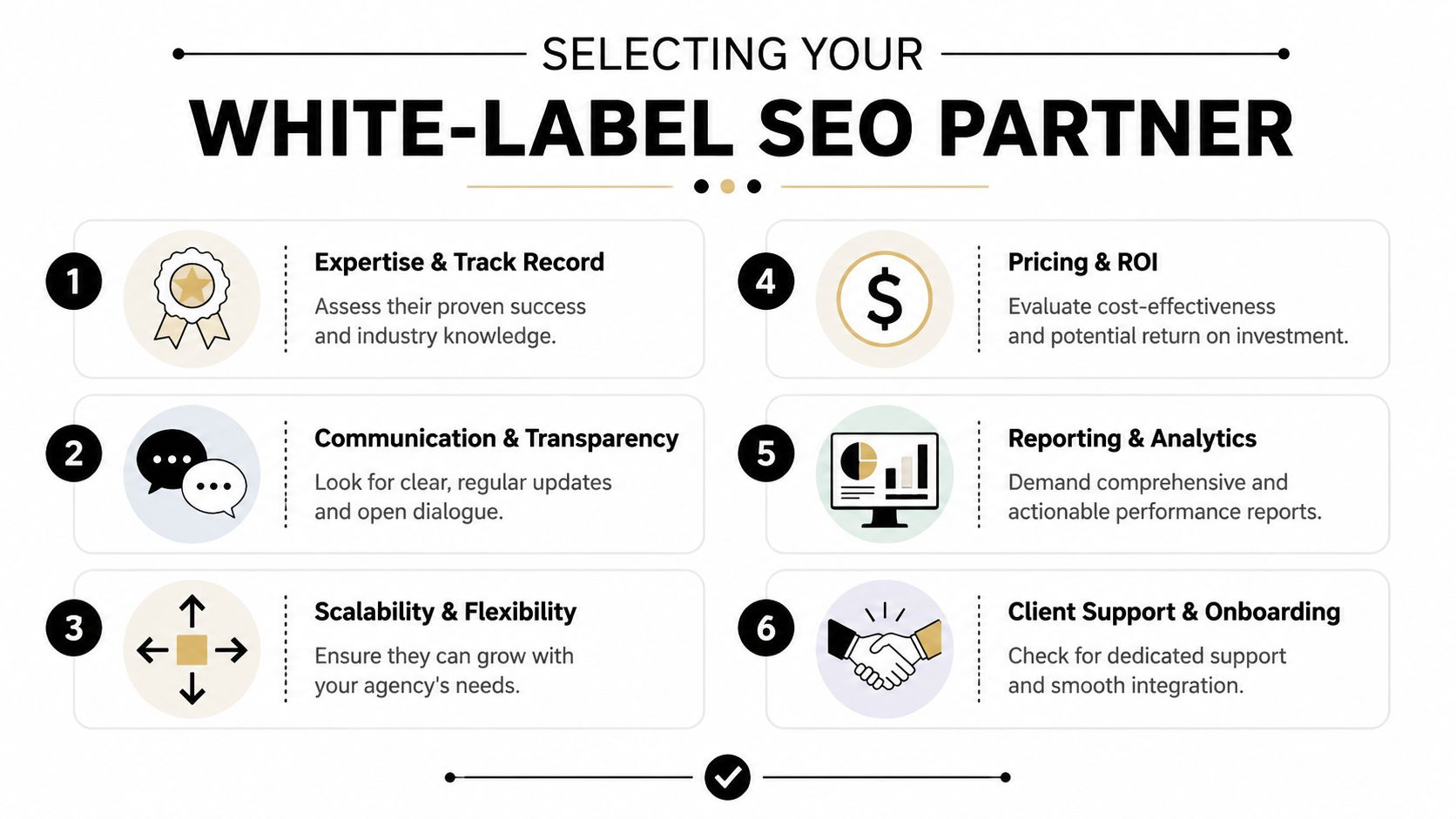
Evaluate the financial fit first
Agency Platform frames the decision well in its article on when outsourcing beats hiring for small agencies. The point isn’t cheap fulfillment. It’s converting fixed payroll risk into variable margin.
That lens changes how you vet partners. You’re not buying labor. You’re buying flexibility, capacity, and risk control.
The checklist that actually matters
Use these filters before you sign anything:
-
Delivery depth. Can they execute technical SEO, local SEO, on-page work, content, and links in one system?
-
Reporting quality. Do reports show actions, movement, and business impact clearly?
-
Process maturity. Is onboarding standardized, or does every project feel improvised?
-
Compliance and quality control. Can they explain how work is reviewed and how risky tactics are avoided?
If you want a stronger due-diligence framework, this Agency Platform resource on how to vet an SEO reseller service for quality and compliance is worth using as a screening checklist.
Red flags that usually predict problems
A partner is usually a bad fit if they:
-
Lead with volume promises instead of process clarity
-
Hide who does the work or how deliverables are reviewed
-
Show generic sample reports with no business context
-
Treat local SEO like a bolt-on when many agency clients depend on it
Integrating a White-Label Partner into Your Agency Workflow
Picking the partner is only half the job. The rest is operational fit.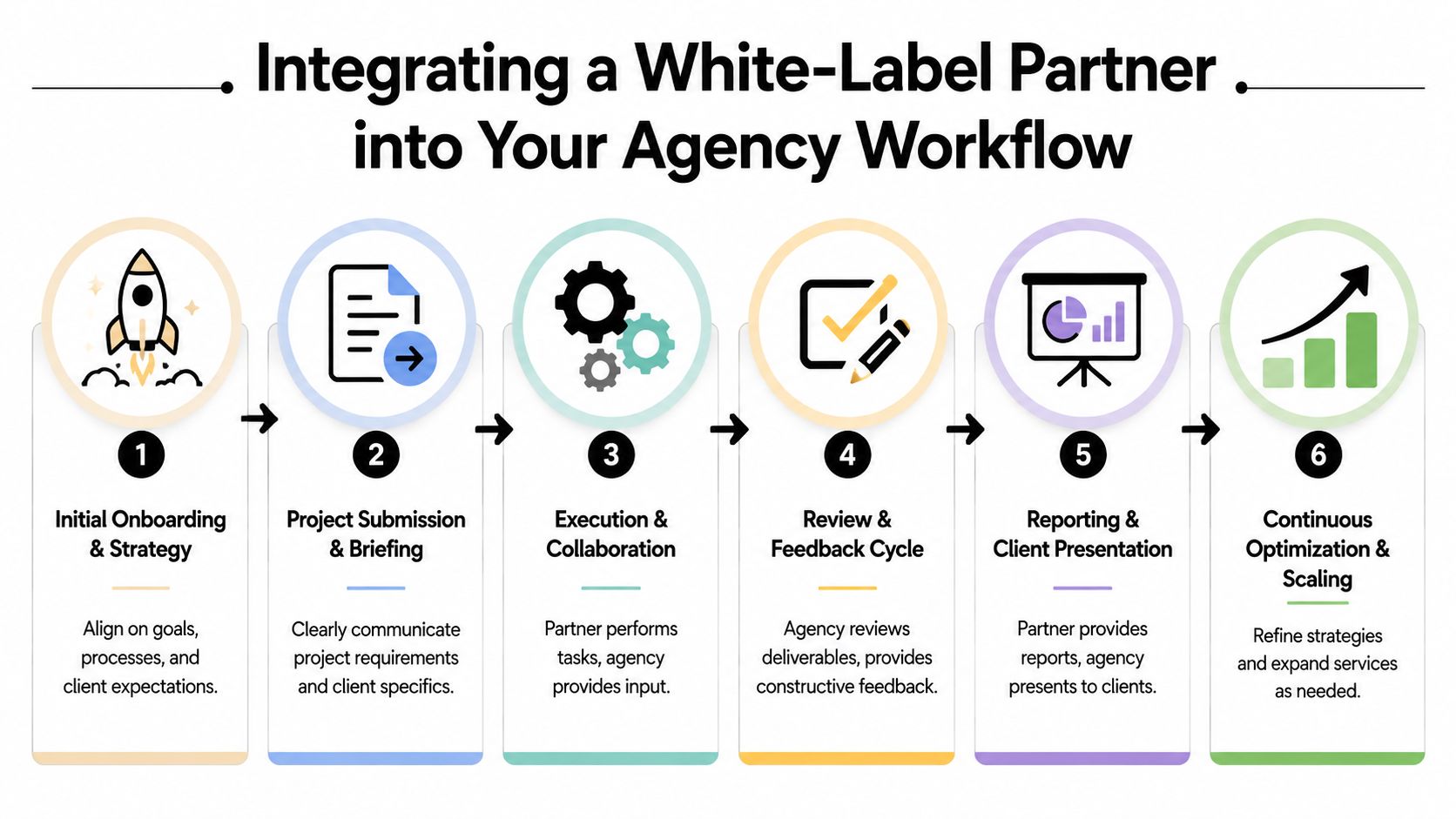
Phase one is sales enablement
Your sales team needs plain-language positioning, package boundaries, and expectation-setting scripts. If they can’t explain the difference between local SEO, technical SEO, and content support, they’ll oversell and create churn later.
Phase two is handoff discipline
Standardize intake. Collect business goals, target locations, service priorities, existing assets, and access details the same way every time. Don’t let every account manager invent their own process.
Phase three is ongoing management
Keep ownership clear:
-
Agency handles strategy alignment, client calls, and approvals
-
Partner handles execution, production, and backend deliverables
-
Both sides share feedback loops and issue resolution
This setup works best when the agency stays visible as the strategist. The partner shouldn’t become the brain of the account in the client’s eyes.
Common Pitfalls to Avoid and How to Maximize Your ROI
The agencies that get real value from seo reseller services don’t just outsource tasks. They manage the model.
Mistakes that hurt margin and retention
The first mistake is buying on price alone. Cheap fulfillment usually means generic work, slower revisions, and thin reporting. The client doesn’t care that your cost was low if results are vague.
The second mistake is selling old SEO in a new search environment. To stay relevant in 2026, reseller services need to adapt to the AI search era with entity optimization, AI-assisted content workflows, and disciplined Google Business Profile management, as described in ALM Corp’s guide to scaling agencies with SEO reseller services.
What improves ROI now
The highest-return reseller relationships usually share a few traits:
-
They connect SEO to lead quality, not just rankings
-
They treat local search as a core revenue channel
-
They report transparently enough for strategic decisions
-
They adapt deliverables when search behavior changes
The easiest way to lose margin is to keep selling static monthly SEO while search keeps changing under it.
A good partner helps you protect client trust during those changes. A weak one leaves your team explaining why old deliverables no longer map to modern search visibility.
If your agency wants recurring SEO revenue without taking on full payroll risk, Agency Platform is a practical next step to evaluate. It combines white-label fulfillment with a brandable dashboard and reporting workflow, which makes it easier to scale delivery while keeping the client relationship under your name.