Dave Thompson August 10, 2026 474 Views
Starting an SEO business in 2026 is still a rational bet because search demand hasn’t gone away. Google handles roughly 3.5 billion searches per day, 68% of online experiences begin with a search engine, and 53.3% of website traffic comes from organic search, according to WebFX’s SEO statistics roundup. The primary challenge isn’t whether SEO works. It’s whether you can package it, deliver it, and scale it without burning out.
Charting Your Course in the Modern SEO Industry

A lot of people ask how to start a seo business as if the first step is building a logo, buying software, or posting on LinkedIn. It isn’t. The first step is choosing a market position that gives you a realistic path to recurring revenue.
SEO is durable because buyer behavior is durable. Search remains the default way people discover services, compare vendors, and validate trust. That matters more than trends.
Why the market is still attractive
The strongest new-agency mistake is treating SEO like a one-size-fits-all service. It’s not. A local contractor needs map visibility, service-area pages, reviews, and Google Business Profile work. A SaaS company needs content strategy, technical clean-up, internal linking, and commercial landing pages. An ecommerce brand needs category architecture and crawl control.
That difference shapes everything:
-
Local SEO fits agencies that want faster sales cycles and clearer deliverables.
-
National SEO often brings larger retainers but higher expectations.
-
Niche SEO for verticals like legal, dental, home services, or SaaS usually converts better than generic “we do SEO for everyone” positioning.
Practical rule: Pick one entry point where you already understand the customer, the buying cycle, and the common SEO gaps.
What page-one economics mean for a new agency
The harsh reality is that clients don’t pay for “optimization.” They pay for visibility where clicks happen. WebFX notes that less than 1% of searchers reach the second page, which is why technical SEO, content quality, and link acquisition matter so much in early delivery.
That has two implications for a new business:
| Decision | What usually works | What usually stalls |
|---|---|---|
| Market focus | One niche or one SEO type | Broad “full-service SEO for any business” |
| Sales message | Outcome-based offer | Long list of tactics |
| Delivery scope | Tight packages | Custom everything from day one |
When I see new agencies struggle, it’s rarely because they picked the wrong logo or CRM. It’s because they promised every service to every client before they had a repeatable system.
Where to enter the market
A practical starting point is to map your offer against three filters:
-
Proof
Can you show even a small sample, audit, or before-and-after process? -
Repeatability
Can you run the same workflow across multiple clients without reinventing delivery? -
Margin
Can you sell it monthly without needing a huge in-house team immediately?
If the answer is yes on all three, you’ve found a viable starting lane.
Designing Your Service Menu and Pricing Model
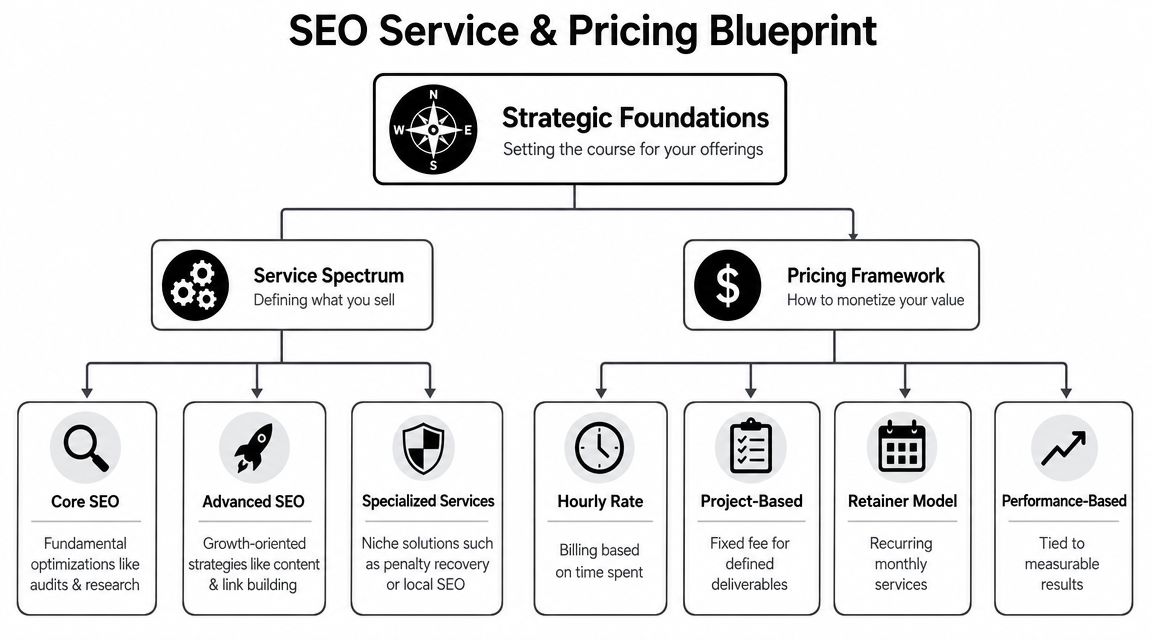
Your service menu should make buying simple and delivery predictable. If clients can’t tell what they’re getting, or your team can’t tell what’s included, the account gets messy fast.
Industry data shows 74% of small businesses invest in SEO, average monthly spend is around $497, and broader SEO services commonly range from $500 to $7,500 per month, based on AIOSEO’s SEO statistics roundup. The same source notes that 49% of marketers say organic search delivers the highest ROI. That supports a retainer model far more than one-off project work.
Build offers around outcomes, not tasks
A clean menu usually starts with three service families.
Local SEO
This works well for agencies serving contractors, med spas, dentists, law firms, and multi-location businesses. Deliverables often include Google Business Profile work, local landing pages, citations, on-page fixes, review strategy, and reporting. If local visibility is your lane, study how local SEO services are typically structured into repeatable monthly deliverables.
National or content-led SEO
This fits B2B, SaaS, publishers, and service brands targeting broader non-local keywords. The package usually centers on keyword mapping, content briefs, technical fixes, internal linking, and authority building.
Specialty add-ons
These might include link building, technical audits, content refreshes, or migration support. These are useful, but they shouldn’t be your main offer at launch unless you already have a strong niche reputation.
Sell a defined business outcome. “More qualified local leads” closes more often than “keyword research, schema, citations, and technical optimization.”
Pick a pricing model that doesn’t trap you
New operators often start with hourly billing because it feels safe. In practice, hourly pricing rewards inefficiency and creates client anxiety around every request.
A better progression looks like this:
-
Project-based work for audits, set-up, or recovery work
-
Monthly retainers for ongoing SEO execution
-
Custom proposals only after you understand your margins
Retainers are the foundation because SEO is cumulative. Rankings, content, link signals, and local authority don’t mature on a one-week schedule.
A simple packaging structure
Use three tiers if you want a broad market fit, but keep the logic clear:
-
Starter for single-location or lower-complexity clients
-
Growth for businesses that need content and authority building
-
Expansion for multi-location, competitive, or multi-service campaigns
Each tier should answer four questions fast:
| Question | Client needs to know |
|---|---|
| What’s included | Specific deliverables |
| What problem it solves | Visibility, leads, authority, local reach |
| What cadence applies | Monthly execution and reporting |
| What’s excluded | Prevents scope creep |
That last one matters. Scope creep kills margins faster than underpricing.
Building Your Fulfillment Engine In-House vs White Label

This is the fork in the road most beginner guides skip. How will you fulfill the work after the client signs?
You have two real options. Build in-house from day one, or use white-label fulfillment and keep strategy, sales, and client communication under your brand.
What in-house gives you
In-house fulfillment gives you control. You choose the process, train the team, review every deliverable, and own the communication loop.
That sounds ideal, and eventually it can be. Early on, it also means hiring risk, management overhead, training time, software costs, and delivery bottlenecks. One account manager can sell faster than a new production team can execute.
Why many small agencies stall here
A common failure point is operational, not strategic. Search Engine Land notes that small agencies often stall because they don’t solve delivery capacity and reporting early enough, and that white-label fulfillment, branded dashboards, and automated reporting directly address that gap in its guide to becoming an SEO freelancer without burning out.
That aligns with what happens in practice. The first few clients feel manageable. Then reporting slips, fulfillment gets inconsistent, and custom requests eat the week.
If delivery depends on your personal bandwidth, you haven’t built a business yet. You’ve built a job with client expectations attached.
When white label is the smarter launch model
White label makes sense when you want to sell recurring SEO without immediately building a full production department. It lets you keep the client relationship while outsourcing specialized execution.
That changes the economics of a new agency in useful ways:
-
You launch faster because you don’t need to hire every specialist up front.
-
You protect margin because fixed fulfillment is easier to forecast than ad hoc staffing.
-
You reduce operational drag because reporting and process are already built.
-
You stay client-facing instead of becoming the bottleneck on every task.
For agencies exploring that path, a white label SEO reseller program is one way to combine fulfillment with branded reporting and recurring service packaging.
The trade-off that matters most
This decision isn’t really about pride or control. It’s about where your time creates the most value.
If you’re great at selling, diagnosing SEO issues, and managing client trust, your business grows when you stay close to those activities. If you spend most of your week chasing edits, formatting reports, and coordinating freelancers, growth slows.
A practical model for many new agencies is hybrid. Keep strategy, sales, positioning, and client communication in-house. Outsource repeatable production until revenue is stable enough to justify internal hiring.
Assembling Your Tech Stack and Business Essentials
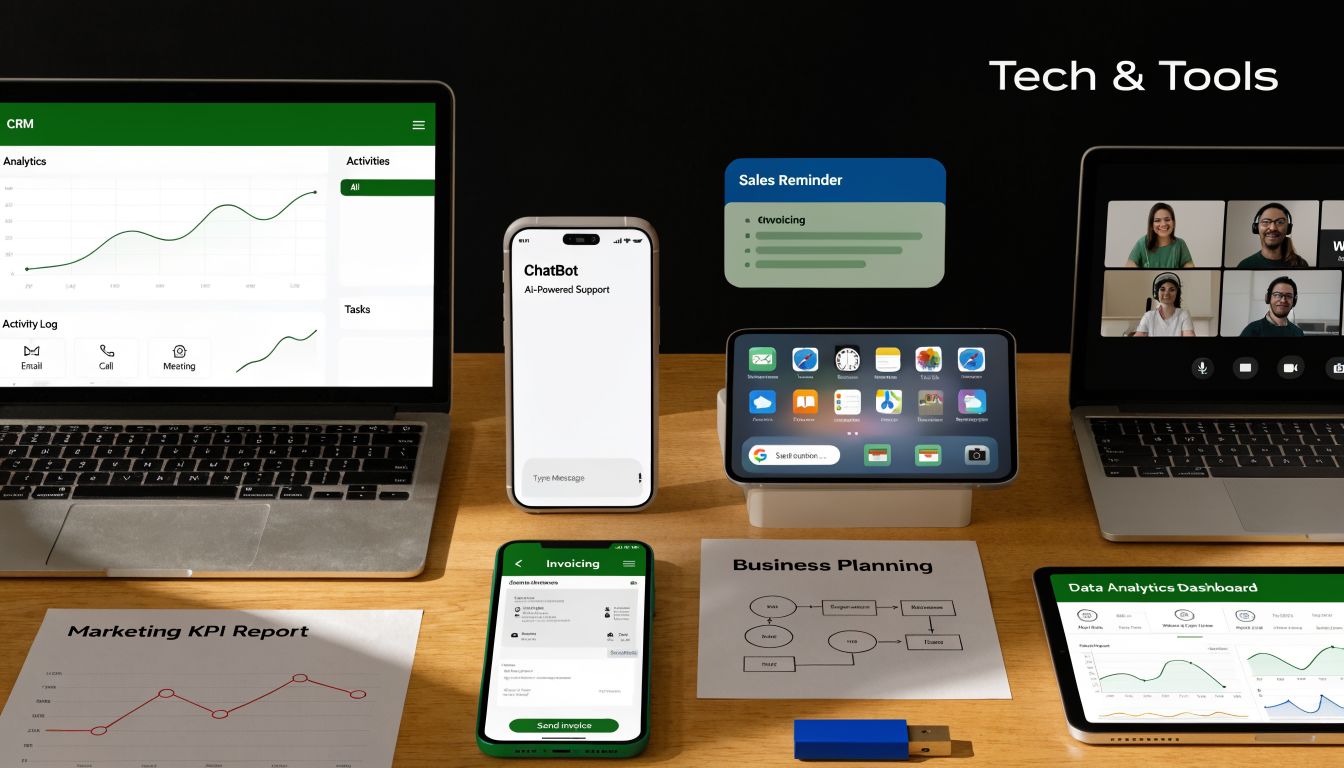
Your stack doesn’t need to be huge. It needs to be usable.
Most new agencies overspend on software and underspend on process. A lean stack is enough if it supports sales, delivery, and reporting.
The minimum operating stack
GigRadar’s agency launch guidance recommends a practical setup built around project management software like Trello, Asana, or ClickUp, plus Ahrefs or Semrush, Google Analytics, and Google Search Console, all tied to a lead-focused website and a small set of proof assets in its article on starting an SEO agency.
That stack covers the essentials:
-
Project management with ClickUp, Asana, or Trello
-
Research and competitive analysis with Ahrefs or Semrush
-
Performance tracking with Google Analytics and Google Search Console
-
Sales support with a clean website, service pages, and a simple proposal process
One platform can also consolidate parts of this stack. Agency Platform combines a brandable dashboard, reporting, and fulfillment workflows for agencies that don’t want to stitch everything together manually.
What your own website must prove
Your site is your first sales asset. It should show that you understand SEO basics in your own environment.
At minimum, your site needs:
-
Clear service pages aligned to your offer
-
Logical structure so buyers and search engines can move through it
-
Useful content that demonstrates expertise
-
Proof assets such as sample audits, case-study style examples, or process walk-throughs
Your agency website doesn’t need to be huge. It needs to make the buyer think, “These people know what they’re doing, and they’ve done this before.”
Formalize the business before taking money
The legal side matters more than most freelancers want to admit. A formal business plan helps you define market, services, and runway. Wolters Kluwer notes that forming an LLC or corporation may require an EIN, a registered agent, and a FinCEN BOI filing, and recommends getting the structure in place before accepting client payments in its guide on how to start an SEO business.
A simple business plan should cover:
| Area | What to define |
|---|---|
| Market | Who you serve |
| Services | What you sell and what you don’t |
| Pricing | Your delivery model and margins |
| Cash flow | How long you can operate before revenue stabilizes |
| Marketing | How you’ll get your first clients |
This is not paperwork for its own sake. It keeps you from improvising the whole business.
Activating Your Client Acquisition and Management System
Client acquisition gets too much attention. Client management gets too little. A healthy SEO business needs both, because bad onboarding and weak reporting erase the gains from strong sales.
How to get your first clients without looking huge
At the beginning, trust beats reach. You don’t need a giant audience. You need a credible niche offer and a reliable sales conversation.
Three channels usually work well:
-
Warm network outreach to past clients, designers, developers, and paid media agencies
-
Authority content on your website that answers buyer questions clearly
-
Targeted prospecting using short, relevant audits instead of long generic pitches
The outreach should be diagnosis-first. Point to one issue, one missed opportunity, or one local visibility gap. Don’t send giant audits to cold leads.
Run a sales process that filters bad fits early
The best sales calls are structured. Ask what they sell, who they target, what’s been tried, what internal resources exist, and how success will be judged.
If a prospect wants guaranteed rankings, unlimited revisions, or broad SEO plus web, ads, and social for one small fee, qualify out. That account usually becomes expensive to service.
A clean sales path looks like this:
-
Short discovery call
-
Focused audit or opportunity review
-
Proposal tied to outcomes and scope
-
Onboarding with access, timelines, and reporting expectations
Onboarding and reporting keep clients longer
Most churn starts in the first month. The client signs, then hears little, doesn’t understand what’s happening, and starts questioning the retainer.
Good onboarding fixes that. Send a clear kickoff agenda, request access once, define the first milestones, and explain what early SEO work will look like. Some tasks won’t feel flashy to the client, so your job is to translate activity into business relevance.
Don’t just send reports. Interpret them. Clients stay longer when they understand what changed, why it matters, and what happens next.
Retention improves when you avoid two extremes. The first is silence. The second is drowning clients in dashboards with no narrative. Strong account management lives in the middle: clear progress, realistic expectations, and visible next steps.
Your Path to a Scalable and Profitable SEO Agency
Starting an SEO business is straightforward. Building one that lasts is harder.
The agencies that make it usually do three things well. They choose a clear market position, package SEO into understandable recurring offers, and solve fulfillment before fulfillment becomes a crisis. That third piece is where many good freelancers get stuck.
The biggest operational decision is whether to build in-house immediately or use a white-label model while the business matures. In-house can work, but it adds management load early. White label can work, but only if you keep strategy, communication, and quality control tight. The right answer depends on your strengths, your runway, and how fast you want to grow.
AI-driven discovery and answer engines are changing search behavior, but they haven’t removed the need for strong websites, structured service pages, local signals, technical health, and content people trust. If anything, they’ve raised the standard. Thin execution stands out faster now.
If you’re serious about how to start a seo business, think like an operator from the beginning. Don’t build around hustle. Build around systems, packaging, and dependable delivery.
If you want a simpler way to launch or scale without building a full fulfillment team first, Agency Platform gives agencies a practical option for branded dashboards, reporting, and white-label search delivery under their own name.