Dave Thompson August 17, 2026 484 Views
An seo reseller lets an agency sell SEO under its own brand while a fulfillment partner does the work behind the scenes, and the model works because SEO is still seen as a high-return channel: 49% of business owners say SEO delivers the best ROI, with average SEO ROI cited at 22:1 (Reboot Online SEO statistics). That matters more now because agencies can’t rely on traffic alone to prove value when AI-driven results and zero-click search reduce the clicks clients used to watch.
The Modern Agency Dilemma and the SEO Reseller Solution
Most agencies don’t lose SEO opportunities because demand is weak. They lose them because hiring specialists, buying tools, building delivery workflows, and maintaining quality control takes time they don’t have.
That’s where the seo reseller model fits. The agency owns the client relationship, strategy framing, and communication. The white-label partner handles fulfillment under the agency’s brand. For a web design firm, paid media shop, or local marketing consultant, that closes a gap fast without building a full SEO department from scratch.
The bigger shift is reporting. In AI-influenced search, clients may see flatter click growth even when visibility improves. A page can appear more often, earn more SERP real estate, or support more assisted conversions while raw sessions stay mixed. Agencies that still sell SEO as “more traffic next month” set themselves up for hard conversations.
SEO reselling works when the agency sells outcomes, not task lists.
A good reseller arrangement solves two problems at once:
-
Capability gap: You can offer technical SEO, content support, local SEO, and reporting without hiring every specialist in-house.
-
Capacity gap: You can keep selling without pausing growth every time delivery load spikes.
-
Positioning gap: You stop referring SEO business out to someone else who might later take the whole account.
That’s why I treat seo reseller services as a strategic business model, not a convenience add-on. If the partner is strong, the agency gets recurring revenue, broader account control, and a more defensible client relationship. If the partner is weak, the agency absorbs the damage.
Understanding the SEO Reseller Business Model
The easiest way to think about an seo reseller business is this: the agency is the front-of-house brand, and the provider is the production engine. The client sees one company. The agency manages trust. The partner handles the work.
A simple analogy helps. A craft brewery may own the brand, customer relationships, and distribution strategy, but still use a specialized facility for canning. The brewery doesn’t stop being the brand. It just avoids building expensive production capacity before it’s necessary.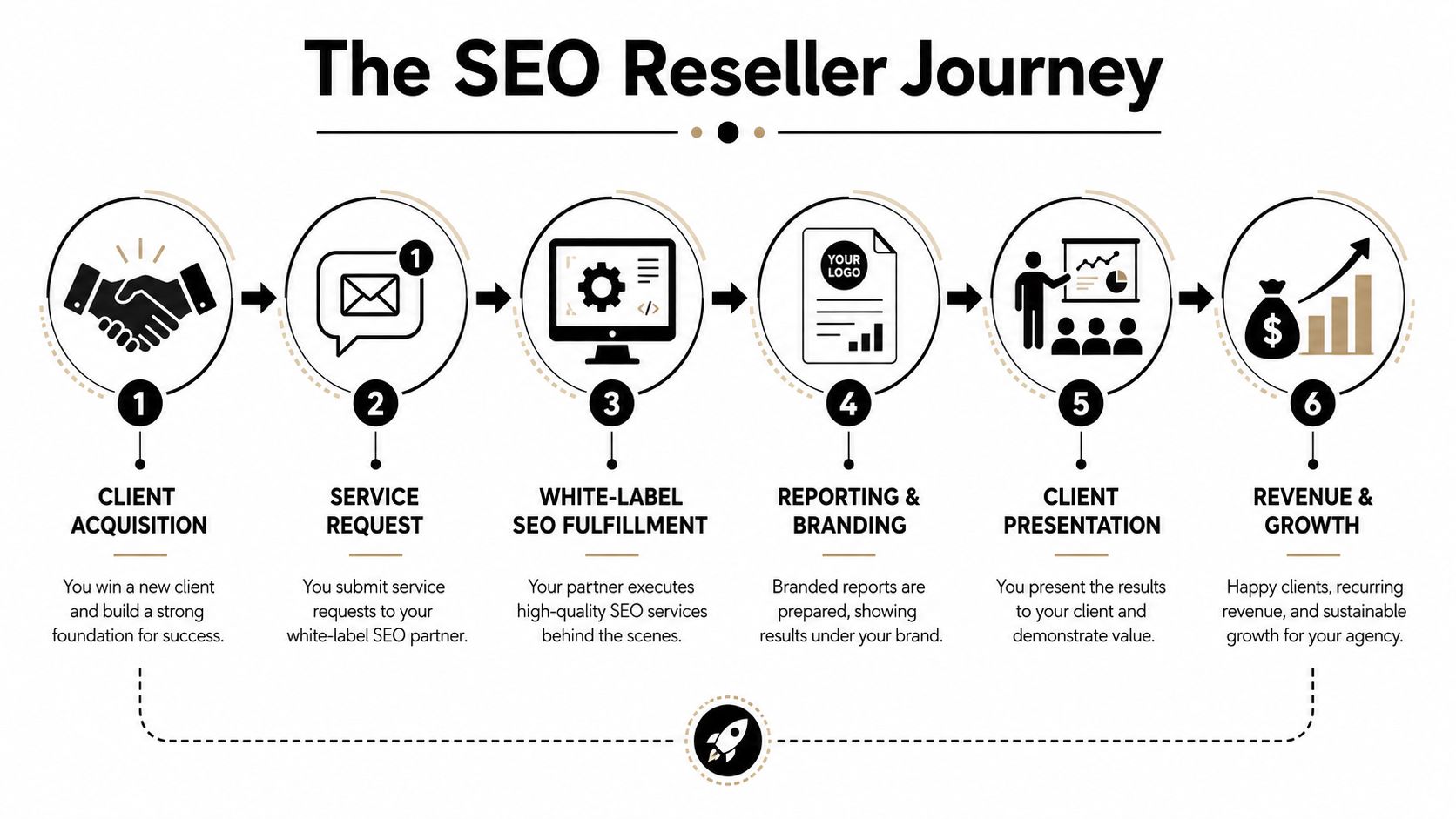
How the revenue model actually works
This model is attractive because SEO is usually sold as a retainer, not a one-time project. That means the financial logic depends on renewal, margin, and account stability more than one-off wins.
According to SEOreseller’s guide to SEO business metrics, agencies should track Customer Acquisition Cost, Customer Lifetime Value, Retention Rate and Churn Rate, and Monthly Recurring Revenue. The same source gives a straightforward example of MRR: 10 SEO clients paying $1,000 per month equals $10,000 in MRR.
A reseller model works well when you build around those recurring economics instead of treating SEO like a standalone campaign.
The metric most agencies underestimate
Retention matters more than most new resellers expect. The same SEOreseller guide states that a healthy SEO company aims for at least 80% annual retention. It also gives a concrete retention formula: if an agency starts with 105 clients, ends with 100, and acquired 10 during the period, retention is [(100-10)/105] x 100 = 85.7%.
That example matters because it shows where reseller businesses really win or lose. Rankings matter. So do leads. But if delivery is inconsistent, communication is slow, or reports are vague, churn rises and the model weakens fast.
Practical rule: Don’t evaluate an seo reseller offer only on wholesale price. Evaluate it on whether the fulfillment quality supports long-term retention.
What separates reselling from basic outsourcing
Plain outsourcing usually solves labor. White-label reselling solves packaging, brand control, and recurring delivery. That difference shows up in day-to-day operations:
-
The agency sells and scopes the service
-
The partner fulfills technical, content, local, or link work
-
The agency presents branded reporting and owns the account
-
The client renews based on outcomes and trust
When this is set up well, the agency becomes more valuable because it controls a recurring service line. When it’s set up poorly, the agency becomes a messenger for someone else’s mistakes.
The Strategic Benefits and Hidden Risks of Reselling
The upside of seo reseller services is obvious. You can say yes to more client demand without carrying the full cost of an internal SEO team. You also get access to specialists in technical SEO, content, local optimization, and reporting that many small agencies can’t justify hiring full time.
That flexibility is especially useful for agencies that already manage websites, PPC, or social media. SEO often fits naturally into those relationships because clients already expect one partner to coordinate digital growth.
Where the model creates leverage
An agency can use reselling to strengthen the business in several ways:
-
Broader account control: If you handle site work, ads, and SEO, clients have fewer reasons to fragment vendors.
-
Faster service expansion: You can launch SEO without waiting on recruiting, onboarding, and process design.
-
Recurring revenue profile: Retainer services are generally easier to forecast than project work.
-
Cross-sell potential: Existing clients are often easier to convert than entirely new logos.
There’s also a less discussed benefit. SEO reselling can improve client retention outside SEO itself. Once you’re tied into search visibility, content updates, local presence, and reporting, your role in the account becomes harder to replace.
Where agencies get hurt
The risk side is operational, not theoretical. Marketers Center’s discussion of SEO reseller programs points to a problem many agencies discover too late: weak quality control and poor communication can damage retention directly, turning the model from a margin play into a trust liability.
That’s exactly what happens in real accounts. The client doesn’t care that a backend vendor missed a deliverable, built weak links, published thin content, or let citations drift. The client blames the agency whose logo is on the report.
Three failure patterns show up often:
-
Invisible fulfillment problems: Work looks acceptable on a report but doesn’t hold up under review.
-
Communication lag: Questions sit too long, which makes the agency sound unprepared.
-
Brand inconsistency: Deliverables feel generic or disconnected from the client’s market and tone.
Poor reseller fulfillment rarely fails loudly at first. It usually shows up as slower progress, awkward client calls, and rising churn a few months later.
Margins can also get squeezed if the agency underprices SEO just to get traction. That creates another problem. When the account needs more strategy, more QA, or more client communication, the agency is doing high-touch work on a thin spread.
How to Choose a White-Label SEO Partner
A white-label SEO partner becomes part of your delivery team the moment a client signs. Treat the selection process like an operational risk decision, not a vendor shopping exercise. If the partner misses strategy, QA, or communication, your agency absorbs the fallout.
Branding and dashboard control
Client experience matters because SEO now has to be explained more often than it has to be “shown.” In a search environment shaped by AI Overviews and zero-click behavior, clients need reporting that ties visibility to business outcomes, not a confusing vendor portal with your logo pasted on top.
The white-label setup should include branded reports, a client-safe dashboard, and permission controls that match how your team works. Agency Platform is one example of a system built for that agency-reseller model. Its guide on choosing the right white-label SEO partner is useful because it focuses on fit, workflows, and accountability rather than feature lists alone.
Ask a simple question during evaluation: if a client logs in today, does the experience strengthen your agency brand or expose the reseller behind it?
Fulfillment quality and technical depth
Surface-level fulfillment is expensive. It looks acceptable in month one and creates retention problems in month four.
Ask the partner to walk through a real audit, a real roadmap, and a real monthly deliverable. Review how they handle crawlability, XML sitemaps, robots.txt, internal linking, schema, mobile usability, HTTPS, Core Web Vitals, and implementation QA. Then go one level deeper. Ask how they prioritize fixes when development resources are limited, what gets deferred, and how they explain those trade-offs to an account manager who is not technical.
Proof-of-work matters more than sales language. A sample deliverable should show issue severity, expected impact, implementation notes, and what was verified after deployment.
Reporting that proves business impact
Weak reseller programs still show their age in these areas. Rank trackers and traffic charts are not enough, especially for clients asking why clicks are flat while branded visibility seems stronger.
Search Engine People’s white-label SEO guidance points to a better reporting model: combine Google Search Console impressions and clicks, GA4 organic conversions such as forms and calls, and backlink authority progression. That framework is more useful because it reflects how search performance works now. An account can gain more search presence, appear in more high-intent queries, and improve lead quality even when raw click growth is uneven.
A strong reporting stack should help your team answer four practical questions:
-
Is the client gaining visibility on commercially relevant searches, not just broad informational terms
-
Are organic landing pages producing qualified actions such as calls, forms, booked consultations, or purchases
-
Is technical health improving alongside authority and content performance
-
Can the account team explain value when AI-generated answers reduce clicks but increase brand exposure
That last point matters. If your reseller cannot help you report on impression share, branded demand, assisted conversions, and lead quality, they are still selling an older version of SEO.
Governance and communication standards
The contract matters less than the operating cadence. Agencies usually lose trust through slow responses, vague ownership, and unclear revisions.
Set the rules before onboarding the first client. Define response times, meeting cadence, escalation paths, revision limits, implementation responsibilities, and who speaks on strategy. If the partner joins client calls, decide that upfront. If they stay invisible, make sure your team gets enough context to speak confidently without chasing answers for two days.
Use this review table during partner selection:
| Review area | What to verify |
|---|---|
| Communication | Named contacts, response times, escalation path, meeting cadence |
| QA | Who reviews content, links, local listings, and technical outputs before delivery |
| Transparency | Task logs, proof-of-work, implementation evidence, and access to campaign notes |
| Strategy | How priorities are set, adjusted, and explained when results or search behavior shifts |
| Flexibility | Ability to support local SEO, content, and technical work by client type |
Good reseller relationships run on process visibility. If the partner cannot show you how work is planned, reviewed, and defended in a client conversation, keep looking.
Your Go-to-Market Launch Checklist
A reseller launch usually fails before fulfillment does. It fails in packaging, sales language, onboarding, and reporting expectations that were never tightened before the first proposal went out.
Build the offer before you sell it
Start by turning SEO from a vague service line into a defined offer. That means choosing what you will sell, who it fits, what gets delivered each month, and what early progress should look like. If those decisions stay fuzzy, sales will overpromise and fulfillment will spend the first 60 days correcting expectations.
Your initial launch needs:
-
Clear package scope: Local SEO, technical SEO, content support, link acquisition, or blended plans
-
Sales positioning: What problem each package solves and for whom
-
Onboarding inputs: Access, goals, target locations, priority services, existing analytics setup
-
Client-safe deliverables: What the client sees each month and how it’s explained
Package design matters more now because traffic alone is a weaker proof point. Agencies need offers that can be sold and defended around visibility, qualified lead impact, and search presence across more than ten blue links.
Train the team on what’s actually being sold
Sales and account managers need more than a price sheet. They need a working explanation of the service, its limits, the likely timeline, and the metrics that matter when AI summaries and zero-click behavior reduce visible traffic gains.
That training should include technical basics. Teams do not need to perform the work themselves, but they do need enough fluency to explain why crawlability, XML sitemaps, structured data, mobile usability, Core Web Vitals, and INP affect performance, implementation priority, and reporting. Agencies that want a better read on how AI is changing search behavior can use this analysis of AI-driven search trend prediction and SEO strategy shifts to sharpen how they position results.
Launch with one internal definition of success. If sales promises one outcome, fulfillment works toward another, and account managers report a third, churn shows up fast.
Start with controlled accounts
Begin with a pilot group. Choose clients where communication is strong, approvals are realistic, and the account team already has trust. A messy client is a poor test case because it hides whether the offer or the rollout is the actual problem.
A practical sequence works well:
-
Pick a pilot set of clients that already need SEO support.
-
Run discovery properly so the partner has strong inputs.
-
Review the first deliverables internally before anything reaches the client.
-
Refine the reporting language based on client questions.
-
Standardize the process only after the first accounts feel smooth.
One more operational check is worth adding. Decide who owns implementation follow-up. Many reseller programs look fine on paper, then stall because recommendations sit in email threads for weeks and no one inside the agency is accountable for getting changes live. That delay hurts timelines, reporting credibility, and client trust.
A disciplined rollout gives you cleaner case studies, tighter sales scripts, and fewer preventable fires in the first quarter.
Proving SEO Value in the Age of AI Overviews
A lot of seo reseller reporting still assumes the old pitch: rankings rise, traffic rises, everyone’s happy. That assumption breaks down when search results answer more questions directly and fewer clicks reach the site.
The wrong response is to defend traffic harder. The better response is to change the proof model.
What to report when clicks don’t tell the full story
LinkGraph’s SEO reseller guide highlights a gap most reseller content misses: agencies need ways to show value through branded search lift, SERP feature ownership, and assisted conversions when AI Overviews and zero-click behavior reduce visible traffic gains.
That changes the client conversation. Instead of asking only, “Did sessions go up?” ask:
-
Is the brand appearing more often across search features
-
Are more high-intent queries being covered
-
Are leads from organic search improving in quality
-
Is SEO assisting conversions that close through another channel
For agencies adapting to AI-shaped search, Agency Platform’s perspective on AI and search trend prediction is useful background for how reporting and strategy have to evolve together.
The KPI shift that keeps clients longer
Mature reseller programs stand apart here. They don’t oversell clicks. Instead, they demonstrate how technical health, content relevance, local visibility, and branded demand support the pipeline over time.
If your report can’t explain value when traffic is flat, your reporting model is obsolete.
In practice, stronger AI-era reporting usually combines search visibility, conversion data, and qualitative context. That gives clients a more accurate picture of progress than rank trackers alone ever could.
Sample SEO Packages and Pricing Models
Agencies should package seo reseller services around scope and business goals, not arbitrary deliverable bundles. The cleaner the packaging, the easier it is to sell, fulfill, and renew.
Because wholesale pricing varies by provider, market, and scope, it’s safer to model packages qualitatively unless your partner has given you exact rates.
| Package Tier | Core Services | Sample Wholesale Cost | Sample Retail Price | Profit Margin |
|---|---|---|---|---|
| Local SEO Starter | GBP support, local on-page work, citation management, basic reporting | Varies by provider | Set above wholesale based on account management load | Margin depends on markup and service time |
| Growth SEO | Technical audit, ongoing optimization, content support, reporting tied to conversions | Varies by provider | Higher than starter tier because strategy and reporting are broader | Margin improves when delivery is standardized |
| Competitive Authority | Advanced technical SEO, content program, link acquisition, multi-location or higher-competition work | Varies by provider | Premium pricing based on scope and client complexity | Margin depends on partner quality and retention |
The practical rule is simple. Price for fulfillment cost, account management time, reporting effort, and revision risk. If you only mark up the wholesale line item, you’ll underprice the actual work of running the account.
Conclusion The Future of Agency Growth
The seo reseller model works when an agency treats it as a business system, not a shortcut. The upside is clear: recurring revenue, broader client retention, and the ability to offer serious SEO without building a full in-house department first.
The hard part isn’t adding the service. It’s choosing a partner whose fulfillment, reporting, and communication protect your brand. That matters even more in AI-shaped search, where agencies have to prove value through visibility, conversion quality, and assisted impact, not traffic alone.
Agencies that win with reselling usually do three things well. They choose carefully, launch deliberately, and report in a way clients can understand. That’s what turns SEO from an outsourced task into a durable growth line.
If you’re evaluating whether an seo reseller model fits your agency, Agency Platform offers a white-label environment built for that exact decision: branded dashboards, fulfillment support, and reporting workflows that help agencies sell and manage SEO under their own name.