Dave Thompson October 23, 2026 10 Views
A client asks whether your agency can add local SEO to its web design or PPC retainer. Your team can sell the service, but you don’t have the specialists, production capacity, or reporting workflow to deliver it consistently. A white label SEO reseller model solves that gap by putting specialist fulfillment behind your brand, while your agency owns the client relationship, strategy, billing, and profit. The model works, but only when you measure contribution profit after account-management labor, revisions, reporting, and scope creep.
The Agency Growth Bottleneck and White-Label Solutions
A familiar conversation happens in growing agencies. A restaurant client is pleased with a new website and paid search results, then asks for help appearing in local organic results and Google Maps. Saying yes could deepen the account. Saying no sends the client to another provider. Hiring an SEO specialist may create fixed overhead before demand is reliable, while learning technical SEO internally takes time your delivery team doesn’t have.
A white-label SEO reseller program creates a third path. A specialist fulfillment partner handles research, technical work, content, authority development, and measurement. Your agency turns that production into a branded service, explains the strategy, and remains accountable to the client.

The commercial logic is strong because organic search has historically generated over 50% of all trackable website visits, more than social, direct, or referral channels, according to BrightEdge’s organic traffic research. That makes SEO more than an add-on. It’s a recurring acquisition service that can sit alongside web design, PPC, social media, and consulting.
Where the agency still creates value
Outsourcing execution doesn’t mean outsourcing the whole account. Your team should own:
-
Commercial positioning: Define the offer, target market, price, and contract terms.
-
Client context: Translate business priorities into an actionable brief.
-
Strategic judgment: Decide which opportunities matter commercially.
-
Relationship management: Lead calls, explain trade-offs, and protect trust.
-
Quality control: Review deliverables before the client sees them.
The provider supplies capacity and specialist execution. Your agency supplies context and accountability. That separation turns a one-time project relationship into an ongoing optimization engagement without requiring a full internal department.
Practical rule: Sell the outcome and the operating system, not a hidden labor arrangement. Clients should understand what will be done, how progress is measured, and who makes strategic decisions.
How White-Label SEO Fulfillment Actually Works
A reliable hand-off has four operational stages. First, your agency qualifies the opportunity and signs the client under its own brand. Next, you submit an intake brief containing goals, locations, services, competitors, access requirements, brand guidance, and known constraints. The fulfillment team then researches, prioritizes, produces, implements, and documents the work. Finally, your agency reviews branded outputs and presents them to the client.
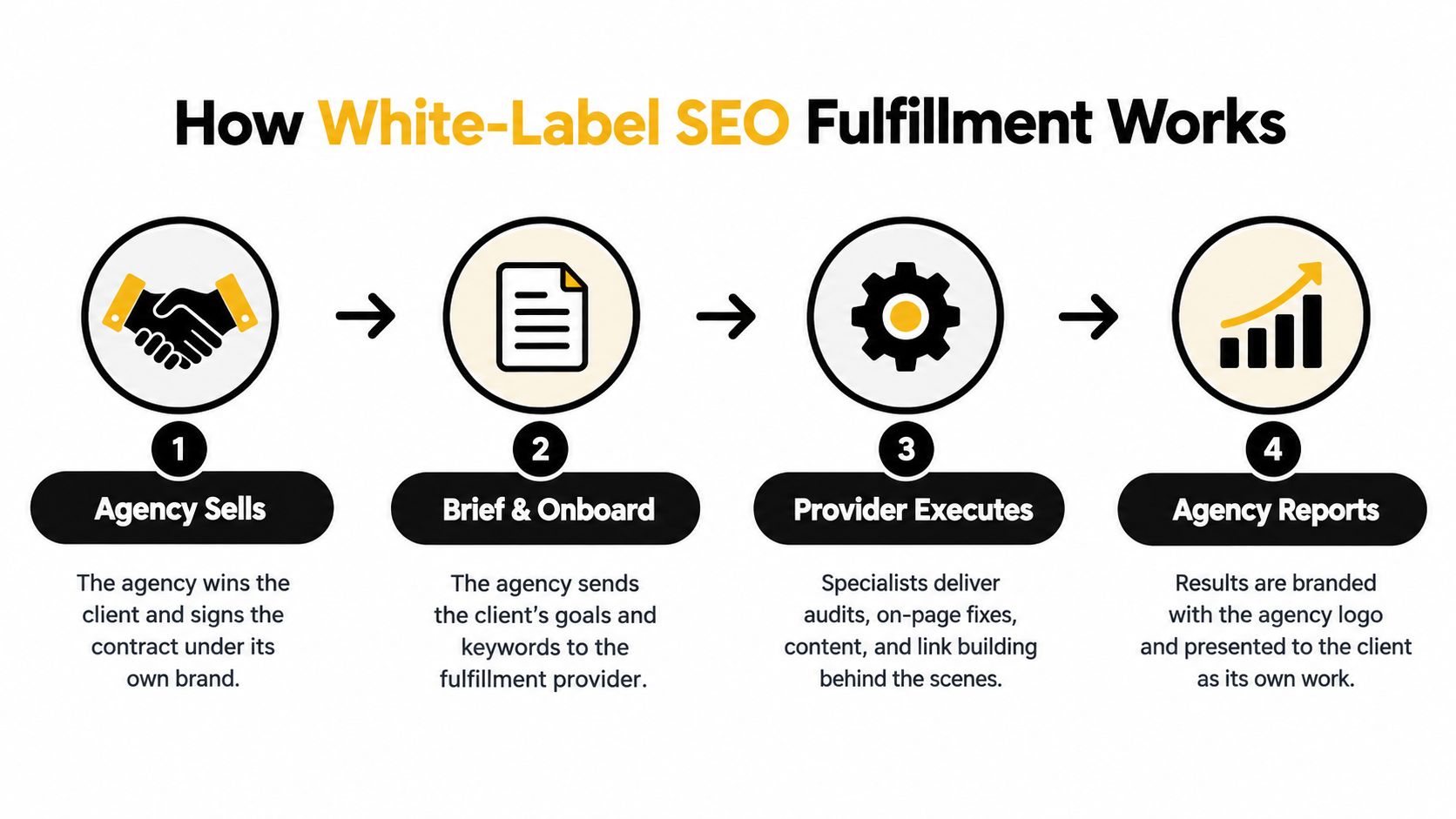
The workflow normally covers keyword research, technical audits, on-page optimization, content, local listings, link development, review support, and reporting. The exact scope depends on the package, but the hand-off must define ownership. If nobody knows who approves a title tag, supplies a service-area detail, or responds to a technical recommendation, the account becomes a revision queue.
Search visibility gives the model a measurable commercial basis. A synthesis of click-through-rate studies reports that the first organic result receives approximately 27.6% of clicks, while the top three receive about 54.4%, as summarized by Colorlib’s SEO statistics reference. Those figures aren’t guarantees, because intent, devices, brand familiarity, and search features affect behavior. They do show why ongoing optimization matters when a small movement changes a page’s opportunity to be discovered.
The control point is the brief
A weak intake form produces generic fulfillment. A strong one records:
-
Business objectives and conversion actions.
-
Priority locations and services.
-
Existing technical problems and access status.
-
Brand voice, compliance limits, and approval contacts.
-
Reporting expectations and definitions of success.
Your provider should return an audit trail, not just a polished PDF. For local accounts, that may include profile changes, citation corrections, location pages, review activity, and local content. For national accounts, it may include technical priorities, topic coverage, internal linking, and authority work.
The client shouldn’t need to know which specialist completed each task. They do need a coherent explanation of what changed, why it changed, and what happens next.
Choosing Between Software Dashboards and Turnkey Services
Software-only and turnkey fulfillment solve different problems. A dashboard gives your team visibility, data connections, workflow controls, and branded reporting. It doesn’t automatically provide the labor or judgment needed to interpret an audit, brief a writer, implement fixes, or manage client approvals.
Turnkey fulfillment acts more like a back office. Specialists execute the work, prepare deliverables, and often support strategy. Your agency retains control of the commercial relationship, but you trade some task-level control for capacity and reduced staffing pressure.
| Model | Best fit | Main advantage | Main risk |
|---|---|---|---|
| Software-only dashboard | Agencies with in-house SEO operators | Direct control over execution | Internal labor remains substantial |
| Turnkey fulfillment | Agencies adding SEO without hiring specialists | Production capacity and repeatable delivery | Provider quality and communication require close vetting |
| Hybrid model | Agencies with strategists but limited production | Flexible division of labor | Ownership can become unclear |
A local SEO platform can help centralize profiles, rankings, tasks, and reporting, but the interface isn’t the strategy. Agencies comparing dashboard options can review the white label SEO dashboard model alongside tools such as LocalHQ’s local SEO platform, then test whether each workflow matches their staffing reality.
How margin and control move together
Software often appears cheaper because you perform more of the labor yourself. Turnkey services may carry a higher wholesale cost, but they can reduce specialist hiring, supervision, and production bottlenecks. The correct comparison isn’t the subscription fee. It’s the loaded cost of delivery, including internal hours, revisions, quality assurance, and client communication.
A hybrid arrangement can work well when your agency owns strategy and client-facing analysis while the provider handles repetitive production. It fails when both teams edit the same assets, issue conflicting instructions, or assume the other team is responsible for implementation.
Key Criteria for Selecting a White-Label Partner
Choose a fulfillment partner as if you were hiring a senior SEO lead. Pricing matters, but it shouldn’t be the first filter. Start by asking how the provider researches, prioritizes, executes, validates, and reports work for the type of clients you sell.
Audit the delivery system
Request a sample workflow, not just a sample report. You want to see how a technical issue moves from discovery to recommendation, approval, implementation, and verification. Google’s SEO getting-started guidance emphasizes accessible crawling resources, sensible robots.txt use, XML sitemaps, and validation of structured data. A credible partner should show how those checks enter its process.
For local SEO, confirm that the team works with the mechanisms Google identifies as relevance, distance, and prominence, including complete Business Profile information, appropriate categories, legitimate reviews, and authority signals. Google explains these factors in its local ranking guidance. Avoid anyone promising guaranteed map-pack positions.
Test communication before signing
Ask who answers an urgent technical question, how feedback is recorded, and what happens when a client changes direction. A generic ticket queue may be adequate for routine requests, but complex accounts need an accountable strategist who can explain trade-offs.
Use a pilot or controlled internal project to assess:
-
Brief interpretation: Does the team ask useful questions?
-
Technical judgment: Are recommendations prioritized by impact and feasibility?
-
Content quality: Does the work match the client’s expertise and voice?
-
Revision discipline: Does feedback reduce recurring errors?
-
Reporting clarity: Can a business owner understand the commercial meaning?
Your partner should also document access, approvals, escalation, and brand rules. For a broader evaluation framework, Agency Platform’s guide to choosing the right white-label SEO partner is a useful checklist to place beside your own scorecard.
The Profitability Paradox and Margin Strategies
The most dangerous white-label SEO mistake is confusing gross margin with contribution profit. An agency may subtract the provider fee from the retail retainer, see a healthy gross margin, and assume the account works. That calculation ignores onboarding, client calls, report preparation, provider follow-up, revisions, payment processing, tool allocation, and out-of-scope requests.
Industry coverage commonly discusses 40% to 60% gross margins, but the analysis of white-label SEO profitability warns that account-management labor and scope creep can erode the actual contribution. Treat those ranges as broad pricing context, not as proof that an account is profitable.

Use a loaded-cost calculator
A practical model separates four lines:
Retail revenue
Minus provider fulfillment fees, tools, payment costs, and direct production expenses.
Gross contribution
Minus account-manager hours multiplied by your loaded hourly cost.
Operating contribution
Minus revisions, reporting time, sales support, onboarding, and scope-related work.
Client contribution profit
The amount left after the account consumes its real operating resources.
For example, don’t ask only whether a retainer exceeds the wholesale fee. Ask how many hours the account manager spends preparing calls, translating provider recommendations, checking reports, and handling revisions. Then model what happens if those hours rise, if the client requests extra pages, or if onboarding takes longer than expected.
High markup doesn’t rescue a low-value account that demands high-touch service.
Set a minimum viable retainer by segment. A small local business may need a tightly bounded package with controlled communication. A national or multilingual account may justify more strategic labor and a higher price. Review contribution at onboarding, after the early delivery period, and later in the client relationship, because service intensity and churn risk change over time.
Building Standardized Service Packages and Reporting
Standardization protects both quality and profit. Build packages around client problems, not an unstructured inventory of tasks. A local foundation package might combine Business Profile work, technical cleanup, location relevance, citation consistency, and reporting. A growth package can add content planning, review processes, local authority development, and deeper strategic analysis.
Each package needs four definitions:
-
Included work, written in operational terms.
-
Approval boundaries, including what the client must provide.
-
Success measures, connected to visibility, traffic, leads, or calls.
-
Out-of-scope pricing, for redesigns, new locations, urgent campaigns, or extra revisions.
Reporting should explain movement rather than dump exports into a branded template. Google Search Console centers organic performance on clicks, impressions, CTR, and position, with CTR calculated as clicks divided by impressions. Its Search Console performance documentation also explains why property-level and page-level grouping can produce different totals.
Build a diagnostic report
A useful monthly report answers three questions:
-
Did exposure change?
-
Did searchers respond to that exposure?
-
Did the resulting visits or leads support the business goal?
Segment the data by query, page, country, device, date, and search appearance where relevant. Preserve the grouping method across reporting periods, then pair KPI movement with completed work and next actions.
For tool evaluation, a curated guide to the top SEO reporting software for agencies can help you compare dashboards. The tool is secondary to the operating discipline. Your account manager should know which number changed, why it changed, and whether the client can act on it.
Managing Client Expectations and Avoiding Pitfalls
More clients don’t automatically produce more revenue. Every new account consumes onboarding time, review capacity, communication bandwidth, and escalation attention. If your team accepts low-retainer accounts with frequent calls and custom requests, growth can increase workload faster than contribution profit.
SEO also isn’t an instant-results service. Explain that rankings, impressions, clicks, and leads can move at different speeds, and that technical fixes, content, authority, and competitive conditions affect the timeline. Don’t promise a position you can’t control. Google states that businesses can’t pay for or request better organic local rankings, so report the work and the evidence rather than guaranteeing map visibility.
Scope control protects the relationship. Put revision limits, approval responsibilities, website changes, new locations, and urgent requests in writing. A client who repeatedly expands the brief isn’t necessarily difficult, but the account needs a commercial reset when the work no longer matches the retainer.
Use a consistent monthly communication rhythm, even when rankings are volatile. Show completed actions, unresolved dependencies, meaningful metric changes, and the next decision required from the client. For local reputation, don’t track only one review platform. BrightLocal’s survey of 1,026 U.S. adults found that 27% use only one website when reading local-business reviews, while 48% turn to local news outlets for those reviews, as reported in the 2025 Local Consumer Review Survey. Platform distribution matters.
Agency Platform combines a brandable client dashboard with turnkey local and national SEO fulfillment, content, link building, paid campaigns, social media, and web design support. If you need to add SEO without building an internal fulfillment team, visit Agency Platform to review the reseller workflow and assess whether its reporting and delivery model fits your agency.