Dave Thompson July 20, 2026 574 Views
A white label SEO platform lets an agency sell SEO under its own brand without building the full delivery team in-house. In 2024 case studies, agencies using white-label platforms saw client organic traffic grow by 58% to 64% year over year, and adds-to-cart from organic search rise by 120%.
That’s why this decision is bigger than software. When I look at agencies that stall, the problem usually isn’t demand. It’s fulfillment capacity, reporting chaos, and too much time spent stitching together audits, rank tracking, client updates, and technical fixes. A good white label SEO platform solves all three at once. It becomes the operating layer that protects margins while making delivery more consistent.
The Agency Growth Challenge in an AI-First World
Agencies have a wide-open market in front of them. 70% of marketers consider basic SEO more effective than paid campaigns, yet 59% of small-to-medium businesses say they struggle to implement it according to Swydo’s review of white-label SEO tools. That gap is where many agencies grow.
The catch is execution. Selling SEO is easier than delivering it at scale. Once an agency moves past a handful of clients, bottlenecks show up fast. Technical audits pile up. Local SEO tasks slip. Reporting becomes a monthly fire drill. Then the owner starts hiring reactively, which usually hurts margin before it helps capacity.
Why agencies hit the wall
A small team can survive on hustle. A larger team needs systems. In an AI-first search market, that system has to handle traditional SEO, local visibility, technical health, and emerging AI search visibility without turning account management into manual labor.
Agencies don’t usually lose profit on strategy. They lose it in delivery friction, rework, and reporting overhead.
That’s the practical value of a white label SEO platform. It gives the agency branded delivery infrastructure, client reporting, and operational support without requiring a full internal bench for every specialty.
What works and what doesn’t
What works is using a platform to standardize repeatable work while keeping strategy, sales, and client relationships close to the agency.
What doesn’t work is treating white label as a shortcut for weak process. If your agency can’t define deliverables, approval flow, or quality control, a platform won’t fix that. It will only expose the cracks faster.
Beyond Software What a White Label SEO Platform Really Is
Many users hear “platform” and think dashboard. That’s too narrow.
A white label SEO platform is closer to a business operating system. The dashboard matters, but the true value is the combination of branded client experience, fulfillment capacity, and automated communication. That combination lets an agency look larger and operate more cleanly than its headcount suggests.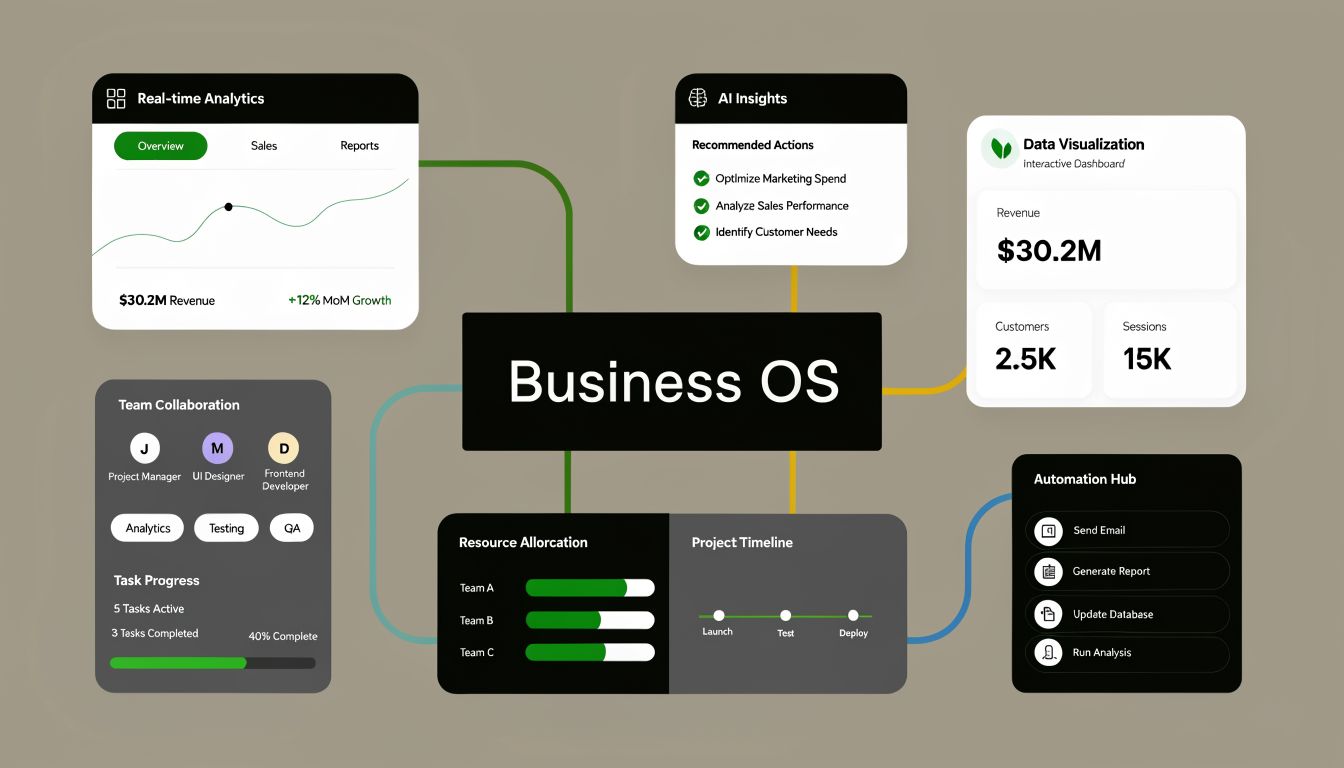
A useful way to think about it is a ghost kitchen. The restaurant owns the customer relationship and brand. The kitchen provides the systems and production environment that make consistent delivery possible. A white label SEO platform does the same for agencies.
The three parts that matter
First, the client-facing layer. Branding matters here. Custom domain, logo, email, and client portal access aren’t cosmetic. They shape how clients perceive professionalism and control. If clients log into a clean branded environment, they experience your agency as the operator, not a middleman.
Second, the fulfillment engine.
This is the part many buyers underestimate. SEO work isn’t one task. It spans local SEO, content, technical fixes, link acquisition, and reporting. A platform that can coordinate those pieces under one workflow reduces handoffs and cuts down on missed details.
Third, the communication layer.
Automated reporting, task visibility, and recurring updates keep accounts stable. Agencies lose trust when clients feel uninformed, not only when rankings fluctuate. A platform should make communication predictable.
For a broader framework on how these systems fit together, Agency Platform’s guide to a white-label digital marketing platform is a useful reference.
What agencies often get wrong
Many agencies buy tools one by one and call the stack a platform. It isn’t. It’s a patchwork.
That usually creates three problems:
-
Reporting drift because data lives in separate systems and gets translated differently by different team members
-
Onboarding friction because each new client needs custom setup across multiple tools
-
Margin leakage because your senior staff spends time coordinating software instead of leading strategy
A real white label SEO platform should reduce those problems, not create another layer on top of them.
The Business Case for Scaling with a White Label Partner
The strongest argument for white label isn’t convenience. It’s the advantage.
When fulfillment is stable, your internal team can focus on work that directly grows the agency: sales, retention, upsells, positioning, and client strategy. That shift changes the economics of the business. Instead of hiring every time demand rises, you add capacity through a partner and keep your internal structure leaner.
The performance proof clients care about
Results are the easiest part of the case to understand. According to Search to Sale’s white-label SEO dashboard case studies, organizations using white-label SEO dashboards saw Topic A organic traffic increase by 64%, Topic B organic traffic increase by 60%, and full target keyword list organic traffic rise by 58% compared with 11% growth for keywords not actively optimized. The same period showed adds-to-cart from organic search increase by 120%.
Those numbers matter because they tie SEO work to business outcomes, not just rankings. If you’re running an agency, that’s what improves retention. Clients stay when they can see movement in traffic quality and commercial activity.
Where the margin improvement actually comes from
A white label partner doesn’t automatically create profit. The margin improvement comes from where you reclaim time.
| Agency activity | In-house burden | White-label advantage |
|---|---|---|
| Technical delivery | Requires specialist bandwidth | Access to repeatable workflows |
| Reporting | Manual assembly across systems | Automated client-ready outputs |
| Capacity planning | Hiring lags demand | Fulfillment scales faster |
| Client communication | PM-heavy if data is fragmented | Centralized visibility |
The operational win is simple. Your account managers spend less time chasing updates, your strategist spends less time fixing production issues, and your owner spends less time hiring under pressure.
Practical rule: If your senior team is still assembling monthly reports by hand, your agency is carrying avoidable overhead.
Brand authority without building every department
There’s also a positioning benefit. A white label model lets a smaller agency present a broader service offering with more consistency. That matters when clients want one partner for local SEO, content, reporting, and technical visibility.
The mistake is overselling capacity you can’t govern. The agencies that use white label well still keep a clear review layer internally. They don’t outsource judgment. They outsource repeatable execution.
Must-Have Platform Features for the 2026 Search Landscape
Agencies do not lose margin on software fees alone. They lose it in the hours spent reconciling audits, reports, tickets, and client updates across disconnected systems. By 2026, a white label SEO platform has to reduce that operational drag while helping your team produce work that holds up under AI-assisted search and stronger E-E-A-T expectations.
A platform that only tracks rankings and exports PDFs creates more admin work than value. The right system gives account managers, strategists, and fulfillment teams one place to see technical issues, content priorities, AI search visibility, and client-facing outcomes.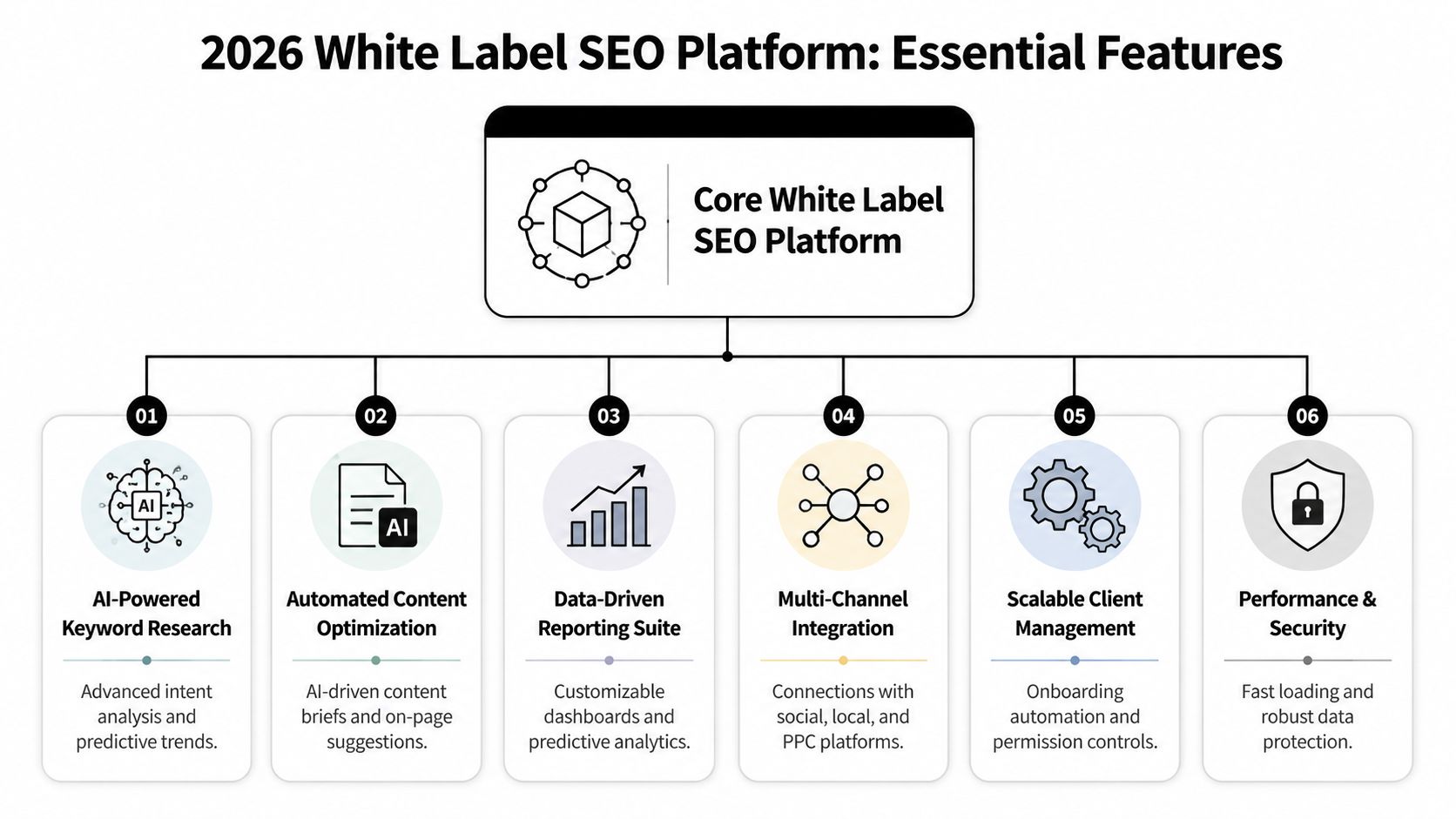
Technical audit depth is a critical requirement
According to ALM Corp’s analysis of white-label SEO for agencies, modern white-label audit tools need to analyze a wide range of technical factors, including Core Web Vitals, page speed, mobile usability, crawl errors, indexation, redirects, schema, canonical setup, sitemap health, and response codes.
That level of coverage matters because technical debt is expensive to ignore. A site can have solid content and still miss growth targets if pages are slow, duplicate URLs are getting indexed, or internal linking is weakening crawl paths. In agency operations, shallow audits create a second cost. Your team ends up buying another crawler, exporting another spreadsheet, and asking a strategist to translate findings manually.
The better platforms tie audit findings directly to execution. Issues should move into work queues, priority labels, and client-ready explanations without extra formatting work from your team.
AI visibility and E-E-A-T signals need to be visible in reporting
Clients have started asking a different question. They still care about rankings, but they also want to know whether their brand appears in AI-generated answers, product comparisons, and research summaries.
That means reporting has to expand beyond classic SERP positions. Agencies need visibility into how content is being surfaced, cited, or ignored across AI-assisted search experiences. They also need a way to connect that visibility back to the content and authority signals that influence it, such as expert-led pages, author attribution, entity consistency, supporting citations, and topical depth.
This is not just a feature request. It is a compliance issue. If a platform pushes scaled content production without quality controls, source tracking, or review workflows, it creates risk for the agency. In the AI search era, weak E-E-A-T signals can hurt discoverability and put client retention under pressure when results flatten.
What matters in day-to-day operations
A feature list matters less than the effect on delivery time, review load, and gross margin. These are the platform capabilities that change how an agency runs:
-
Brand controls: Custom domain, full logo replacement, branded reports, and clean client access
-
Role management: Separate permissions and views for leadership, account managers, fulfillment teams, and clients
-
Technical workflow automation: Audits that feed directly into task queues, QA steps, and implementation priorities
-
Cross-channel reporting: SEO data tied to leads, pipeline activity, conversions, and revenue signals
-
AI search tracking: Visibility monitoring across AI-assisted discovery, not only standard search results
-
Content governance: Review layers for authorship, source use, factual checks, and page-level quality standards
-
Workflow continuity: Reporting, fulfillment, communication, and status tracking in one operating environment
One practical option in this category is Agency Platform, which combines a brandable client dashboard with white-label fulfillment and multi-tool integration for agencies that want one operating layer instead of separate reporting and service systems.
The trade-off is straightforward. Platforms with broader coverage often require tighter onboarding and cleaner internal process ownership. That is still cheaper than running a fragmented stack where your staff becomes the integration layer by hand every month.
Comparing Fulfillment Models In-House vs Reselling
The in-house versus reseller decision isn’t ideological. It depends on the stage of the agency, the complexity of accounts, and how much operational drag the team can absorb.
An in-house team gives tighter control, but control is expensive if utilization is uneven. A reseller model gives flexibility, but only if the partner’s process is clear and your internal review standards are strong.
The trade-off table agencies should use
| Decision factor | In-house team | White-label reseller model |
|---|---|---|
| Control over process | Higher | Shared with partner |
| Hiring pressure | Ongoing | Lower |
| Specialized coverage | Depends on who you hire | Usually broader |
| Operational simplicity | Can become fragmented | Better if platform is unified |
| Scaling speed | Slower | Faster |
The hidden issue in the in-house path is tool sprawl. Most agencies don’t build one system. They assemble one. Audit tool here, reporting tool there, local SEO software somewhere else, project management in another place. The team then becomes the integration layer.
Operational drag is real, even when you can’t easily quantify it
The industry still lacks hard data on how many agencies run on five or more disconnected tools, how much staff time they lose consolidating exports, or the all-in labor cost of that fragmentation. That gap itself is revealing. Agencies often evaluate software by license price and ignore the labor cost of switching between platforms, normalizing metrics, and fixing inconsistent reports.
That’s where a unified white label SEO platform usually wins. Not because every feature is deeper than a specialist tool, but because the system cuts coordination overhead.
A fragmented stack can make a profitable service line look less profitable than it really is.
What I’d choose at different stages
For a very small agency with a narrow offer, in-house can work if the founder is still close to delivery.
For a growth-stage agency selling recurring SEO across local, national, and content-led accounts, reselling through a unified platform is often the cleaner move. It lets the team standardize operations before headcount expands too far.
For larger agencies, the strongest model is often hybrid. Keep strategy, client leadership, and QA internal. Push repeatable production into a white-label system that can scale without forcing a hiring sprint every quarter.
How to Evaluate and Choose Your White Label Partner
Most agencies compare pricing, dashboards, and turnaround times first. Those matter, but they aren’t the main risk.
The bigger risk is accountability. If your provider uses tactics that create compliance problems or weak content, your agency owns the client fallout. Your logo is on the report. Your team is in the meeting. That’s why provider evaluation has to include process transparency, documentation standards, and algorithm risk.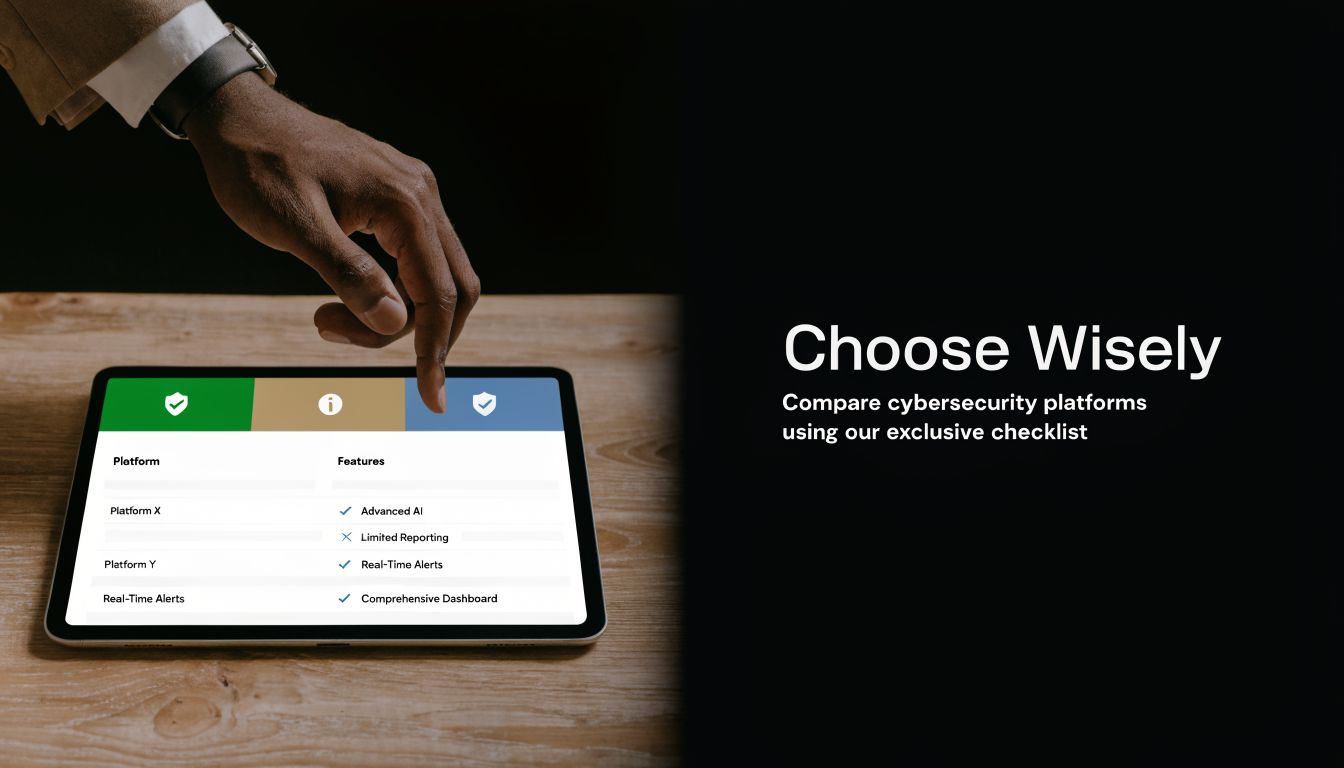
Ask harder questions than most agencies ask
Vulcan Point’s guide to white-label SEO companies highlights a critical point: agencies should ask how providers document E-E-A-T alignment and what contractual protections they offer around major Google updates, because the agency carries the reputational risk.
That means your evaluation process should include questions like:
-
How is work documented? Content, links, technical changes, and approvals should leave a trace.
-
What happens after an algorithm shift? You want response process, not hand-waving.
-
Who owns remediation? If a tactic creates a problem, the answer can’t be vague.
-
How visible is the workflow? Black-box fulfillment creates client risk.
Good signs and bad signs
Good signs
-
Clear deliverables and review checkpoints
-
Transparent communication with named contacts
-
White-label reporting that aligns with actual work completed
-
Flexible commercial terms that leave room for margin
Bad signs
-
Promises without process detail
-
“Proprietary” language used to avoid transparency
-
No documented QA path
-
Rigid agreements that make exits difficult
A more detailed checklist is in Agency Platform’s post on mistakes to avoid when choosing a white-label SEO provider.
If a provider can’t explain how they stay aligned with search quality standards, don’t trust them with your client relationships.
Pricing should be judged by margin fit, not sticker shock
Low pricing can hide expensive cleanup. Higher pricing can still be profitable if delivery is consistent and account management effort drops. The right question is whether the model supports healthy resale margin after revision cycles, reporting time, and client communication are factored in.
Demonstrating SEO Value with Client-Centric Reporting
Agencies lose accounts when reporting fails to connect SEO work to revenue, retention, and risk reduction. A polished dashboard does not fix that. Clear reporting does.
Clients need to see three things every month. What changed. What caused it. What the result means for the business. If that chain is missing, reporting becomes admin work your team dreads and clients question.
What to show instead of vanity metrics
Good reports tie SEO activity to commercial priorities. That usually means a tighter set of metrics, explained well:
-
Search visibility by service line or location: Show whether the pages tied to revenue are gaining ground
-
Traffic quality: Separate qualified organic visits from raw session growth
-
Local search performance: Track map pack presence, profile accuracy, and location-level visibility where local intent matters
-
Lead and sales signals: Form fills, calls, booked consultations, pipeline assists, or purchases when tracking is in place
-
Technical progress: Document issues found, fixes completed, and constraints still blocking growth
The explanation matters as much as the metric. If visibility improved because title tags were rewritten, internal links were cleaned up, and weak pages were consolidated, say that plainly. Clients stay longer when they can follow the cause-and-effect.
This also protects margin. When reporting is vague, account managers spend extra time defending the work. When reporting is specific, review calls get shorter, renewals get easier, and pricing conversations get more grounded.
AI search has added another reporting layer. Clients now ask whether their brand shows up in AI-driven discovery, not just in traditional results. As noted earlier, some platforms have started tracking visibility across AI answer engines. That matters, but only if the report ties those impressions back to business goals and content quality standards such as E-E-A-T. Otherwise it is just a new vanity chart.
The stronger approach is to pair visibility reporting with proof of execution. Show what content was published, what entities or topics were strengthened, what citations or links were earned, and what technical updates improved crawlability or trust signals. In the AI search era, that audit trail matters. It helps clients understand performance shifts, and it gives your agency a defensible record when algorithms change.
Strong reporting answers two questions every month: what changed, and why should the client care?
A white label SEO platform should reduce reporting labor, not hide the work behind charts. Branded dashboards, task-to-outcome mapping, and client-ready summaries are useful if they help your team explain performance without rebuilding the story from scratch.
If you want a white label SEO setup that combines branded dashboards, reporting, and fulfillment in one system, Agency Platform is worth reviewing. It fits agencies that want to scale recurring SEO without building every operational layer in-house.