Dave Thompson August 31, 2026 388 Views
Nearly half of Google searches carry local intent, which is why google maps seo near me work keeps showing up as one of the highest-margin service lines for agencies that can execute it consistently. The map pack often captures the first real buying click, especially on searches like “plumber near me” or “med spa near me,” where the prospect wants a nearby provider fast and has little patience for weak profiles or mixed signals.
For an agency, this is operational work as much as SEO work. Strong local visibility comes from getting the core setup right, standardizing the signals that matter across every client location, and reporting performance in a way clients can understand and renew against. That matters even more when you are managing local SEO at scale or fulfilling it through a white-label process such as Agency Platform.
Maps rankings only matter if they turn into booked jobs.
For home service clients, lead handling often decides the outcome after the click. If you’re pairing local SEO with lead response, this guide on outbound calling for home service leads is worth reviewing because speed to contact often determines whether that local search turns into revenue.
Why “Near Me” SEO is Your Agency’s Biggest Opportunity
A large share of local searches happens when the buyer is ready to choose, not browse. That is why “near me” SEO produces some of the clearest revenue attribution an agency can deliver. The click often comes from a prospect who needs a nearby provider now, compares only a few options, and contacts the business that looks credible fastest.
For agencies, that creates a strong service opportunity because the work is repeatable. The ranking inputs are clear. Google evaluates local visibility through relevance, distance, and prominence, and each one maps to tasks an account team can standardize across locations. Agencies lose margin when consultants treat local SEO like a collection of hacks instead of a production process.
What agencies actually control
-
Relevance: The business profile, service pages, and categories need to match the terms the client wants to rank for.
-
Distance: The target area has to align with the verified location or legitimate service area. Agencies cannot manufacture proximity, so market selection and client expectations matter.
-
Prominence: The business needs signals that show it is established locally, including reviews, citations, links, brand mentions, and steady engagement.
The trade-off is simple. Relevance and prominence can be improved through execution. Distance usually cannot. Good consultants explain that early, then build the campaign around the locations and services that can produce wins.
This is also where agency operations matter. A solo consultant can fix one profile by hand. An agency managing 20 or 200 locations needs checklists, QA, reporting, and a consistent fulfillment method. Teams that use a documented Google My Business page optimization workflow usually spot problems faster, train new specialists faster, and protect margins better.
One warning for home service accounts. Ranking in the map pack does not guarantee revenue if lead response is slow. If you’re pairing local SEO with lead response, this guide on outbound calling for home service leads is worth reviewing because speed-to-contact often decides whether that local lead turns into booked work.
Master the Google Business Profile Foundation
Businesses in the local 3-pack get 126% more traffic and 93% more actions than businesses ranked in positions 4 through 10 (SOCi local SEO statistics). For an agency, that makes Google Business Profile setup one of the fastest ways to change client outcomes without waiting months for broader SEO gains.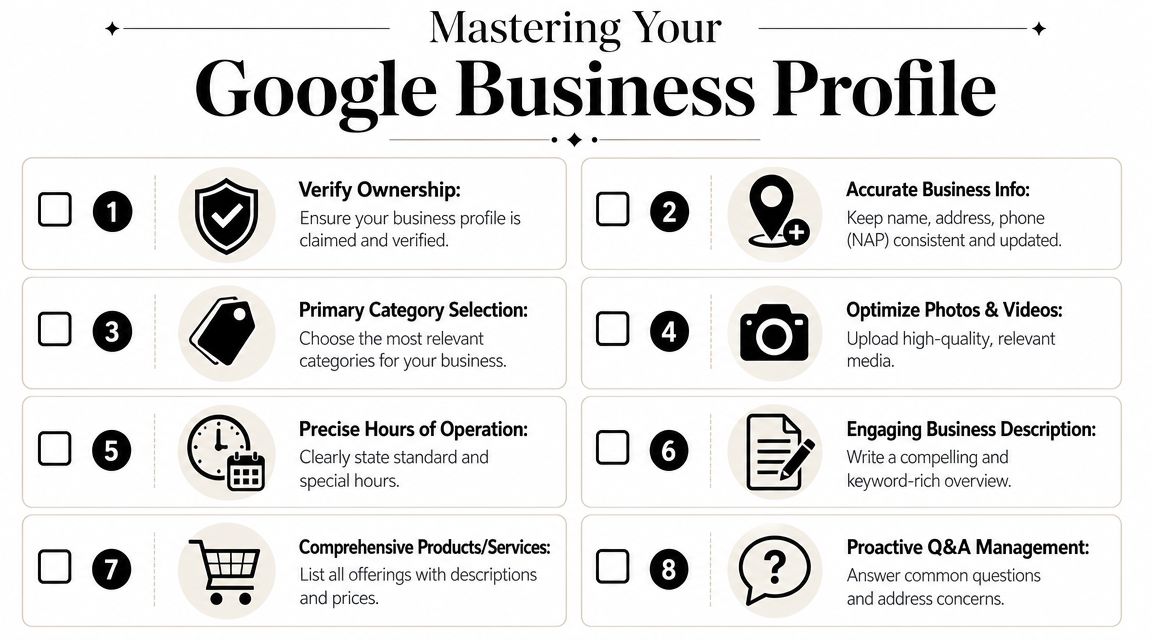
Poor map performance usually starts with preventable profile issues. The profile is incomplete, the primary category is too broad, the service area is set badly, or the business information conflicts with what Google finds elsewhere. Agencies that want repeatable wins need a fixed intake and QA process, not one-off profile edits done from memory.
The order matters. Verify the profile, choose the primary category based on the main revenue-driving service, add only secondary categories that reflect real offerings, confirm the map pin, and complete every customer-facing field. Then review the profile against the client’s website and existing business data. A documented Google My Business page optimization workflow helps teams catch these issues before they turn into ranking stalls or support tickets.
The fields that move the needle
Category selection carries more weight than many new consultants expect. A weak primary category can hold back a strong business, while an accurate one sharpens relevance for the searches that bring leads.
Use this standard in fulfillment:
-
Primary category: Match the client’s core service and main conversion goal.
-
Secondary categories: Add only real supporting services. Extra categories create noise.
-
Business description: Explain services, geography, and differentiators in plain language.
-
Hours, phone, address, verification: Complete and accurate fields improve trust and reduce avoidable friction for customers.
-
Photos and videos: Add current, real-world media that shows the location, staff, vehicles, products, or completed work.
Photos deserve more attention than they usually get. They affect click behavior, trust, and conversion quality. In agency work, I treat weak media as both a ranking issue and a sales issue, because a profile that looks abandoned gets fewer actions even when it does rank.
Why agencies should fix GBP before chasing harder wins
This work is not glamorous, but it scales well. Junior specialists can follow a checklist, senior reviewers can spot category or policy mistakes quickly, and account managers get a cleaner story to report to clients.
A complete profile is the starting line. If the foundation is wrong, every later task takes longer to troubleshoot and produces less lift.
Amplify Prominence with Website and Citation Signals
Map rankings get unstable fast when Google sees conflicting business details across the web. In agency fulfillment, this is one of the highest-return cleanup tasks because small inconsistencies can suppress visibility, waste reporting cycles, and make results harder to defend to clients.
Google does not evaluate a Google Business Profile by itself. It checks the profile against the client’s website, major directory listings, and other references to the business. If the address format changes from one source to another, if an old tracking number still appears on citations, or if a closed location is still indexed, trust drops and troubleshooting gets messy.
The operational standard is simple. Keep the Name, Address, and Phone number consistent on the GBP, the website, and priority citations. In practice, the errors that create the biggest drag are usually boring ones: suite numbers written three different ways, franchise naming differences, duplicate listings, and disconnected call tracking setups.
For agencies, this work scales well because it can be systemized. Build a citation audit template, define approved NAP formatting, and assign cleanup by listing authority instead of trying to fix everything at once. Clients rarely notice this work directly, but they notice the outcome when rankings stabilize and lead quality improves.
Location pages that help
For “near me” searches, location pages need to support real service coverage and real buying intent. A page should explain why the business is relevant in that area, what services are offered there, and what a searcher should do next. Swapping city names into the same template creates thin pages that are hard to rank and even harder to justify in client reporting.
Use this decision framework:
| Situation | Better move |
|---|---|
| Same competitors rank across nearby towns | Use one stronger regional page |
| Distinct search behavior by area | Build separate pages |
| Team can’t realistically serve the area | Don’t target it |
Agency discipline matters significantly. A client may want twenty city pages because a competitor has them. If the business cannot serve those areas quickly, if proof is thin, or if the pages would be near-duplicates, the better choice is fewer pages with stronger local proof. That usually means unique service details, area-specific testimonials, project examples, embedded maps, and conversion elements tied to the location.
That approach is easier to scale profitably too. Teams can reuse a page framework, keep quality control tight, and report on page-level performance without defending weak assets that never had a real chance to rank.
Drive Engagement with Reviews and Local Links
Static optimization gets a client into the game. Ongoing engagement is what keeps them there in competitive local markets.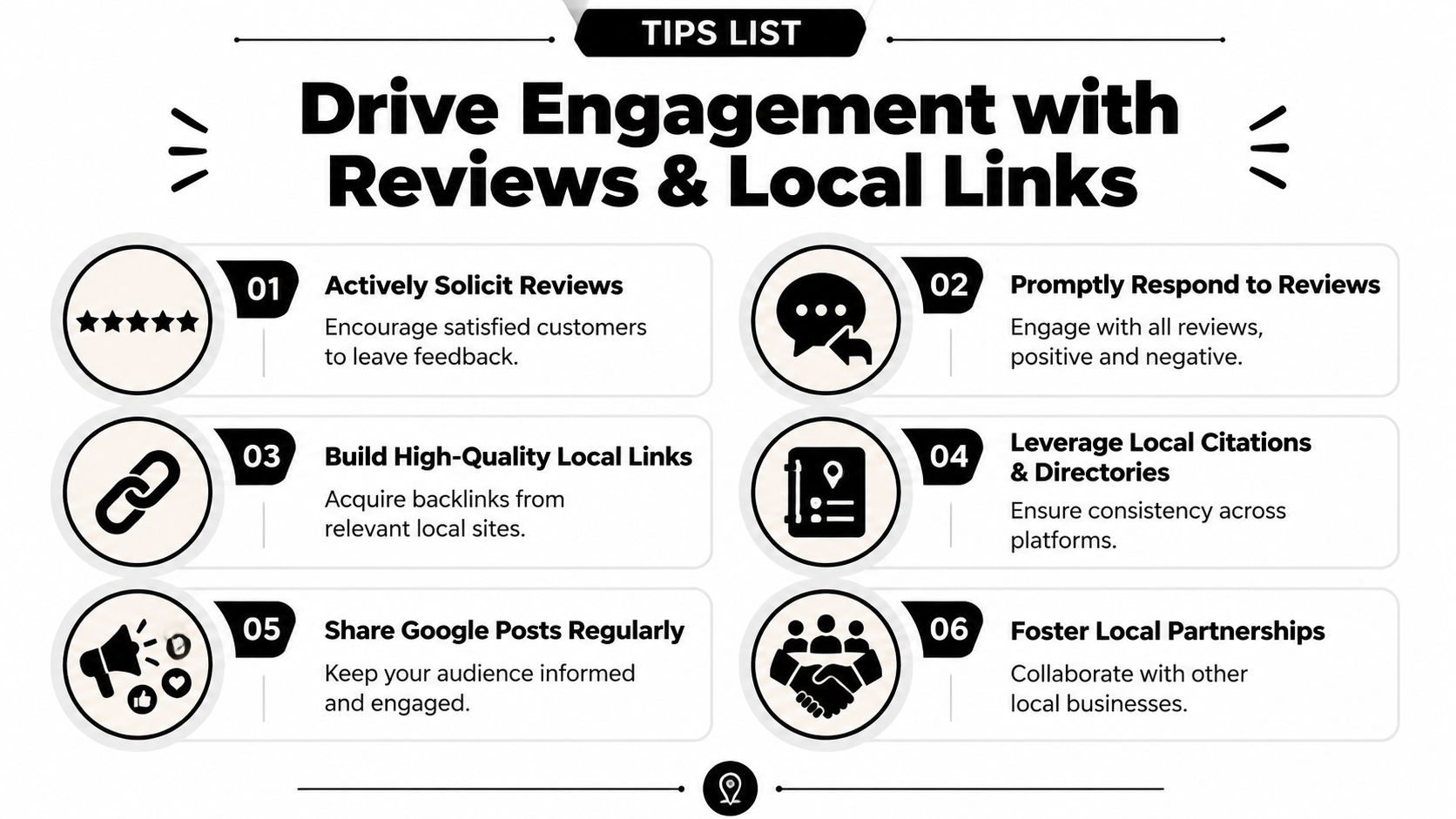
Recent analysis suggests Google may now reward review recency and review content, with stronger ranking correlations for businesses receiving descriptive text reviews within the last month than for businesses leaning on older star-only ratings (recent local review analysis summary). That matches what many consultants see in practice. A profile with steady, specific feedback tends to look healthier than one with a large but aging review base.
What agencies should operationalize
-
Review requests tied to real jobs: Ask after the service is complete, not weeks later.
-
Text over stars only: Encourage customers to mention the service experience naturally.
-
Responses as routine: Google explicitly recommends responding to reviews.
-
Fresh media uploads: New photos and videos support an active profile.
If a client already has plenty of reviews, the next lever usually isn’t “get more at any cost.” It’s consistency, detail, and freshness.
Local links still matter too, but not the spammy kind. The best ones usually come from sponsorships, chambers, neighborhood organizations, local partnerships, and community coverage that a real business would earn anyway.
Track, Report, and Scale Your Local SEO Services
The hardest part of google maps seo near me work isn’t knowing what to do. It’s doing it consistently across multiple clients without drowning in audits, screenshots, and manual reports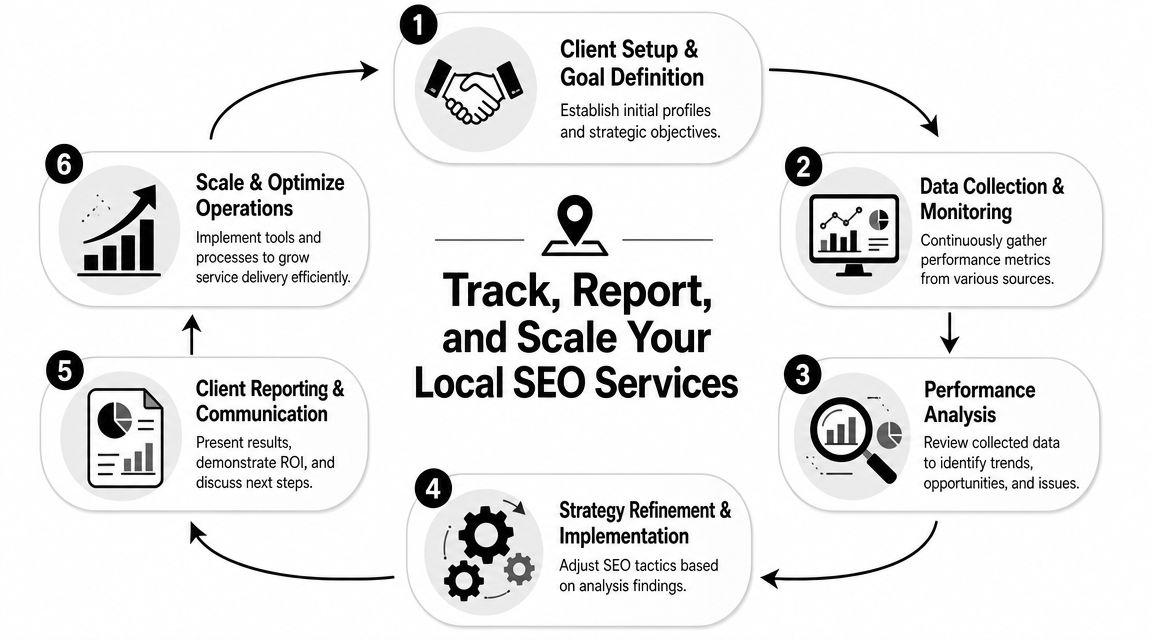
A solid agency workflow tracks map pack visibility, profile engagement, calls, clicks, direction requests, review activity, and website support pages by service area. Service-area businesses need extra discipline here. The safer approach is to define a realistic drivable radius and group nearby towns onto one stronger page when the same competitors rank across them, instead of publishing thin pages for every location (service-area local SEO guidance).
Where agencies lose margin
-
Manual reporting: It eats strategist time that should go into optimization.
-
Inconsistent SOPs: Different consultants make different category, citation, and page decisions.
-
No visibility for clients: If clients can’t see progress, retention gets harder.
That’s why agencies looking to productize local SEO usually need a clearer fulfillment system and reporting layer. A managed framework like Agency Platform’s local SEO services makes that easier to standardize across accounts without rebuilding the process every month.
If you want to scale local SEO without turning your team into a reporting department, Agency Platform gives agencies a white-label way to deliver fulfillment, reporting, and client visibility under their own brand. It’s a practical next step when you’ve proven the strategy and need cleaner execution at scale.