Dave Thompson July 14, 2026 944 Views
Selling SEO services starts with one shift. Stop selling SEO as a task list and start selling it as a revenue system. That matters more now because the SEO services market is projected to reach USD 148.86 billion by 2031, growing at a 12.12% CAGR, with SMEs holding 58.40% of market share in 2025 while enterprise demand grows faster at 16.10% CAGR according to Mordor Intelligence’s SEO market analysis. If you want to know how to sell seo services, build a repeatable system for positioning, packaging, fulfillment, reporting, and renewal.
Master Your Positioning Before You Pitch
Most agencies struggle to sell SEO because they sound interchangeable. They pitch audits, rankings, blog posts, and backlinks. Prospects hear the same language from every other shop.
That creates a race to the bottom. In a large market, generic agencies don’t just compete on quality. They get forced into price comparisons.
Pick a buyer, not a service menu
The fastest way to improve close rates is to narrow your sales story. Sell to a clear buyer with a clear pain point.
A local service business usually wants lead flow, phone calls, and map visibility. A B2B SaaS company wants qualified pipeline and non-branded demand. A multi-location brand wants governance, reporting, and location-level execution. Those aren’t the same sale, even if the channel is SEO.
Use a simple positioning filter:
-
Buyer type: local SMB, ecommerce brand, B2B SaaS, healthcare group, franchise, enterprise
-
Commercial outcome: leads, booked appointments, demos, revenue from non-branded search
-
Delivery strength: local SEO, technical cleanup, content production, link acquisition, reporting
-
Sales friction: budget sensitivity, buying committee complexity, proof required
If you can’t say who you’re best for in one sentence, your prospect won’t know why to choose you.
Practical rule: Position around the business problem you solve repeatedly, not the SEO activities you happen to deliver.
Specialization makes your pitch easier
A niche doesn’t limit sales. It removes wasted conversations.
When an HVAC company hears that you understand service-area pages, Google Business Profile management, review workflows, and lead attribution, the call gets shorter. When a law firm hears generic language about “improving online presence,” the call gets longer and weaker.
This also changes your operations. Specialized agencies can standardize onboarding, audits, proposals, and reporting. That lowers delivery friction and improves margins. Even support functions benefit from tighter focus. Agencies that scale often need cleaner internal processes around staffing, risk, and compliance, which is why resources like Workers’ comp solutions for marketing firms become relevant once headcount grows.
Build a sharper value proposition
Your offer needs three parts.
| Element | Weak version | Strong version |
|---|---|---|
| Audience | We help businesses grow online | We help local service businesses turn search demand into qualified leads |
| Problem | Better rankings | Missed high-intent searches, weak local visibility, poor conversion paths |
| Outcome | More traffic | More qualified calls, form fills, booked jobs, and clearer reporting |
A strong positioning statement sounds like this in practice: you help a specific kind of business capture high-intent organic demand with a defined process and measurable reporting.
That makes every later step easier. Packaging gets cleaner. Sales calls get more relevant. Objections get easier to handle because the prospect feels understood before pricing even appears.
Structure SEO Packages That Sell Themselves
Once positioning is clear, packaging does the heavy lifting. Bad packages create scope creep, price friction, and confused buyers. Good packages make the decision feel obvious.
The most practical packaging model is tiered. It gives buyers a reference point, protects your delivery team, and creates a built-in upsell path.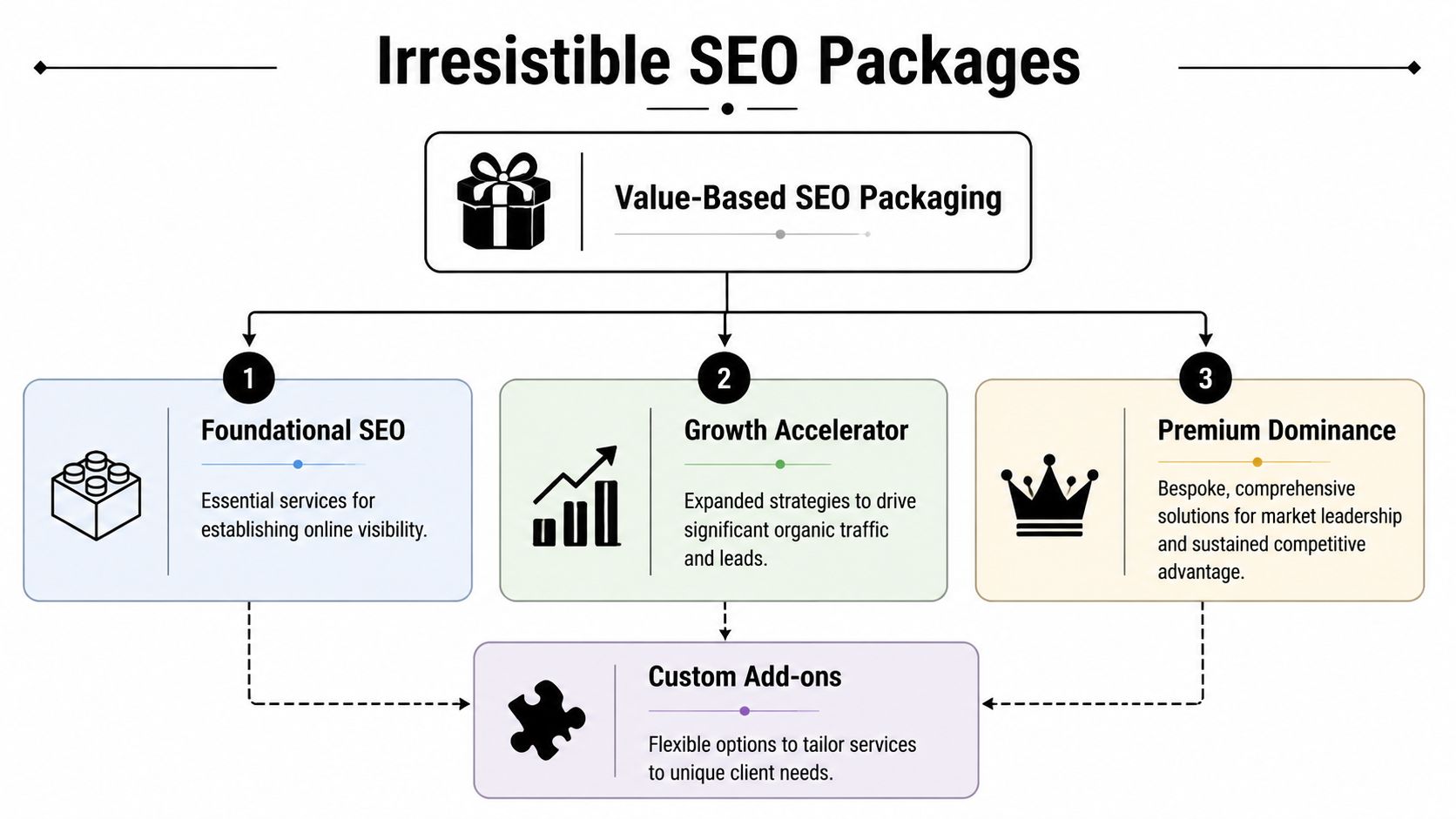
Agencies that scale well often bundle services into tiers because it improves client ROI and avoids common sales mistakes. One cited framework shows 2 to 3x ROI for clients within 6 to 12 months, with a basic bundle at $1k per month focused on On-Page and Local SEO tied to a 30% lead increase, and a premium bundle at $4k per month adding content and link building for a 25% traffic uplift, based on Adaptify’s breakdown of selling SEO services.
What each package should do
Don’t build tiers by piling on random deliverables. Build them around buyer maturity.
-
Foundational SEO
Good for smaller businesses that need technical cleanup, core on-page work, local SEO basics, and reporting. Many agencies often begin with local SEO services at this level because the value story is easy to understand. -
Growth Accelerator
This tier usually adds deeper technical work, content production, stronger internal linking, and more active optimization across priority pages. It’s for clients that already have a working site and need momentum. -
Premium Dominance
This is for competitive categories where authority, content depth, technical oversight, and off-page work need to run together. The sale is less about tasks and more about sustained search share.
Package around outcomes, not labor
Hourly pricing weakens SEO sales because clients compare cost instead of return. Retainers tied to a clear scope and business objective are easier to defend.
A package should answer these questions without a long explanation:
-
What problems does this tier solve?
-
What work is included every month?
-
What won’t be included?
-
How will the client see progress?
The fourth question matters most. If reporting is vague, the package feels expensive. If the client sees rankings, traffic, leads, and implementation progress, the retainer feels grounded.
Clients rarely object to packaging itself. They object to unclear scope and weak value framing.
Keep add-ons separate
The mistake many agencies make is stuffing everything into one retainer. That hurts margins and makes renewals messy.
Keep add-ons visible and optional. Examples include content expansion, link campaigns, landing pages, paid support, or multi-location rollout work. A clean core package plus clear add-ons gives account managers room to grow revenue without renegotiating the whole relationship.
The Consultative Sales Call That Closes 75% of Deals
Pitching SEO too early kills deals. Strong sales calls feel more like diagnosis than persuasion.
A proven sales framework built around value demonstration can achieve a 75% close rate. In that process, giving prospects 3 to 5 actionable fixes during discovery can support 20 to 30% CTR improvements, and customized proposals convert 40% of the time versus 10% for generic templates, based on Backlinko’s SEO sales process research.
Run the call like a strategist
Before the meeting, review the site, search presence, top pages, and obvious technical or local issues. Tools like Ahrefs, Semrush, Google Search Console, and PageSpeed Insights help you enter the call with context.
Then structure the conversation in five moves:
-
Qualify the account
Confirm fit. If the budget, timeline, or internal ownership isn’t realistic, don’t force the sale. -
Surface the commercial problem
Ask where leads come from, which services matter most, and where sales quality breaks down. -
Show early wins
Offer a few concrete observations. Missing title intent, weak service pages, thin internal linking, poor schema implementation, or under-optimized local listings all work here. -
Map the right package
Tie the proposal to the problems you uncovered. Not every prospect needs technical SEO, link building, and content from day one. -
Close on next action
Don’t end with “let me know.” End with a proposal review, access request, or start date.
What to say and what to avoid
Here’s the difference between a weak and strong framing approach.
| Weak phrasing | Better phrasing |
|---|---|
| We do full-service SEO | You’re missing demand on pages tied to your highest-value services |
| We improve rankings | We fix the pages and signals that influence qualified lead flow |
| We build backlinks and content | We prioritize authority and content where it affects revenue first |
Give the prospect one useful insight before they buy. That proves expertise faster than a credentials slide ever will.
Customized proposals win
Generic proposals fail because they force the buyer to translate SEO language into business value. Most won’t do that work for you.
A strong proposal reflects the call. It should reference their market, current obstacles, and the order of operations. If the site has technical debt, say so. If local visibility is the issue, anchor the plan there. If content is the bottleneck, make that central.
Prospects don’t need more jargon. They need confidence that you’ve seen their situation clearly and built a plan that fits it.
Scale Profitably with White-Label SEO Delivery
Most agencies don’t hit a sales ceiling first. They hit a fulfillment ceiling.
You can close business with a strategist and a good process. You can’t keep scaling if every new account requires more hiring, more management layers, and more fragmented tools. That’s where white-label delivery becomes a business model decision, not just an operations shortcut.
A major gap in SEO sales advice is reseller pricing and margin management. Agencies often struggle to price white-label services without eroding profit. Solutions built around month-to-month wholesale pricing and a brandable dashboard solve that problem by removing the need for in-house staff while preserving margin, as discussed in this review of white label SEO programs for scaling your business.
White-label changes the economics
Hiring internally sounds attractive until utilization drops or quality varies by account. White-label partners let agencies keep sales and client ownership while outsourcing production capacity.
That model works when three conditions are true:
-
The fulfillment scope is clear
On-page, local, technical, content, and links need defined workflows. -
The client experience stays branded
The buyer shouldn’t feel like they’re dealing with multiple vendors. -
Reporting supports retention
Delivery without visibility creates churn risk.
Agency Platform fits this model as one option in the market. It provides white-label SEO fulfillment and a brandable dashboard agencies can host under their own brand, which matters when you’re selling recurring services instead of one-off projects.
Price from the front end, not the backend
Prospects should pay based on the value and scope you manage, not on what your fulfillment costs happen to be. If you anchor your pricing to internal costs, margin gets squeezed every time a client asks for more.
A better approach is simple:
-
Define a retail price by package and market.
-
Keep fulfillment standardized in the background.
-
Use reporting and communication to reinforce value monthly.
That lets your sales team stay focused on outcomes while operations stay predictable.
Turn Signed Contracts into Long-Term Recurring Revenue
The sale isn’t complete when the contract is signed. That’s when margin either compounds or disappears.
Many agencies close SEO retainers and then undermine them with weak onboarding, scattered reporting, and reactive communication. That creates uncertainty fast. Clients don’t cancel only because results are poor. They cancel because they can’t clearly see what is happening.
A common gap in agency operations is the lack of an integrated system showing rankings, traffic, leads, and task progress in one place. That visibility problem is a major reason agencies struggle with recurring revenue, as outlined in Pronto Marketing’s analysis of SEO sales and retention.
Build retention into delivery
Strong retention comes from cadence and clarity.
During onboarding, set expectations around timelines, dependencies, and what the first phase will prioritize. Then keep the client inside a visible process. If they have to ask what your team is doing, the account is already at risk.
The most stable post-sale system usually includes:
-
A branded dashboard that shows core performance and work in progress
-
A reporting cadence that connects activity to business outcomes
-
A structured review process where upsells come from evidence, not improvisation
Renewals become easier when the client sees progress continuously, not just at monthly review time.
Use operations to support upsells
Upsells work best when they feel like the next logical move. If reporting shows local pages are performing, content expansion makes sense. If visibility is growing but authority is weak, link work becomes easier to justify.
Backend structure matters. Agencies that rely on spreadsheets and disconnected apps burn too much time assembling basic updates. Teams that standardize delivery and support functions scale more calmly. Even adjacent operational models, such as essential BPO setup features, show the same pattern. predictable infrastructure reduces friction and improves service continuity.
The core goal is simple. Make value visible enough that retention and expansion feel operational, not heroic.
Handling Objections and Proving Your Worth
Price objections usually mean one of three things. The prospect doesn’t understand the value, doesn’t trust the process, or doesn’t believe the timeline.
You handle all three with evidence, not pressure.
SEO delivers an average 22:1 ROI, compared with 5:1 for digital marketing overall, and that sales conversation gets stronger when you tailor the benchmark to the client’s vertical. Backlinko reports 1,389% ROI for real estate over 13 months and 702% ROI for B2B SaaS over 7 months in its SEO services statistics roundup.
Reframe the objection
When a prospect says your price is too high, don’t defend line items. Move back to the economics.
Ask which channel they’re comparing SEO against, what a qualified lead is worth, and how long they expect a durable acquisition channel to take. That changes the frame from monthly spend to return and breakeven logic.
A few objection responses work consistently:
-
If timing is the issue
Explain that SEO compounds, but the timeline depends on starting conditions, competition, and implementation quality. -
If trust is the issue
Use a proposal grounded in their site, not a generic deck. -
If price is the issue
Compare the investment against lead value and the expected role of organic search in their mix.
Proof beats persuasion
Case studies matter, but only when they match the buyer’s context. A local service business doesn’t care much about an enterprise migration story. A SaaS company won’t respond to generic local ranking screenshots.
The strongest proof set usually includes:
| Proof type | Why it works |
|---|---|
| Tailored audit findings | Shows you understand their specific situation |
| Vertical-relevant examples | Reduces transfer risk in the buyer’s mind |
| Reporting samples | Makes the ongoing relationship feel real |
| Clear scope | Removes fear around hidden work and hidden cost |
If you want to sell SEO consistently, track your own pipeline with the same discipline you apply to campaigns. Watch close rate, proposal quality, retention signals, and package mix. The agencies that improve fastest usually don’t talk more. They diagnose better, scope better, and report better.
If your agency wants a more scalable way to sell and deliver SEO, Agency Platform gives resellers a white-label system for fulfillment, reporting, and branded client visibility so you can focus on sales, retention, and margin instead of building everything in-house.