Dave Thompson June 22, 2026 486 Views
A backlink profile is the complete collection of all external links pointing to a website, evaluated by the quality, quantity, and diversity of its sources. In practice, the most important metric is referring domains, because 10 links from 10 different sites outperform 100 links from one site, and a site with 10,000 backlinks from just 50 referring domains is weaker than one with 500 backlinks from 500 unique domains.
If you’re managing SEO for clients, you’ve probably seen the pattern. Rankings slide, traffic softens, and nothing obvious is broken on the site. That’s usually when the backlink profile stops being a theory and starts becoming a diagnostic tool.
For agencies, a backlink profile isn’t just an off-page SEO concept. It’s a manageable asset that signals authority, trust, and risk. A clean profile supports rankings. A manipulated one creates drag. A neglected one erodes until a competitor with better links takes the position.
Your Client’s Backlink Profile Is Talking What Is It Saying
A client’s backlink profile tells search engines how the web talks about that business. It shows who references them, whether those references make topical sense, and whether the growth pattern looks earned or forced.
When people ask what is backlink profile, they usually want the simple definition. The agency answer is broader. It’s the footprint of a brand’s authority across the web, and it often explains why one site wins even when on-page work looks similar.
What agencies see in the field
A healthy profile usually reflects real brand activity. You see links from relevant publications, niche blogs, directories that make sense, and citations with mixed anchor text. Growth tends to be steady, not erratic.
An unhealthy profile tends to leave fingerprints:
-
Repetition: The same domains linking over and over with little diversity
-
Mismatch: Links from irrelevant sites that have no audience overlap
-
Over-optimization: Anchors that read like a keyword list instead of natural references
-
Sudden surges: Link spikes that don’t match any campaign, launch, or PR event
A backlink profile is one of the fastest ways to tell whether a site’s authority is being earned or manufactured.
That matters because agencies don’t get judged on theory. They get judged on whether clients rank, hold those rankings, and avoid cleanup projects six months later.
Why this matters beyond rankings
A backlink profile affects more than keyword positions. It influences how much trust search engines place in the site overall. It also changes how difficult future SEO work becomes.
If the profile is strong, content and technical improvements usually compound faster. If the profile is weak, every gain takes more effort because the domain lacks the external validation that competitors already have.
The Anatomy of a Healthy Backlink Profile
A healthy backlink profile looks more like a balanced portfolio than a pile of links. Diversity matters. Relevance matters. So does restraint.
According to Reporter Outreach’s explanation of backlink profiles, backlinks have been a top-3 Google ranking factor since at least 2016, and the strongest signal in an audit is still referring domains, not raw link count.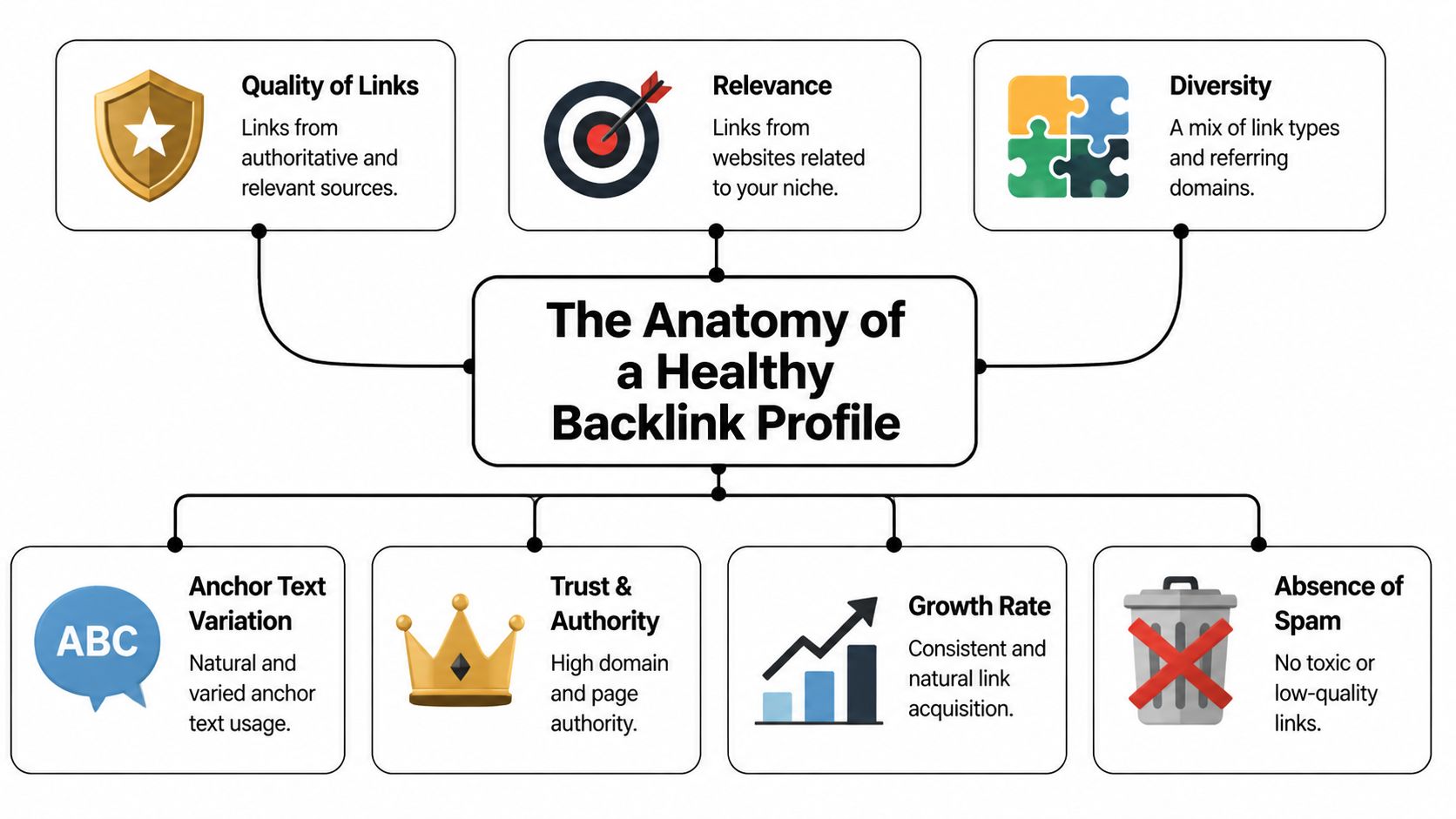
Referring domains matter more than total backlinks
This is the metric agencies should check first. If a client has a huge backlink count but very few unique domains, the profile often looks inflated rather than authoritative.
Here’s the practical difference:
| Signal | What it usually means |
|---|---|
| High backlinks, low referring domains | Repetition from the same sources, limited authority spread |
| Moderate backlinks, high referring domains | Broader trust signals and more natural growth |
That’s why one editorial link from a new, relevant site can matter more than dozens of repeated links from a partner footer or sitewide placement.
Relevance and authority work together
A good link isn’t just “high authority.” It also has to make sense contextually. A local law firm doesn’t benefit much from random links on unrelated hobby sites. A SaaS company gains more from industry publications, partner ecosystems, and expert commentary than from generic directories.
Backlink quality is shaped by the referring domain’s authority, age, traffic profile, and spam risk. In practice, five links from established sites often matter more than a long list from weak domains.
Anchor text should look natural
Anchor text tells search engines how other sites describe the destination page. That’s useful until teams overdo it.
A strong profile usually includes a mix of:
-
Branded anchors: Company name or product name
-
Naked URLs: Plain URL mentions
-
Contextual phrases: Natural references within a sentence
-
Selective keyword anchors: Used in moderation, not as the default
If every meaningful link uses the same exact commercial phrase, the profile starts to look designed for algorithms instead of readers.
Practical rule: If the anchor text pattern looks like a campaign spreadsheet instead of editorial behavior, it’s too aggressive.
Velocity, link types, and spam control
The shape of acquisition matters. Strong profiles grow steadily and include different link attributes and placements. Weak profiles often show bursts, long dead zones, or suspiciously uniform link types.
A healthy profile often includes:
-
Balanced link types: Editorial, contextual, citation, mention-based
-
Mixed follow signals: Dofollow and nofollow in a believable pattern
-
Topical spread: Links from niche-adjacent sources, not random categories
-
Low toxicity: Spam exists, but it doesn’t dominate the profile
The goal isn’t perfection. It’s credibility.
Why Your Backlink Profile Is a Critical SEO Asset
Search engines treat backlinks as trust signals, but they don’t treat every signal equally. They look at how links are acquired, how they’re described, and whether the overall profile resembles real editorial behavior.
According to Flowtrix’s glossary entry on backlink profiles, a natural profile typically maintains a dofollow-to-nofollow ratio of approximately 60% to 40%, and sudden link spikes can trigger black hat SEO flags.
What search engines infer from link patterns
A backlink profile helps search engines answer three practical questions:
-
Is this brand being referenced by credible sites
-
Do those references make topical sense
-
Was this growth earned gradually or pushed unnaturally
That’s why backlink management is tied so closely to trust and E-E-A-T. Search engines want corroboration from outside the site. They also want that corroboration to look real.
If you want a broader view of how links support search visibility, this guide to the importance of backlinks in organic search marketing is a useful companion read.
What works and what usually fails
What works is slower than most clients want, but it holds up. Editorial links, relevant mentions, digital PR, niche citations, and content-led outreach tend to strengthen a domain over time.
What fails is usually obvious in hindsight. Bulk placements from weak domains. Exact-match anchor campaigns. Sitewide links that inflate counts without adding trust. Short-term wins from those tactics often become long-term cleanup.
A strong backlink profile doesn’t just help pages rank. It gives the whole domain more room to compete.
That’s why experienced teams treat backlinks like infrastructure. They’re not a one-off deliverable. They’re part of the authority layer that supports every future SEO investment.
How to Conduct an Effective Backlink Profile Audit
Most backlink audits fail because they stop at exporting a spreadsheet. An effective audit turns raw link data into decisions. For agencies, that means repeatability across clients, clear thresholds, and reporting that can survive client scrutiny.
According to Linkbuilder.io’s agency-focused workflow, a practical process includes exporting profiles that show more than 10% toxic links, segmenting by client, prioritizing with automated scores, and monitoring post-disavow changes through weekly notifications. It also notes that this workflow can reduce manual oversight by 50% per agency reports.
A practical five-step agency workflow
Start with complete data. Use Google Search Console alongside a commercial backlink tool such as Ahrefs or SEMrush. Search Console gives you Google’s own view of discovered links. Commercial tools add authority metrics, anchor text analysis, and filtering.
Then apply a process like this:
-
Export and consolidate data
Pull backlink and referring domain data from Google Search Console and your audit tool. If the profile shows more than 10% toxic links, move the account into cleanup priority. -
Segment by client account
Keep access and reporting separated by client. Role-based access matters when multiple strategists, account managers, and fulfillment teams are involved. -
Prioritize with toxicity scoring
Automated scoring won’t replace judgment, but it’s useful for triage. It helps teams sort obvious risks from links that look odd. -
Build disavow candidates and branded reports
Don’t rush to disavow everything suspicious. Group links into keep, review, outreach for removal, and disavow candidate. -
Monitor weekly after action
Watch whether toxic domains disappear, whether new suspicious domains appear, and whether the profile stabilizes.
What to look for during review
A backlink audit should answer specific questions, not just generate charts.
Look for:
-
Referring domain concentration: Too much dependence on a few sites
-
Anchor text skew: Commercial phrases showing up too often
-
Velocity anomalies: Link surges without a real business event behind them
-
Relevance gaps: Domains that don’t fit the client’s market, geography, or topic
-
Toxic clusters: Similar sites, low-quality directories, obvious network patterns
A good audit also checks lost referring domains. If a client keeps losing legitimate links, authority can erode gradually even when no penalty exists.
When disavow is justified
Disavow is not a routine maintenance task. It’s a risk control measure. Use it when the profile contains clear toxic patterns and removal outreach isn’t realistic or effective.
The mistake agencies make is treating every suspicious link as an emergency. The real job is separating harmless noise from links that distort the profile.
That distinction is where experienced SEO teams save clients from unnecessary work and unnecessary risk.
From Audit to Action Building a Healthier Profile
Once the audit is done, the work splits in two directions. First, remove or neutralize harmful links. Second, build stronger links that improve the profile’s overall quality.
According to ReportCard’s analysis of backlink profile impact, 100 low-authority backlinks from new, spammy domains produce negligible ranking impact compared to 5 backlinks from established, high-authority sites. That’s the core trade-off agencies need to explain to clients.
Clean the profile without overcorrecting
Not every ugly link is toxic. Some low-quality links are just background noise. The aim is to remove patterns that signal manipulation, not to sanitize the web.
Use a simple action framework:
| Link type | Best response |
|---|---|
| Clearly spammy or manipulative | Add to disavow candidate list |
| Irrelevant but not dangerous | Monitor or request removal if repeated |
| Weak but natural | Usually leave it alone |
| Strong and relevant | Protect, reclaim if lost, and build similar links |
That keeps teams from wasting time chasing harmless links while real problems sit untouched.
Build links that improve the whole domain
The best link building work improves the profile at the domain level, not just one URL. That usually means earning links from sources that are relevant, editorial, and diverse.
Three approaches hold up well:
-
Competitive gap analysis
If competitors earned coverage in industry publications, those sites become valid outreach targets. This is often the fastest way to identify realistic opportunities. -
Editorial and PR-driven placements
Expert commentary, proprietary insights, and useful resources earn stronger links than generic guest posts. -
Relevant local and niche sources
For local SEO clients, niche associations, chambers, local publications, and community sites often produce the most defensible links.
If your team is refining its process, this roundup of link building tools for successful off-page SEO can help structure the stack.
What agencies should stop doing
Some tactics still get sold because they’re easy to package. They’re not the same as effective.
Avoid leaning on:
-
Bulk directory submissions that create volume without relevance
-
Exact-match anchor outreach that makes every placement sound scripted
-
Cheap guest post farms that look polished but exist only to pass links
-
One-source dependency where too many placements come from the same network
A healthier profile is built through selection. Better targets, better context, better pacing.
Agencies win backlink campaigns by saying no to easy links that weaken the profile.
That’s not always the fastest route, but it’s the one that creates durable authority.
The Agency Workflow for Monitoring and Reporting
Backlink management gets harder after the cleanup phase, not easier. New links appear, good links disappear, and emerging threats don’t wait for quarterly audits.
One of the biggest current issues is AI-generated link spam. According to Morningscore’s review of backlink profile trends, the 2025-2026 trend is a 25% rise in low-quality links from AI sites. It also reports that profiles with more than 15% AI-origin links can see rankings drop 12% YoY, and that dashboards should flag more than 50 new links per month from new domains for review.
What ongoing monitoring should include
An agency-grade monitoring routine should track:
-
New referring domains: So strong additions can be recognized and suspicious ones investigated
-
Lost referring domains: So teams can reclaim valuable mentions and links
-
Velocity changes: So unusual growth patterns are reviewed quickly
-
Anchor text drift: So a natural profile doesn’t gradually become over-optimized
-
AI-origin risk: So thin, machine-generated sites don’t flood the profile undetected
Therefore, many agencies need better operations, not just better SEO knowledge. The challenge isn’t spotting one bad link. It’s maintaining visibility across many client portfolios without turning account management into spreadsheet work.
Reporting clients actually understand
Clients don’t need every raw backlink metric. They need an explanation of what changed, what matters, and what action the agency is taking.
Good reporting usually covers:
-
What improved: New relevant referring domains, reclaimed links, reduced toxicity
-
What needs attention: Lost authority links, suspicious spikes, anchor imbalance
-
What happens next: Outreach, disavow review, competitive targeting, monitoring
Clear backlink reporting builds trust because it shows control, not just activity.
The agencies that retain SEO clients longest tend to make this process visible. They don’t wait for ranking drops to start talking about off-page risk.
Scale Your SEO Services with Confidence
A backlink profile is not just a list of inbound links. It’s a working asset that affects trust, rankings, and the stability of every other SEO investment you make for a client.
That’s the practical answer to what is backlink profile. It’s the full external link footprint of a site, but for agencies, it’s also a system to audit, improve, monitor, and report on at scale.
The teams that do this well don’t chase backlink volume for its own sake. They prioritize referring domains, relevance, steady acquisition, anchor discipline, and ongoing review. They know when to clean up, when to build, and when to leave harmless noise alone.
AI-driven search will keep raising the bar for trust and source quality. That makes backlink profile management more operational, not less. Agencies that treat it as a repeatable service line can protect client performance and create more durable recurring revenue.
If you want to deliver backlink audits, link building, client reporting, and broader SEO fulfillment under your own brand, Agency Platform gives agencies a white-label way to scale without building the entire operation in-house.