Dave Thompson May 12, 2026 1226 Views
A white label SEO reseller program gives an agency a way to sell SEO without building a full delivery department before the revenue is there. For many agencies, that is the difference between turning down demand and converting SEO into a repeatable service line with predictable margin.
The constraint is rarely sales. It is execution. Clients expect technical fixes, content production, local optimization, reporting, and a clear plan tied to leads and revenue. Building that in-house means hiring specialists, training account managers, buying tools, and creating QA processes that can hold up as client volume grows.
Used well, a white label seo reseller program becomes more than outsourced fulfillment. It becomes part of your operating model. Your agency keeps the client relationship, strategic direction, and positioning, while a specialized partner handles production at a level that would take time and capital to build internally.
That model can improve capacity, protect margin, and help your agency show up as a stronger authority in an AI-shaped search market. It also raises the bar on management. Agencies that succeed here set clear scopes, control communication, and treat the partner like an extension of operations rather than a hidden vendor.
What Is a White Label SEO Reseller Program
A white label seo reseller program lets an agency sell SEO under its own name while another company handles fulfillment behind the scenes. Your agency owns the client relationship, pricing, communication, and positioning. The provider does the technical and production work.
What the agency controls
The agency stays front-facing. That means you handle discovery calls, proposal strategy, onboarding, expectation setting, and account direction. If the client asks why rankings moved, why leads dipped, or what the next quarter looks like, they ask you.
That’s the part many newer resellers underestimate. White label doesn’t remove strategy. It removes production bottlenecks.
What the fulfillment partner handles
A strong provider typically executes work such as:
-
Technical SEO tasks including audits, on-page fixes, and indexing issues
-
Content production for service pages, blogs, and supporting assets
-
Link acquisition and authority-building work
-
Local SEO fulfillment for location pages, profiles, and citations
-
Reporting workflows so the agency can present progress under its own brand
The model works best when the provider is invisible operationally, but visible to the agency in process, scope, and accountability.
Agency maturity matters here. A provider can make delivery easier, but it can’t fix weak packaging or poor client communication. The agencies that do well in this model productize the offer, define what’s included, and sell outcomes the client can understand.
One established example is Agency Platform, which has been trusted by over 1,200 partners for more than 20 years and offers a fully brandable dashboard with month-to-month pricing. That kind of longevity matters because white label SEO is less about finding a vendor and more about building a reliable backend for your agency.
How the White Label SEO Model Works in Practice
The easiest way to understand the workflow is to think of the agency as the restaurant owner and the provider as the kitchen. The guest knows your brand, trusts your menu, and judges the experience through your service. The kitchen does the cooking, but you still control the promise.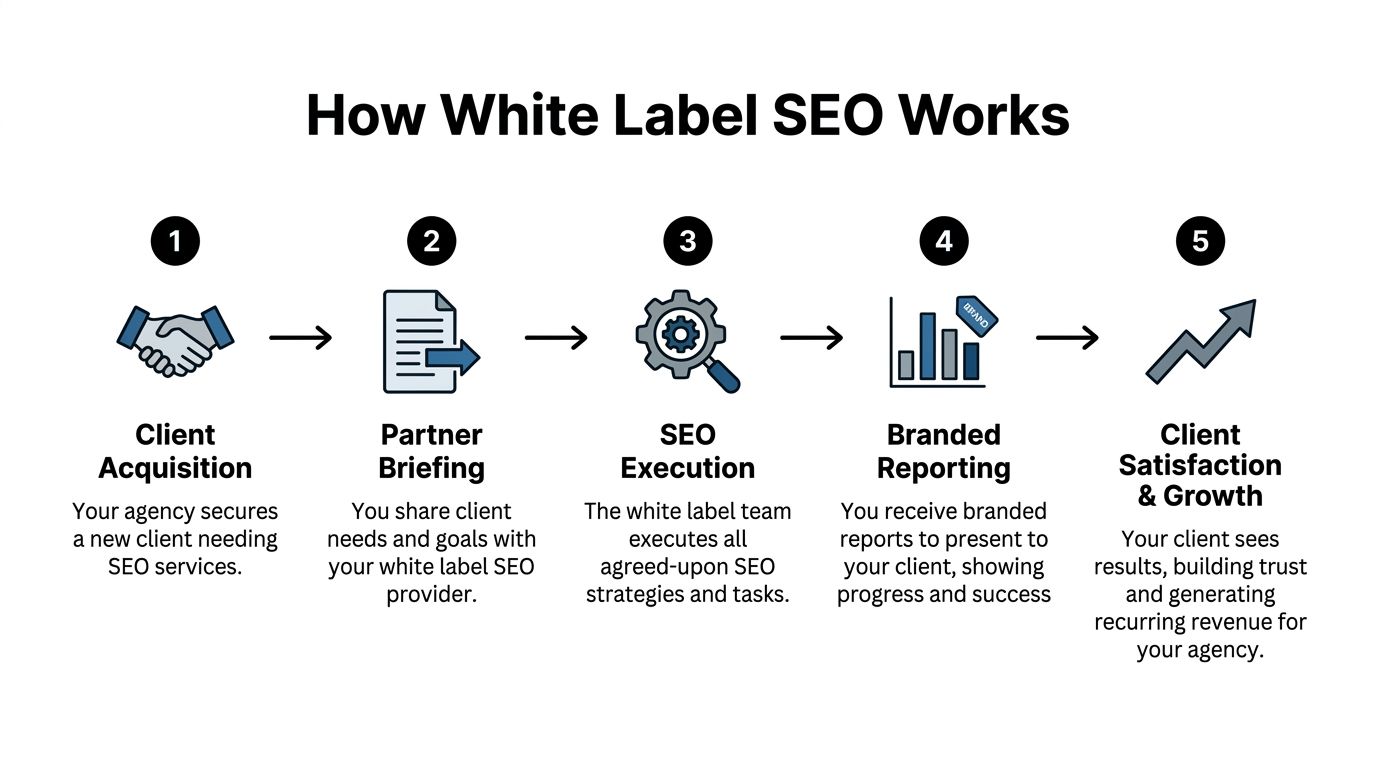
The handoff from sale to fulfillment
A practical workflow usually looks like this:
-
Your agency closes the client
You sell the SEO package, define goals, set timelines, and frame success properly. -
You brief the provider
Many campaigns succeed or fail at this stage. A weak brief produces generic execution. A strong brief includes business goals, service area, priority pages, constraints, and lead quality expectations. -
The provider executes the work
That may include keyword research, on-page updates, content, link building, local SEO tasks, and reporting prep. -
You review branded deliverables
Good resellers don’t forward work blindly. They quality-check recommendations, adjust messaging for the client, and tie activity back to the business goal. -
You present progress to the client
The client sees your brand, your process, and your strategy. The provider stays in the background.
Where agencies lose control
The failure points are usually operational, not technical.
-
Loose scope creates friction fast. If the client thinks SEO includes redesign work, sales enablement, or unlimited revisions, your margins disappear.
-
Bad expectation setting leads to churn. SEO compounds over time, but clients still need early signs of progress.
-
Weak communication loops create lag between fulfillment and client-facing updates.
Practical rule: Never sell a deliverable your provider hasn’t explicitly agreed to own, measure, and support.
What smooth operations look like
A strong white label setup gives the agency visibility without forcing the client to see the backend. That’s why dashboards matter. Modern reseller dashboards can show rankings, traffic, leads, task status, and reporting in one place, which helps agencies stay responsive and credible.
The best agency operators also separate three roles clearly:
-
Sales owns the promise
-
Account management owns communication
-
Fulfillment owns execution
When one person tries to do all three without process, service quality slips. White label works because it creates specialization. Your job is to keep the client confident and the machine moving.
Core Strategic Benefits for Your Agency
Agencies usually adopt a white label seo reseller program for three business reasons: protect margin, expand capacity, and add expertise faster than they could build it internally. The strategic upside goes further. Used well, white label SEO becomes an operating model that helps an agency scale without turning every new client into a hiring decision.
Profitability without fixed overhead
The financial case starts with cost structure.
An in-house SEO department brings payroll, recruiting time, management load, software subscriptions, QA, and training. Those costs hit before the service line is stable. A reseller model shifts much of that spend into delivery costs tied to active accounts, which gives agencies more control over cash flow and lowers the risk of adding SEO too early.
That matters most for agencies in the messy middle stage. They have enough demand to sell SEO, but not enough volume to justify a full team. In that situation, white label fulfillment protects margin while giving the agency room to refine packaging, pricing, and positioning. For a closer look at what fulfillment usually includes, review what is typically covered in white label SEO packages.
There is a trade-off. Variable fulfillment costs improve flexibility, but weak scoping can erase margin just as fast. Agencies that win here sell clear deliverables, control revision limits, and price account management separately when needed.
Scalability that does not depend on constant hiring
A lot of agencies hit the same ceiling. Sales works. Demand comes in. Then fulfillment starts pulling founders, strategists, or account managers into production work they were never meant to own full time.
A strong white label partner removes that pressure and lets the agency grow in stages. You can add SEO to existing accounts, test a local package, or take on a higher volume of monthly retainers without building the full department first. That is more than outsourcing tasks. It is a way to separate growth from headcount.
The catch is operational discipline. Scale only works if the partner can maintain quality across more accounts, tighter timelines, and different client types. If their process breaks at 20 clients, your agency absorbs the fallout.
Expertise that strengthens your market position
Search is more complex than it was a few years ago. Clients expect strategy across technical SEO, content, local visibility, authority signals, reporting, and the growing influence of AI-generated search results. A generalist agency can sell that vision, but it often struggles to execute at specialist depth across every account.
A good reseller partner closes that gap. The agency keeps the client relationship and strategic ownership. The fulfillment team brings focused execution, repeatable processes, and a tighter grip on SEO changes that affect performance.
That structure can also raise perceived authority. When a web design, paid media, or branding agency adds credible SEO delivery, it becomes harder for clients to justify splitting work across multiple vendors. The result is often better retention, larger account value, and more recurring revenue.
The key is using the partner to extend capability, not replace judgment. Agencies still need to set direction, qualify fit, and connect SEO work to business outcomes. White label works best when the provider becomes part of your operating system, not a hidden production shortcut.
Common Services in a White Label SEO Program
Not every white label seo reseller program offers the same depth. Some only provide links or content. Others deliver a full operating stack that covers local SEO, national campaigns, analytics, and branded reporting. The difference shows up in client retention.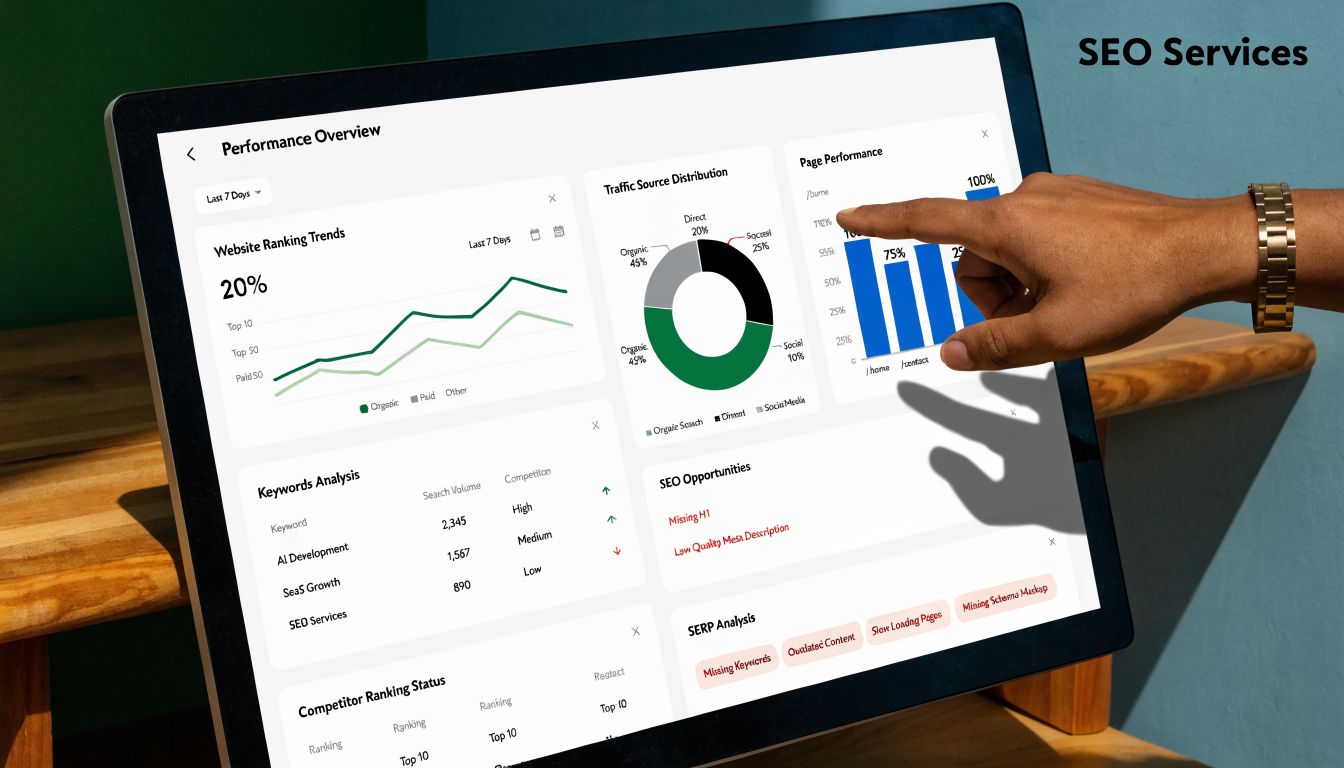
Local and national SEO fulfillment
For local businesses, good fulfillment usually includes profile optimization, citation consistency, localized on-page work, and service-area relevance. For broader campaigns, the work tends to focus more on site architecture, content targeting, internal linking, technical fixes, and authority building.
What matters is fit. A local law firm, a multi-location home service brand, and a national SaaS company shouldn’t receive the same package with different labels.
Content and link building
Content still drives most SEO programs, but quality control matters. Agencies should expect deliverables that align with search intent and the client’s actual service model. Thin articles written only to hit keywords create reporting noise, not business value.
Link building is similar. If a provider can’t explain how links fit the broader campaign, that’s a warning sign. Good fulfillment connects links to page priorities, authority gaps, and long-term visibility goals.
Reporting and client visibility
Modern reseller dashboards integrate with 25+ marketing tools, consolidating rankings, traffic, leads, and task progress into one branded portal, according to Agency Platform’s guide to becoming a white label SEO reseller. That matters because agencies don’t just need data. They need client-facing clarity.
A strong reporting system should help you answer three questions fast:
-
What work was completed
-
What changed in visibility or lead flow
-
What happens next
If you’re reviewing package structure, this guide to what’s included in white label SEO packages is a useful reference for comparing deliverables.
How to Evaluate and Choose the Right SEO Partner
Choosing a provider is less like hiring a freelancer and more like choosing an operating partner. If they miss, your brand takes the hit.
Start with search quality and compliance
One of the biggest blind spots in reseller selection is whether the provider can operate safely in an AI-era search environment. As Marketers Center notes in its review of SEO reseller programs, resellers need partners that understand E-E-A-T and transparent fulfillment because weak alignment exposes both the agency and the client to algorithm risk.
That means asking direct questions:
-
How do you approach content quality and authority signals
-
What does your link vetting process look like
-
How do you prevent over-optimization
-
How do you document strategy changes after search updates
Evaluate operations, not just sales promises
A polished sales call doesn’t tell you much. Look at how the provider runs accounts.
Review these areas closely:
-
Dashboard and branding so reports, notifications, and portals can live under your brand
-
Communication rhythm so your team knows when strategy updates, deliverables, and blockers will be shared
-
Scope discipline so add-ons, revisions, and turnaround expectations are clear
-
Support access so you can reach strategists, not only account coordinators
If the provider can’t explain how work moves from intake to delivery, they probably can’t scale cleanly.
For a more detailed checklist, these key considerations for choosing the right white label SEO partner are worth reviewing.
Watch for red flags
The common red flags are familiar:
-
Generic deliverables that look identical across industries
-
Opaque reporting that highlights activity but not business relevance
-
Long-term lock-in before service quality is proven
-
No clear stance on AI search, authority, or content governance
A good partner makes your agency more credible. A bad one forces your team into cleanup mode.
Navigating Pricing Models and Contract Terms
Pricing shapes margin, sales velocity, and account stability. It also changes how much risk your agency carries.
Comparison of White Label SEO Pricing Models
| Pricing Model | How It Works | Best For | Pros | Cons |
|---|---|---|---|---|
| Wholesale pricing | You buy fulfillment at a set partner rate and resell at your own price | Agencies that want control over margins and packaging | Flexible markup, strong positioning control, easier to bundle into broader retainers | Requires disciplined pricing and clearer sales messaging |
| Flat-rate monthly pricing | The provider charges a recurring amount per package or account tier | Agencies that want predictable delivery costs | Simple forecasting, cleaner proposals, easy internal planning | Can get rigid if client needs vary widely |
| A la carte services | You purchase individual items such as content, links, or audits | Agencies testing demand or filling specific delivery gaps | Low commitment, useful for custom campaigns, easy to pilot | Harder to build a consistent retainer model |
What to check in the contract
The contract should tell you exactly what happens when delivery gets complicated. Look for clarity on:
-
Scope of work and what counts as extra work
-
Reporting cadence and who owns client-facing communication
-
Revision policies for content, recommendations, and campaign changes
-
Cancellation terms so you’re not trapped if quality slips
-
Confidentiality provisions to protect the white label arrangement
A month-to-month structure is usually easier for agencies that are still refining their offer. If you’re comparing pricing approaches, this breakdown of white label SEO pricing for agencies helps frame the trade-offs.
The practical rule is simple. Don’t buy on low price alone. Buy on whether the model supports durable margin after account management time, sales effort, and inevitable client questions.
Your Onboarding Checklist for a Successful Launch
A smooth launch usually has less to do with SEO knowledge and more to do with operational discipline. Agencies that rush into selling without packaging and process tend to create avoidable churn.
Build the offer before you pitch it
Start internally.
-
Train sales on the service so they can explain what’s included, what isn’t, and how results should be judged
-
Define packaged outcomes such as local visibility, lead growth support, or content expansion
-
Set reporting language that translates SEO work into client-friendly updates
Then configure your branded environment. Dashboard setup, report naming, email branding, and intake workflows should be done before the first client goes live.
Launch with a controlled client set
Industry guidance recommends a phased onboarding that starts with 3 to 5 clients so agencies can refine workflows and communication before scaling, according to My AI Front Desk’s guide on SEO white label reseller program growth.
That advice is practical. A small pilot reveals where proposals overpromise, where intake forms are weak, and where reporting needs translation.
Start narrow, tighten operations, then scale. Agencies that skip that step usually spend the next quarter fixing delivery friction.
Create a repeatable account rhythm
Use a standard cadence from day one:
-
Client kickoff with goals, baselines, and roles
-
Provider handoff with complete intake details
-
Internal review before anything reaches the client
-
Scheduled updates so communication doesn’t become reactive
The agencies that get the most from a white label seo reseller program don’t treat it like invisible labor. They treat it like a system that needs packaging, review, and consistent client communication.
Frequently Asked Questions About White Label SEO Reselling
Will clients know I’m outsourcing the work
Not if the program is structured properly. In a true white label setup, the provider stays behind the scenes while your agency presents the strategy, reports, and communication under your brand. The key is using branded dashboards, branded deliverables, and a clear internal review process before anything reaches the client.
How should I handle strategy questions from clients
You should stay the strategic point of contact. Even if the provider contributes research or recommendations, your agency should translate that into business terms the client understands. Clients don’t need a backend vendor. They need a trusted advisor who can connect SEO activity to revenue, lead quality, and next steps.
How long does it take to see results
SEO timelines vary by market, competition, site condition, and scope. What clients need most is honest framing. Early progress often shows up as technical fixes completed, content published, improved indexing, or stronger local visibility before larger gains become obvious.
Is white label SEO better than building in-house
For many agencies, yes, especially when demand exists but internal SEO operations aren’t mature. In-house teams make sense when you have stable volume, management capacity, and a clear process already working. A reseller model makes more sense when you want to expand services quickly while keeping overhead lower and delivery more flexible.
If your agency wants to add SEO without building a full internal fulfillment team, Agency Platform is one option to evaluate. It combines white label fulfillment with a brandable dashboard, month-to-month pricing, and a partner model built for agencies that want to sell under their own brand while keeping control of the client relationship.