Dave Thompson May 6, 2026 1002 Views
A modern link acquisition strategy is a repeatable system for earning relevant, defensible backlinks that improve rankings, brand authority, and client reporting. That still matters in AI-shaped search. Pages in Google’s top positions have 3.8 times more backlinks than pages in positions 2 through 10, according to LinkyJuice’s 2025 link acquisition analysis. For agencies, that changes the conversation. Link acquisition isn’t a side tactic. It’s an operating model built around research, vetting, execution, scale, and proof of value.
The Modern Link Acquisition Strategy for Agencies
Most agencies fail at link building for one reason. They treat it like a list of tactics instead of a delivery system.
A real link acquisition strategy starts with the client’s market, not an outreach template. You identify who already ranks, reverse-engineer why they rank, qualify the opportunities worth pursuing, build assets people will cite, then report outcomes in a way clients understand.
For agency owners, the working framework looks like this:
-
Planning around search reality: target pages, ranking gaps, and the types of sites that already influence the niche.
-
Prospecting with evidence: use Ahrefs, SEMrush, and search results to find replicable links and content patterns.
-
Quality control: evaluate authority, relevance, editorial standards, and anchor mix before outreach starts.
-
Execution strategically: prioritize tactics that can earn trusted editorial links, not just easy placements.
-
Measurement: connect links to rankings, referral traffic, and business outcomes so the service stays on retainer.
Practical rule: If a link can’t be explained to a client in plain English, it probably shouldn’t be in the campaign.
That’s the shift agencies need to make. The old model chased volume. The current model rewards fit, credibility, and consistency.
Foundation of Strategy Competitive Intelligence and Prospecting
Good prospecting starts before anyone builds a contact list. It starts with evidence from the search results, the backlink profiles behind those rankings, and the formats that already earn citations in the category.
Start with the SERP, then open the backlink tools
Pull the revenue pages, supporting content, and priority keyword clusters first. Then review the sites that consistently rank for those terms in Ahrefs or SEMrush.
The goal is pattern recognition. A useful competitive review shows where links come from, what type of asset earned them, and why a publisher chose to cite that page instead of another one.
Look for patterns in three areas:
-
Editorial patterns: trade publications, local media, associations, software directories, expert blogs
-
Content patterns: benchmark reports, calculators, original data, service explainers, comparison pages
-
Link intent: citation, recommendation, partner mention, resource inclusion, or outdated-link replacement
I care less about a raw export of referring domains than about repeatable opportunity types. If three competitors all picked up links from association resource pages, that is a channel. If the top pages all attracted links with original data or a tool, that is an asset decision.
Turn competitor data into an agency prospect map
A usable prospect list needs structure. Random domain exports create messy outreach, inconsistent fulfillment, and poor reporting.
I group prospects by acquisition path so strategists, outreach specialists, and white-label fulfillment partners can work from the same brief.
| Prospect type | What you’re looking for | Typical next move |
|---|---|---|
| Editorial targets | Journalists, publishers, niche media | Digital PR pitch |
| Resource pages | Curated guides and tool lists | Resource inclusion outreach |
| Broken-link targets | Relevant pages with dead outbound links | Replacement pitch |
| Partner opportunities | Vendors, associations, complementary brands | Relationship-based outreach |
| Content-gap prospects | Sites linking to outdated assets | Build stronger replacement content |
Agencies gain efficiency. Once a team labels opportunities by path, it becomes easier to estimate effort, assign work, and explain to clients why one campaign needs digital PR while another needs a linkable asset and targeted outreach.
Prioritize by likelihood and business impact
Every prospect list gets smaller once real prioritization starts.
I use a simple filter. Prospects move up the queue if they have linked to direct competitors, publish pages that regularly cite outside sources, or clearly support the client’s commercial goals. A local law firm does not need the same prospect mix as a SaaS company targeting national comparison terms. Relevance to the business model matters as much as relevance to the topic.
AI helps here, but only if the inputs are clean. Use it to cluster domains, identify recurring content themes, surface contact patterns, and speed up qualification. Do not hand it a scraped list and expect strategy. Agencies that scale well use AI for triage, then apply human review before outreach starts.
Build prospecting into the delivery system
Prospecting should produce more than a list for the current month. It should create reusable market intelligence.
For Agency Platform partners, that usually means building category-specific prospect maps, asset recommendations, and outreach paths that can be reused across similar client accounts. The result is faster onboarding, cleaner handoff to fulfillment, and reporting that ties each prospect segment to a clear acquisition strategy.
A good question to ask during review is simple: who already links to this type of page in this market, and what made them do it? That question produces better campaigns than starting from a blank spreadsheet.
The Quality Mandate Vetting Links for Authority and Relevance
A prospect list is only useful if your team knows what to reject.
A strong backlink profile isn’t built by chasing the highest visible authority metric. It’s built by selecting links that make sense editorially, fit the target page, and support a natural pattern over time.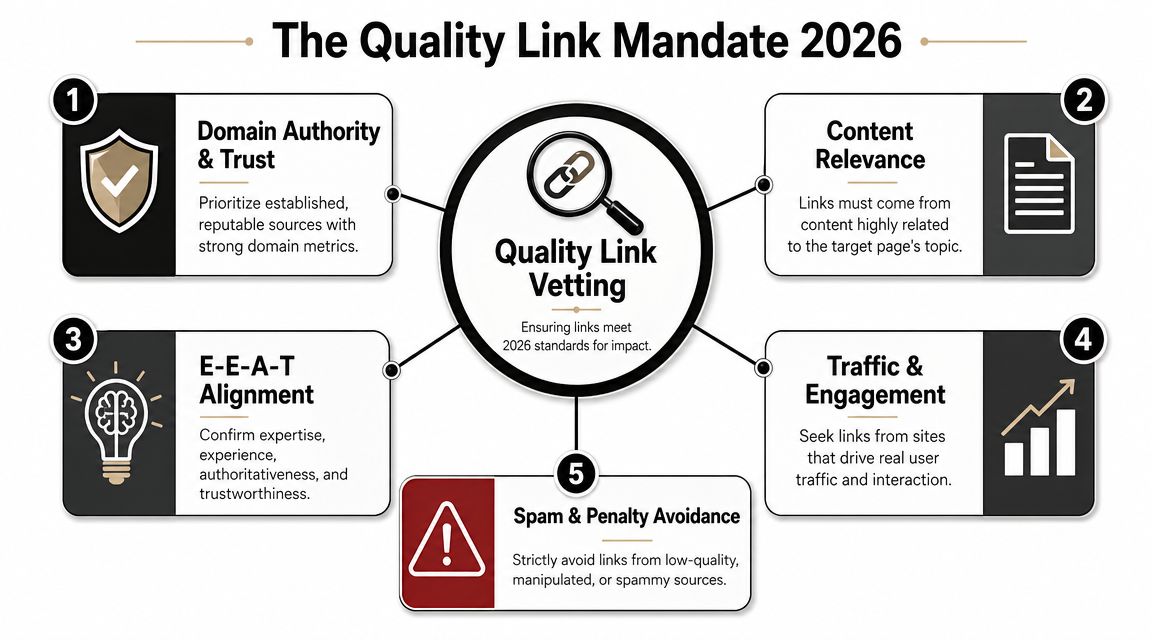
Build a link quality scorecard
I’d rather place a link on a tightly aligned industry site than force one onto a broad site with weak topical connection. Relevance is often the deciding factor when two prospects look similar on paper.
A practical scorecard should review:
-
Topical relevance: does the site publish in the same subject area as the target page?
-
Editorial integrity: are articles written for readers, or does every page look built for link sales?
-
Audience signals: does the site appear to have real readers, comments, authors, or clear publishing standards?
-
Trust indicators: named authors, credible about pages, cited sources, and a coherent content focus
-
Spam risk: strange outbound link patterns, thin content, off-topic categories, or obvious paid placement footprints
Anchor text needs discipline
Even good links can create problems if the anchor profile is aggressive.
Loganix recommends a natural mix of 40% branded, 30% partial-match, 20% generic, and 10% exact match, and notes that overusing exact-match anchors can drop rankings by 15-30% in its review of link building mistakes and anchor diversification.
That doesn’t mean every month must hit those ratios perfectly. It means your campaign should trend toward a profile that looks earned, not engineered.
A clean anchor profile usually sounds like how people naturally reference brands, pages, and resources. It doesn’t read like a keyword list.
What gets filtered out
Many agencies know what they want, but not what they should automatically disqualify. Consistency matters here.
Skip placements when:
-
The site is off-topic: authority without relevance provides little advantage.
-
The page exists only for outbound links: especially when every post follows the same commercial pattern.
-
The domain shows spam signals: poor content quality, irrelevant topics, or suspicious outbound behavior.
-
The anchor request is too optimized: if the placement only “works” with an exact-match keyword, it probably isn’t worth the risk.
This vetting step is what separates a scalable service from a churn machine. It protects rankings, preserves trust, and gives your team a standard they can apply across every client vertical.
High-Impact Execution Link Acquisition Tactics That Work
Once the shortlist is clean, execution becomes much simpler. You don’t need more tactics. You need a smaller set that can earn links from sites worth having.
Digital PR should anchor the campaign
If you’re building authority for clients in competitive spaces, digital PR belongs near the center of the strategy.
BuzzStream reports that Digital PR is the most effective link building tactic in 2026, rated top by 48.6% of SEO professionals, and that a single practitioner averages 15.58 links per month using the tactic in its roundup of link building statistics and Digital PR benchmarks.
That lines up with what agencies see in practice. Editorial links compound. They support rankings, brand trust, and future outreach because publishers recognize the brand.
Digital PR works best when the asset gives writers a reason to cite it:
-
Original surveys or data studies
-
Location-based analyses with a real angle
-
Expert commentary tied to a current trend
-
Tools, calculators, or reference resources
If your team already invests in content, pair that with a stronger promotion model. Agency owners looking to connect content and authority building can also review this guide to link building with content marketing.
Broken link building still works when the replacement is better
Broken link building fails when agencies send generic emails pointing to weak content. It works when the replacement asset clearly improves the dead resource.
Uniek Digital’s methodology for broken link building and outreach process lays out a useful pattern. The workflow is straightforward:
-
Find broken pages on relevant authority sites using Ahrefs or SEMrush filters for 404 targets.
-
Check whether the dead page earned links for a real reason. If it was useful before, replacement demand already exists.
-
Create the replacement asset with stronger coverage, fresher examples, and cleaner formatting.
-
Write to the right editor or site owner with a specific note about the dead link and why your page helps their readers.
That’s a quality-first tactic. It creates value before asking for anything.
Resource pages and selective guest posting
Resource pages remain useful when the fit is obvious. A niche tool list, training library, or curated reference page can produce stable links over time.
Guest posting still has a role too, but only when the host site has real editorial standards and the topic matches the target page. If the opportunity exists only because someone is selling placement inventory, it won’t age well.
The best outreach emails don’t sound clever. They sound informed, concise, and helpful.
A good campaign usually combines one authority tactic, one relationship tactic, and one cleanup tactic. That mix keeps the link profile varied and reduces overdependence on any single channel.
Operationalizing for Scale Outreach Systems and Linkable Assets
Agencies that scale link acquisition well usually improve output before they expand headcount. The gains come from tighter prospect selection, better asset planning, and a delivery system that keeps campaigns moving without turning outreach into a volume game.
Use AI to prioritize work, then let specialists make the decisions
The strongest agency use case for AI is triage.
According to SeobotAI’s review of AI link building strategies for prospecting and content gaps, agencies can use AI to focus human effort on the highest-potential opportunities and speed up the identification of content gaps worth building around.
In practice, that means using AI to score and cluster prospects before an outreach specialist touches the campaign. It can surface patterns quickly, but it should not decide who gets pitched, what angle gets used, or which domains are worth a relationship investment. Those calls still need editorial judgment and commercial context.
Useful scoring inputs include:
-
Topical fit with the target page
-
Likelihood of editorial placement
-
Existing relationship history
-
Signs that a new asset is needed before outreach starts
-
SERP gaps that suggest a stronger research, data, or expert-led angle
This matters at the operations level. Junior staff stop wasting hours on weak lists, senior staff spend more time on high-value publishers, and account managers get a cleaner production pipeline.
Build linkable assets as reusable campaign infrastructure
Scalable outreach needs assets that can support more than one wave of pitching.
Original research, benchmark pages, expert commentary hubs, calculators, and strong reference content give the team a repeatable reason to contact publishers across multiple segments. They also improve efficiency across the client portfolio. One well-scoped asset can support digital PR outreach, resource page placements, unlinked mention recovery, and vertical-specific pitching instead of serving a single campaign.
For teams refining outreach around those assets, this blog outreach strategy guide for high-quality backlinks is a useful reference.
A scalable operating model usually runs through four queues:
-
Research queue: prospect scoring, topic mapping, and opportunity validation
-
Asset queue: production of studies, tools, guides, and support pages
-
Outreach queue: segmented campaigns by publisher type, angle, and target page
-
Follow-up queue: response handling, relationship tracking, and timing for re-pitches
The trade-off is straightforward. Better assets take more time and budget upfront, but they lower outreach waste and create more reuse across months of delivery. Cheap assets move faster, but they usually force the team back into one-off pitching with weaker conversion rates.
An integrated platform helps agencies keep that system organized. Agency Platform, for example, combines white-label fulfillment with a brandable dashboard, which helps agencies manage delivery, client visibility, and reporting without building the entire fulfillment stack internally.
Proving Value KPIs Reporting and Risk Management
A client can see ten new referring domains in a month and still ask, “Did this help revenue?” Agencies that keep link acquisition retainers healthy answer that question before it gets asked.
Reporting has to connect links to page-level business outcomes. Activity reports create procurement conversations. Outcome reports create strategy conversations.
The KPIs that matter
The cleanest reporting stack tracks cause, intermediate movement, and business effect in one view:
| KPI | Why it matters |
|---|---|
| Link quality by target page | Shows whether links were pointed at pages with ranking and conversion value |
| Link velocity | Shows delivery pace and whether momentum is stable or sporadic |
| Referral traffic | Identifies placements that send qualified visits, not just authority |
| Keyword movement on mapped terms | Ties earned links to the exact query sets the client approved |
| Organic traffic trend by landing page | Gives clients the business-level view they care about |
| Assisted conversions or lead actions | Shows whether pages supported by links contributed to pipeline, even without last-click credit |
The reporting move many agencies miss is page mapping. Every acquired link should be tied to a target URL, a keyword cluster, and a business goal before outreach starts. Once that structure is in place, monthly reporting becomes much easier to defend. A rise in non-brand clicks to a service page means more than a raw domain count because it matches the original brief.
How to present performance without getting dragged into vanity metrics
Use a short executive summary at the top of the report. Three lines usually do the job:
-
What authority was acquired
-
What changed on the target pages
-
What the team is changing next month
Then include one client-facing example. If a client asks why 12 links only produced modest traffic growth, show the page-level sequence: links were earned to a commercial page, rankings improved from page three to the bottom of page one for high-intent terms, impressions rose first, clicks followed, and lead volume typically lags the ranking change. That keeps the discussion grounded in search behavior instead of turning into a debate about link quantity.
This is also where white-label systems matter operationally. If your team is using white-label custom link building plans for agencies, the reporting layer should make fulfillment, link QA, target pages, and outcome tracking visible in one place. Agency owners do not need more spreadsheets. They need a client-safe view and an internal production view that line up.
Reporting on links that did not move the needle
Some links will index, pass review, and still produce little visible movement. Report them anyway.
The right framing is simple. Explain whether the link supported authority diversification, protected natural anchor distribution, or reached a page that still needs stronger internal links, better content depth, or more time. A placement can be valid and still have low standalone impact. Senior clients usually accept that trade-off if the explanation is specific.
A useful note in the report sounds like this: this placement met quality standards and supports the authority profile of the target page, but we have not yet seen material ranking movement because the page still trails competitors on content depth and internal link support. Next month we are pairing link acquisition with on-page revisions and a second tier of relevant placements.
That level of detail reduces friction. It also shows the agency is managing a system, not hiding behind averages.
Risk management is part of the retainer
Link acquisition risk is rarely one catastrophic event. It usually shows up as drift. Anchors get too concentrated. Publisher standards slip. Legacy links stay on the profile long after a client changes direction.
A practical review process includes:
-
anchor text concentration by page
-
referring domain quality shifts over time
-
topical fit between linking domain and target page
-
index status and link persistence
-
sudden spikes in low-trust placements from old vendors or past campaigns
Set review thresholds in advance. For example, if a commercial page starts accumulating too many exact-match anchors, slow outreach to that URL and redirect new placements to supporting content. If a referring domain portfolio starts drifting away from the client’s topic set, tighten prospect filters before the next campaign cycle.
Clients respect agencies that talk about protection as well as growth. Good operators show how they handle upside and how they contain downside. That mindset is part of modern agency management, and it aligns with the operational discipline discussed in vibrant marketing management.
Building Your Agency’s Link Acquisition Engine
The agencies that win with link acquisition don’t chase hacks. They run a system.
That system starts with competitor intelligence, tight prospecting, and clear quality rules. It earns authority through tactics that still work, especially digital PR, broken link reclamation, selective resource inclusion, and content-led outreach. It scales with better prioritization, stronger assets, and cleaner operations. Then it proves value through reporting clients can understand.
If you want a useful outside perspective on how strategic brand building supports agency growth, this piece on vibrant marketing management is worth reading because it highlights the operational side of modern marketing, not just the creative side.
For agencies packaging this as a service, structure matters as much as skill. Standardized qualification, asset production, outreach workflows, and monthly reporting turn link acquisition from a custom task into a margin-friendly offer.
If you need a done-for-you framework under your own brand, custom link building plans can shorten the path from idea to delivery.
Link acquisition works when it’s treated as an ongoing authority system, not a batch of one-off placements. Agency Platform gives agencies a white-label way to pair fulfillment with branded reporting, so you can sell, deliver, and prove SEO value without building every process in-house.