Dave Thompson October 9, 2026 14 Views
Search is changing fast, and agencies are feeling it first. White label AEO gives you a way to sell answer-engine optimization under your own brand, without building the technical fulfillment in-house. The opportunity is real: Google AI Overviews appeared in 18% of searches in Pew Research Center's study, and traditional-result clicks fell to 8% when a summary appeared, compared with 15% when it didn't.
That shift raises the bar for every SEO partner. Clients no longer care only about rankings. They also want to know whether answer engines understand their business, cite it, and represent it accurately.
What Is White-Label AEO and Why It Matters Now
Google introduced the Search Generative Experience in 2023, renamed it AI Overviews, and expanded the feature internationally. By May 2025, Google reported availability in more than 200 countries and territories and over 40 languages (Ahrefs' overview of Google AI Overviews).
White-label AEO lets an agency sell this work under its own brand while a specialist partner handles research, content engineering, technical recommendations, and citation monitoring. You keep the client relationship and commercial control. The fulfillment partner supplies the operational expertise.
This is an extension of white-label SEO, not a replacement for it. The service should help clients become easier for AI systems to understand and quote across informational, commercial, and local searches.
Practical rule: Sell AEO as a measurable visibility service, not as a promise of guaranteed inclusion in an AI answer.
The commercial opportunity is speed. Your team can add answer-engine work without hiring semantic search specialists or building a new monitoring process. For a useful foundation, review this answer engine optimization guide, then turn its principles into a repeatable client workflow.
How White-Label AEO Differs From Traditional SEO
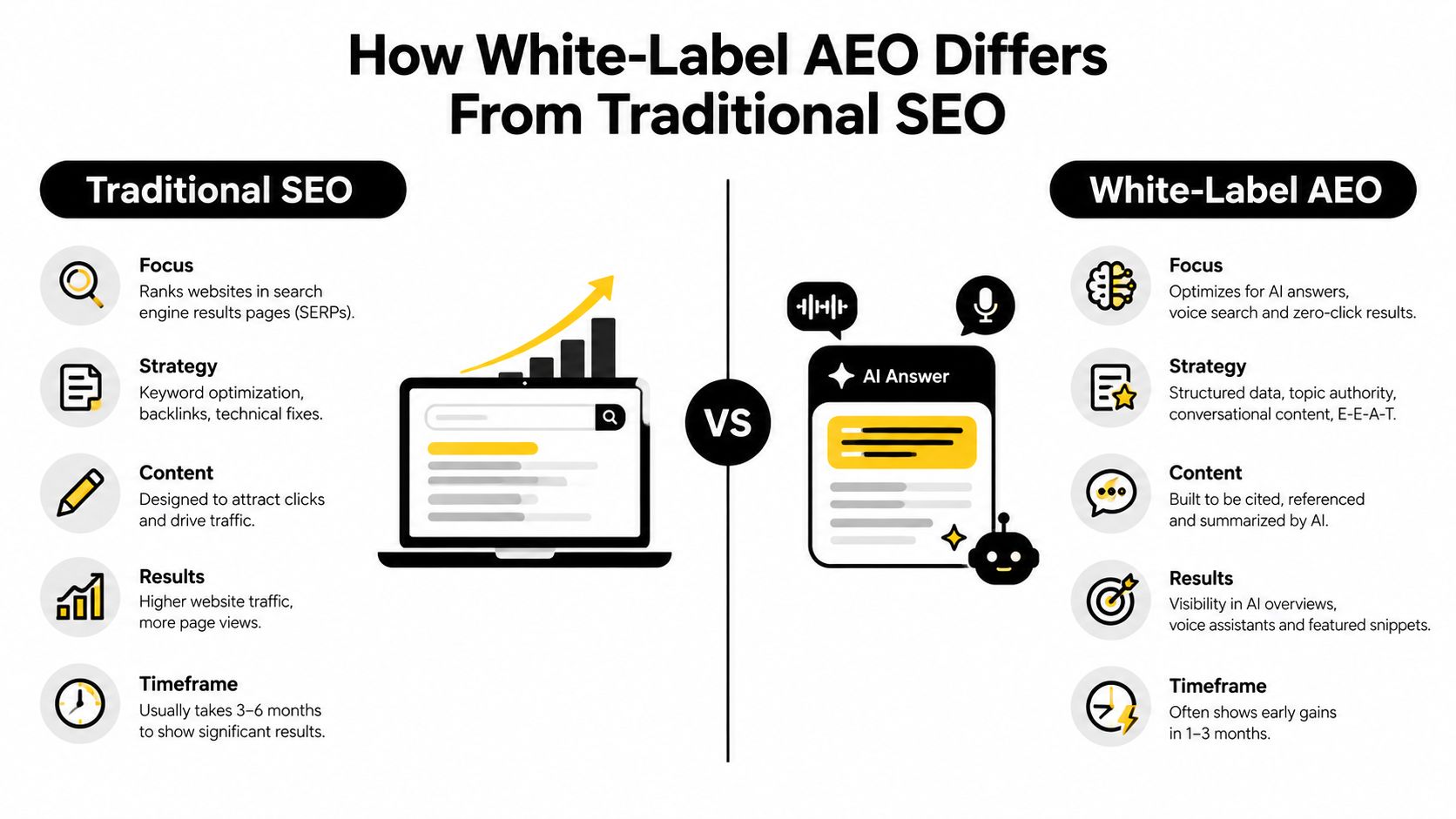
Traditional SEO aims to earn a strong position in a results list through crawlability, relevance, content quality, links, and technical health. AEO aims to make information clear, complete, authoritative, and quotable inside a synthesized response.
These disciplines work together. One industry analysis found that approximately 76% of Google AI Overview citations came from pages already ranking in the top 10 (Search Engine Journal's AEO guidance). That makes conventional SEO a prerequisite for many citation opportunities.
| Area | Traditional SEO | White-label AEO |
|---|---|---|
| Primary outcome | Organic ranking | AI citation and accurate brand representation |
| Content format | Topic and keyword coverage | Direct answers, comparisons, specifications |
| Core signals | Indexability, relevance, links | Completeness, freshness, entities, evidence |
| Reporting | Rankings, traffic, leads | Citations, cited passages, prompts, influence |
Local agencies should also separate geographic relevance from answer visibility. This resource on local SEO vs geo targeting offers useful context for that distinction.
Benefits of Offering White-Label AEO Services
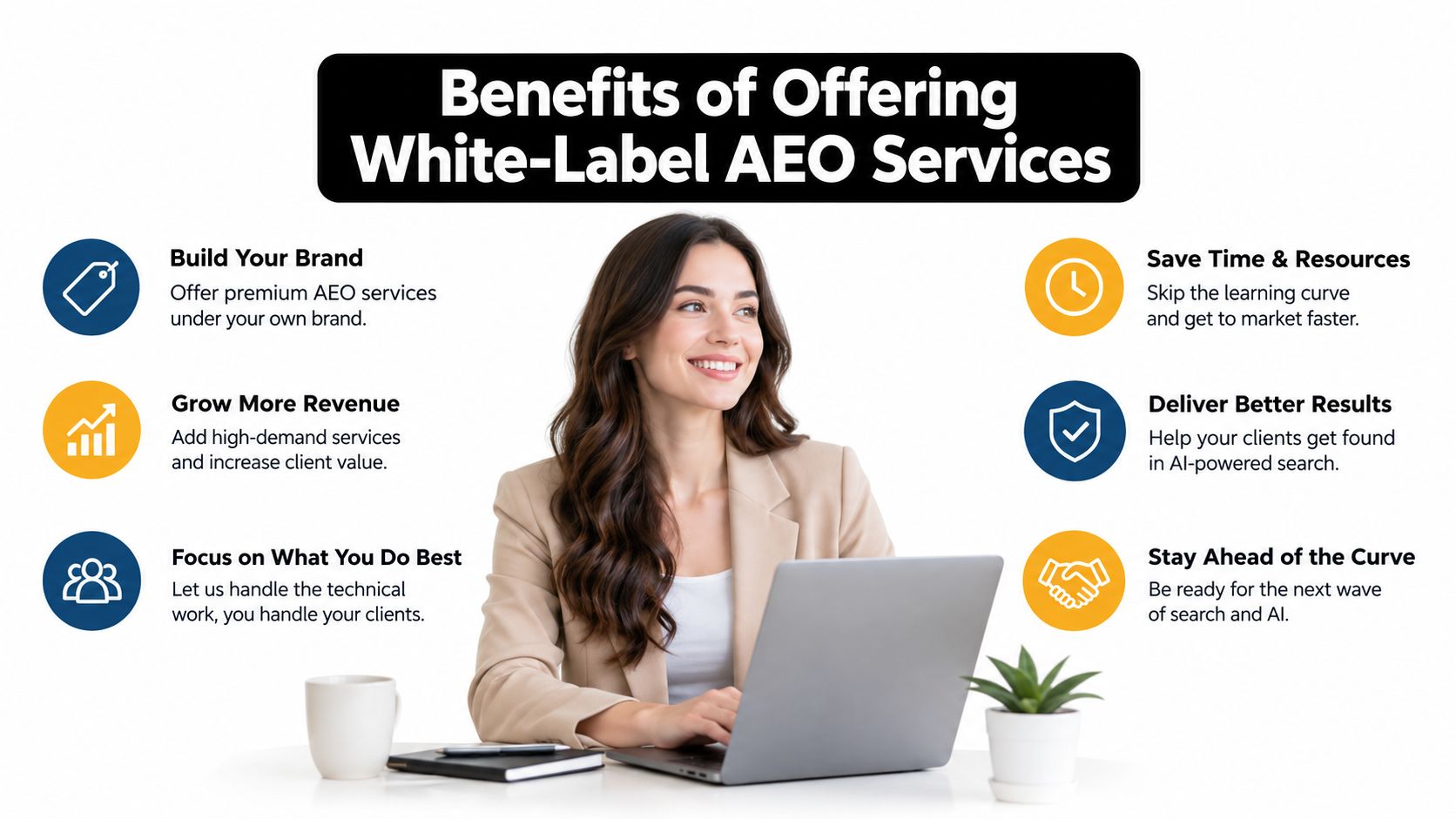
The strongest benefit is faster service expansion. A fulfillment partner can provide prompt research, answer-ready content, entity alignment, and citation tracking while your agency packages the work with existing SEO services.
That creates a more scalable offer:
Broader delivery: Add AI-search visibility without hiring an internal specialist team.
Consistent execution: Use repeatable audits, content templates, QA checks, and reporting.
Better client conversations: Discuss citations, branded search, assisted conversions, calls, and form submissions instead of traffic alone.
Stronger positioning: Show clients that your agency understands zero-click discovery and synthesized answers.
Don't price AEO as a cheap content add-on. It requires factual QA, query testing, source alignment, and ongoing interpretation. The most defensible packages connect AI visibility with business outcomes, while clearly explaining that a citation may influence a buyer without producing an immediate click.
Implementation Checklist for Agencies
Launch the service in this order:
Audit the foundation. Check crawlability, indexation, internal linking, and page quality before proposing AI-specific content work.
Prioritize queries. Select commercially valuable prompts and separate discovery questions from searches where qualified website visits matter most.
Rewrite for extraction. Put the direct answer first. Add definitions, comparisons, specifications, availability, authorship, dates, and evidence-backed claims.
Align entities. Keep business names, services, locations, prices, operating details, and terminology consistent across the site and relevant third-party profiles.
Use schema selectively. Google states that generative AI visibility doesn't require special schema markup. Structured data can still support entity clarity and rich-result eligibility.
Report two layers. Combine rankings, indexed URLs, and crawl status with prompt-level citations, cited passages, pages, and claims.
A branded client dashboard should distinguish controllable technical indicators from probabilistic citation outcomes. Rerun a fixed prompt set after major edits, compare competitors, and send unsupported or stale claims to human review.
How to Choose the Right White-Label AEO Partner
Don't choose a provider because it uses the words “AI” or “GEO” in its sales copy. Ask how it handles factual completeness, local entities, multilingual content, source consistency, and citation-level reporting.
A comparative study across six large language models found that topic mismatch, missing price information, stale timestamps, and lower retrieval position acted as dominant gatekeepers, with reported odds ratios above 100 (the study's HTML version). Your partner should therefore maintain a source-of-truth record and rerun fixed prompts after substantive changes.
| Evaluation Area | What to Verify | Red Flags |
|---|---|---|
| Fulfillment | Research, content, QA, implementation | Content-only delivery |
| Reporting | Prompt, page, claim, and citation data | Vanity mention counts |
| Local capability | Reviews, profiles, services, locations | Website-only optimization |
| Pricing | Clear wholesale and recurring costs | Unrealistic flat rates |
| Governance | Accuracy checks and rollback rules | Guaranteed AI rankings |
For broader vendor-selection context, see choosing the right white label SEO partner. A reliable partner should welcome a controlled trial and explain what it can measure, what it can't attribute, and how it handles incorrect AI summaries.
Common Pitfalls and How to Avoid Them
The first mistake is treating AEO as a replacement for SEO. Citation opportunities often depend on strong organic visibility, so abandoning technical work, useful content, or authority development weakens the foundation.
The second is measuring only clicks. Pew found that users ended their browsing session 26% of the time when an AI Overview appeared, compared with 16% without one (Business Standard's coverage of the findings). Report citation presence, cited themes, branded search, direct traffic, calls, forms, assisted conversions, and revenue together.
The third is automating everything. Triage queries by commercial value, factual risk, AI-summary likelihood, and conversion path. Preserve click-oriented pages for high-value searches, and use concise answer units for discovery queries. Monitor local reviews carefully too, since 48% of consumers read an AI-generated review summary before reading selected reviews (BrightLocal's 2025 survey).
Agency Platform offers white-label SEO and AEO fulfillment, including answer-ready content, local entity alignment, AI-search visibility tracking, and client reporting. Visit Agency Platform to evaluate a branded way to add measurable AI-search services without building the fulfillment operation in-house.