Dave Thompson September 18, 2026 12 Views
TL;DR
- Real estate SEO helps agents and brokerages reach local buyers and sellers through traditional search and AI-powered results. Competing with major property portals starts with specific local expertise—not broader keywords or shortcuts.
- Target relevant searches: Focus on neighborhoods, property types and questions that reflect buyers’ and sellers’ needs.
- Publish useful content: Create informative local pages, accurate listings and practical guides supported by quality images and virtual tours.
- Strengthen local visibility: Optimize your Google Business Profile, maintain consistent contact details and encourage honest reviews.
- Get the fundamentals right: Keep your site secure, fast, mobile-friendly and easy to navigate, and earn relevant backlinks.
- Include AI search: The same SEO foundations apply to Google’s AI Overviews and AI Mode; no special AI schema is required.
- Measure meaningful results: Track inquiries alongside traffic and search visibility. Avoid keyword stuffing, manipulative links and low-value duplicate pages.
WHAT IS REAL ESTATE SEO?
Real estate SEO uses a range of techniques to improve your website’s visibility in search engine results pages (SERPs), making it easier for prospective buyers and sellers to find you.
Stronger search visibility can bring more relevant visitors to your site. That now includes discovery through Google’s AI Overviews and AI Mode, alongside traditional search results. Google’s AI search guidance confirms that the same SEO fundamentals still apply.
WHY YOU SHOULD USE AN SEO STRATEGY FOR REAL ESTATE
In its 2026 Home Buyers and Sellers Generational Trends report, the National Association of REALTORS® (NAR) reported that over half of homebuyers, specifically 52%, discovered their home online, while 27% found their home through a real estate agent. These figures cover primary-residence purchases from July 2024 through June 2025.
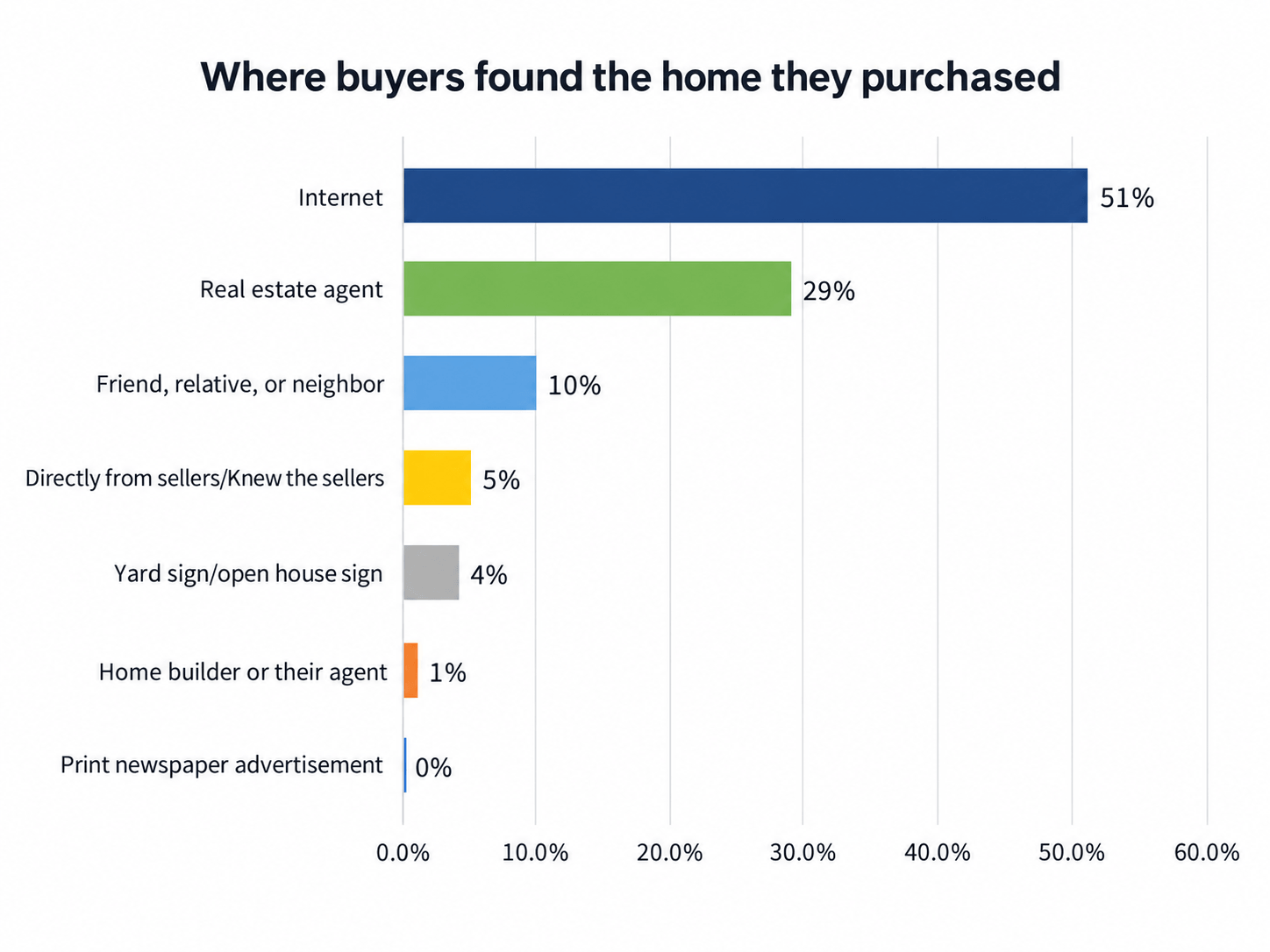
These findings show that potential clients are researching their next home online. Without a visible digital presence, you risk missing opportunities to connect with them.
An SEO strategy helps you make a strong first impression on potential buyers and sellers by:
- Identifying the keywords and questions that buyers and sellers use when searching online.
- Improving your visibility for relevant searches to attract buyers and sellers and turn their interest into inquiries.
THE CHALLENGE
Real estate is built on connections with local customers. Online, reaching those customers means competing with both nearby businesses and major property websites. Aggregators such as Zillow, Realtor.com, Trulia and Redfin are prominent competitors for broad searches. The original Google results example below illustrates this for a common query: “Homes For Sale in Frisco TX“.
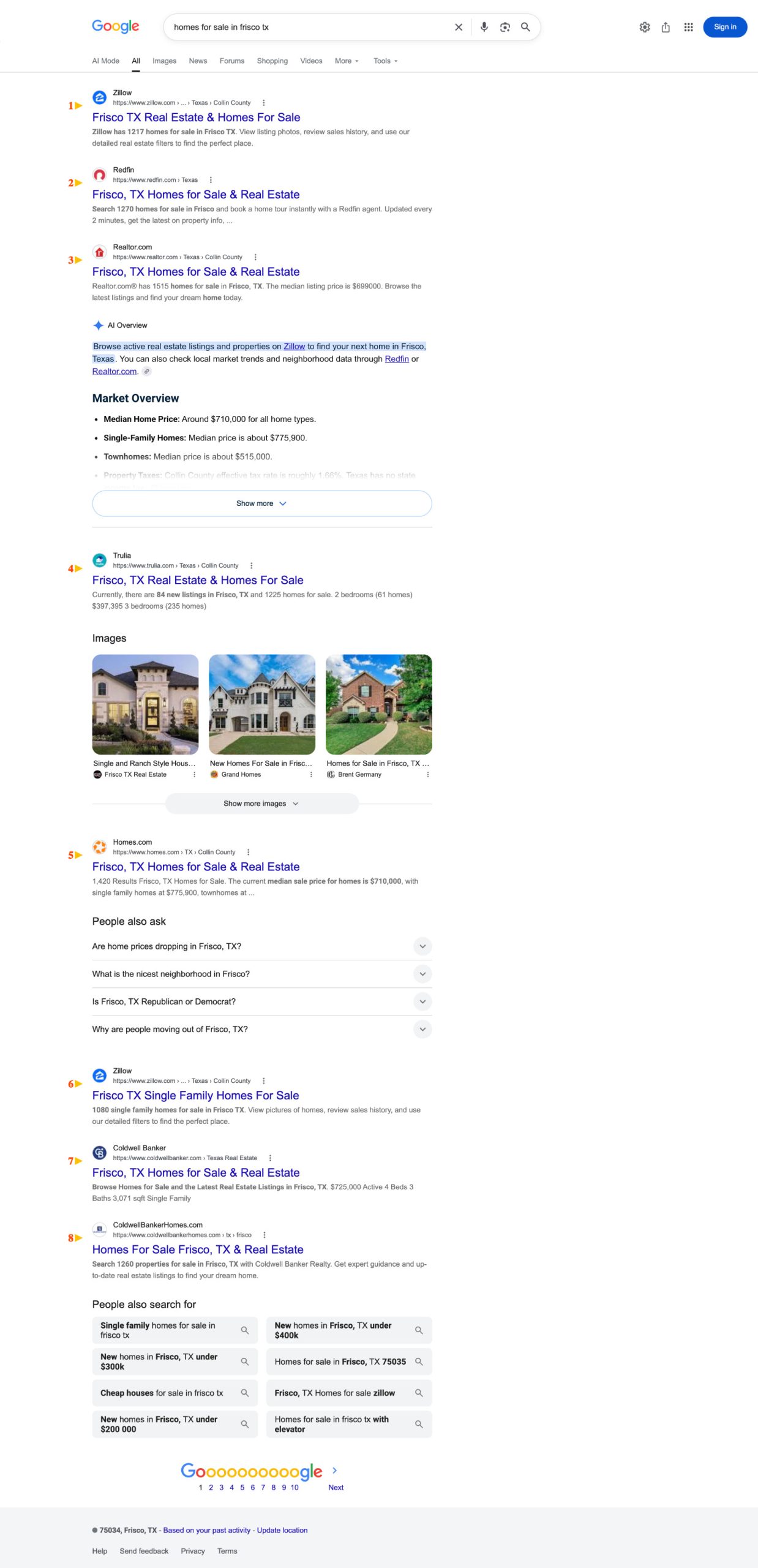
In this example, real estate aggregators occupy prominent positions, making it harder for individual broker listings to stand out.
Not every real estate search displays a local listing pack. Results vary by query and location, and some now include AI-generated answers, creating additional considerations for search visibility.
Competing with larger brands can seem difficult, but it does not put meaningful visibility out of reach. The following strategies explain how to build a focused SEO plan for your real estate website.
HOW TO CRAFT A STRONG SEO STRATEGY FOR YOUR REAL ESTATE WEBSITE
- Utilize SEO Best Practices
- Keyword research
Effective keyword research is the foundation of a successful SEO plan. When competing with large property websites, look beyond broad terms and identify searches where your local knowledge is relevant. Review the actual results to see which queries show a local pack, property listings or AI answers, then match your page to the searcher’s needs.
Choose keywords that reflect your strengths, specialties and service areas. Rather than starting with the most competitive terms, focus on specific searches you can answer well. Include the natural-language questions buyers and sellers ask, whether they use a search engine or an AI assistant.
Here are examples of real estate keywords that often fall into higher- and lower-competition categories.
High Competition Keywords
- Short-tail Keywords: “homes,” “real estate,” “property,” “houses for sale”
- Major Cities: “Los Angeles real estate”, “Miami homes”
- Generic + Location: “[City name] realtor”, “[State] real estate agent”
Why are they high competition? These broad keywords can attract substantial search demand and competition from major real estate platforms and aggregators such as Zillow and Trulia. Competition will vary by market.
Lower Competition Keywords
- Long-tail Keywords: “3 bedroom homes with pool in [neighborhood]”, “luxury condos downtown [city name]”
- Specific Niches: “historic homes [city]”, “equestrian properties [state]”, “investment properties [city]”
- Location + Features: “[Neighborhood] homes with mother-in-law suite”, “[City] condos with water views”
Why are they lower competition? More specific keywords often attract fewer searches but reveal clearer property preferences. Check the actual search results and demand before assuming a term is easier to rank for.
Key Considerations:
- Domain Authority: New websites and independent agents may find highly competitive keywords difficult to rank for. More focused terms can offer a practical starting point. Use authority metrics as a guide, not as a guarantee of ranking potential.
- Search Intent: Specific keywords can reveal what buyers and sellers need and how far they are into their research. Matching that intent helps you attract relevant prospects.
- It’s a spectrum: Keywords do not fall neatly into high-competition and niche categories. Many sit between the two, with different levels of demand and competition. For example:
- Moderately popular locations: Smaller cities or neighborhoods within major cities may attract useful search demand without the competition associated with the largest markets.
- Feature-specific keywords: “Homes with finished basements” is more specific than just “homes” but less niche than “homes with in-ground pools and a hot tub”.
- Intent-based keywords: “First-time homebuyer programs [city]” addresses a more specific need than “homes for sale [city]”. Its competition level still needs to be checked.
- Optimize page titles, meta descriptions, and headers
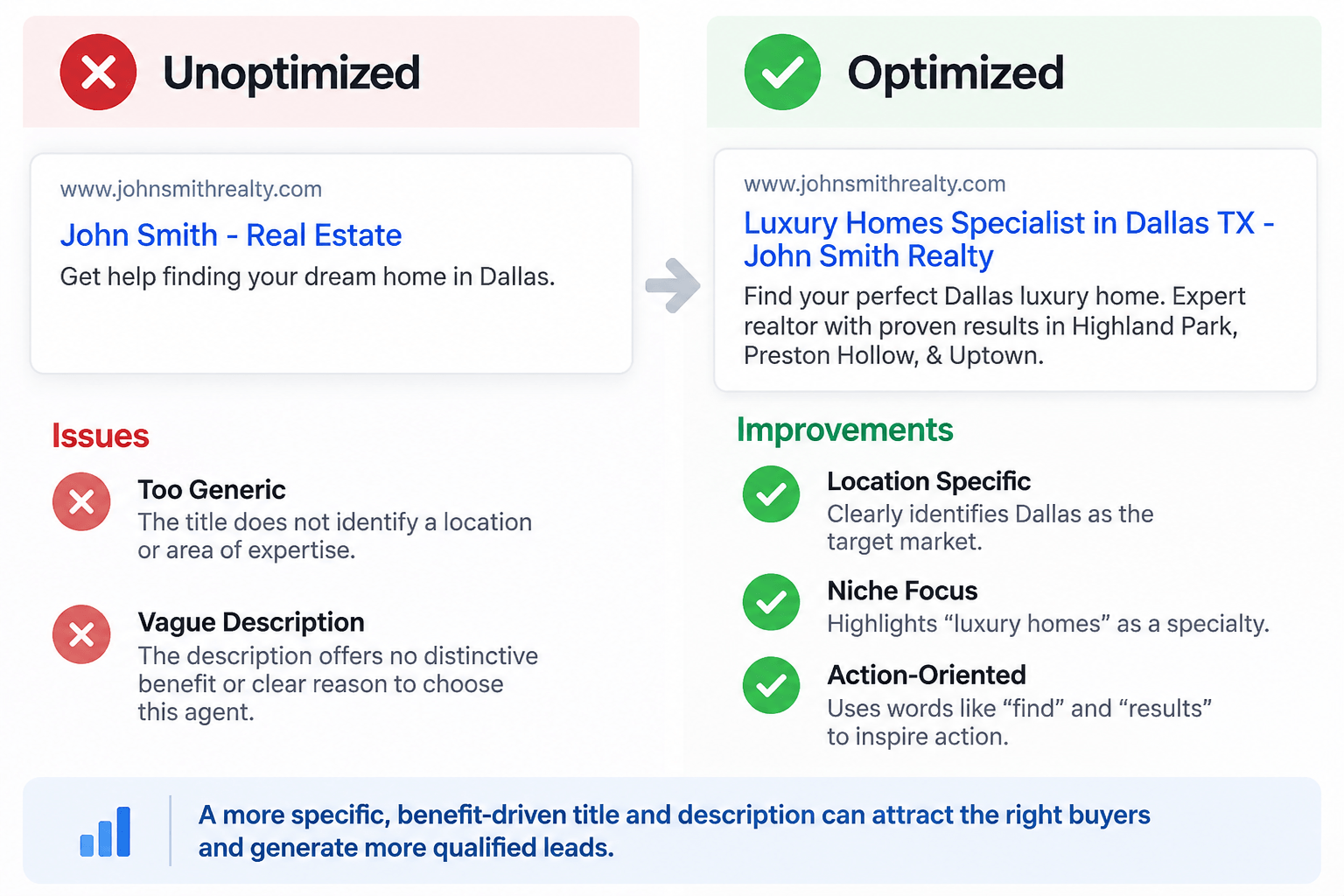
Use relevant keywords naturally in title tags, meta descriptions and headers. These elements should clearly describe the page and help searchers understand why it is relevant. Where appropriate, include a concise call to action.
Scenario: A potential home buyer is looking for a realtor in Dallas. These are illustrative examples; use expertise and results claims only when they can be substantiated.
Additional Tips for Optimization
- Call to Action: Consider adding “Call for a free consultation” if that accurately reflects the service offered.
- Use schema markup
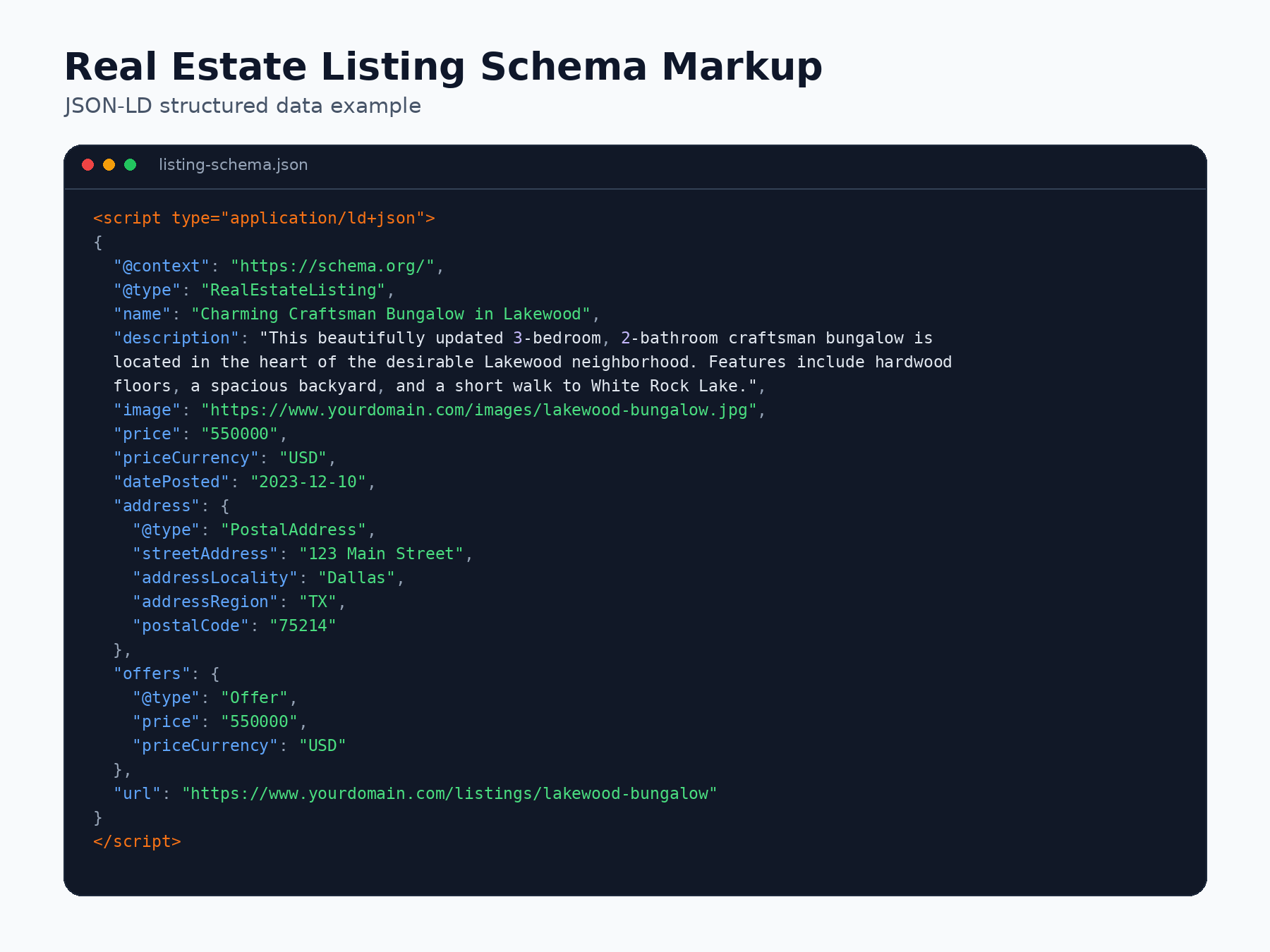
Use schema markup, including RealEstateListing where appropriate, to help search engines understand your property information. Keep it consistent with the visible page content. Structured data does not guarantee richer results or higher click-through rates, and Google requires no special schema for AI search.
Here is an illustrative RealEstateListing example. This is not production-ready code; validate and update the markup against current documentation before using it on a live website.
- Generate High-Quality Content
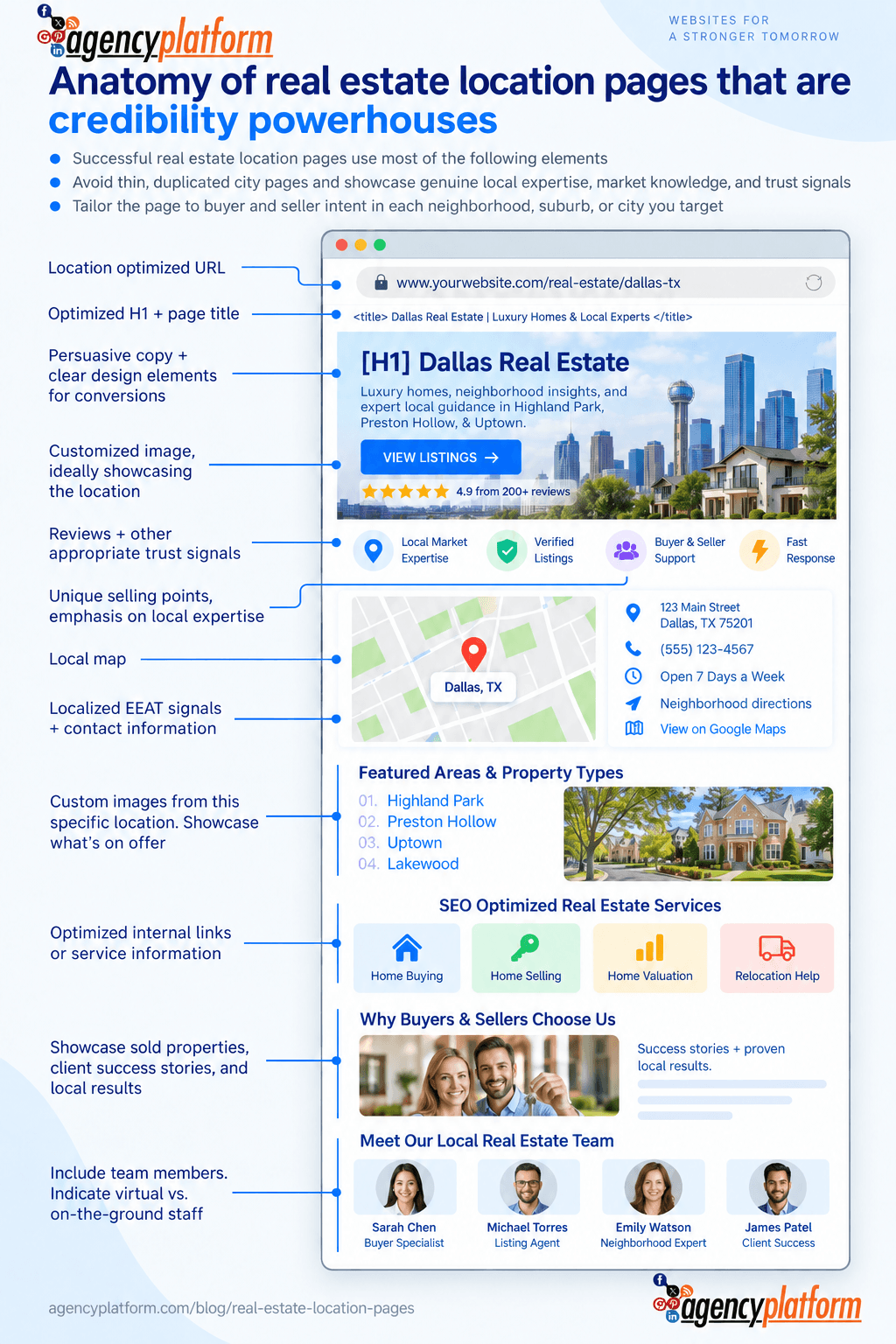
- Create optimized landing pages
Well-optimized landing pages help you match the way clients search for properties and local services. Build each page around a relevant area, property type or client need, using specific information that demonstrates your knowledge of the market.
- Don’t just sell homes, educate clients!
Useful blog posts, market analysis and buying or selling guides help clients understand local trends and make informed decisions. Share your expertise, cite the source and date of market figures, and answer common questions clearly. Clear, factual text also makes the information accessible in an AI-assisted search journey.
- Use high-quality images and virtual tours
High-quality images and virtual tours help showcase a property’s layout, condition and atmosphere. They give prospective buyers a clearer sense of the space before arranging a viewing. Pair visual content with accurate written descriptions so important details are available to readers and search engines.
- Update content regularly
Keep content useful by updating it when the underlying information changes. Review property availability, prices and market commentary, and make the relevant dates clear. Accurate, current information serves prospective clients better than simply changing a page’s publication date.
- Dominate Local Search
- Claim and optimize your Google Business Profile
Claim and optimize an eligible Google Business Profile, formerly Google My Business. Keep business information, photos and posts accurate and current to support your presence in Google Search and Maps. Use a profile for the eligible business or practitioner, not for each individual property listing.
These common issues indicate that a Google Business Profile needs attention.
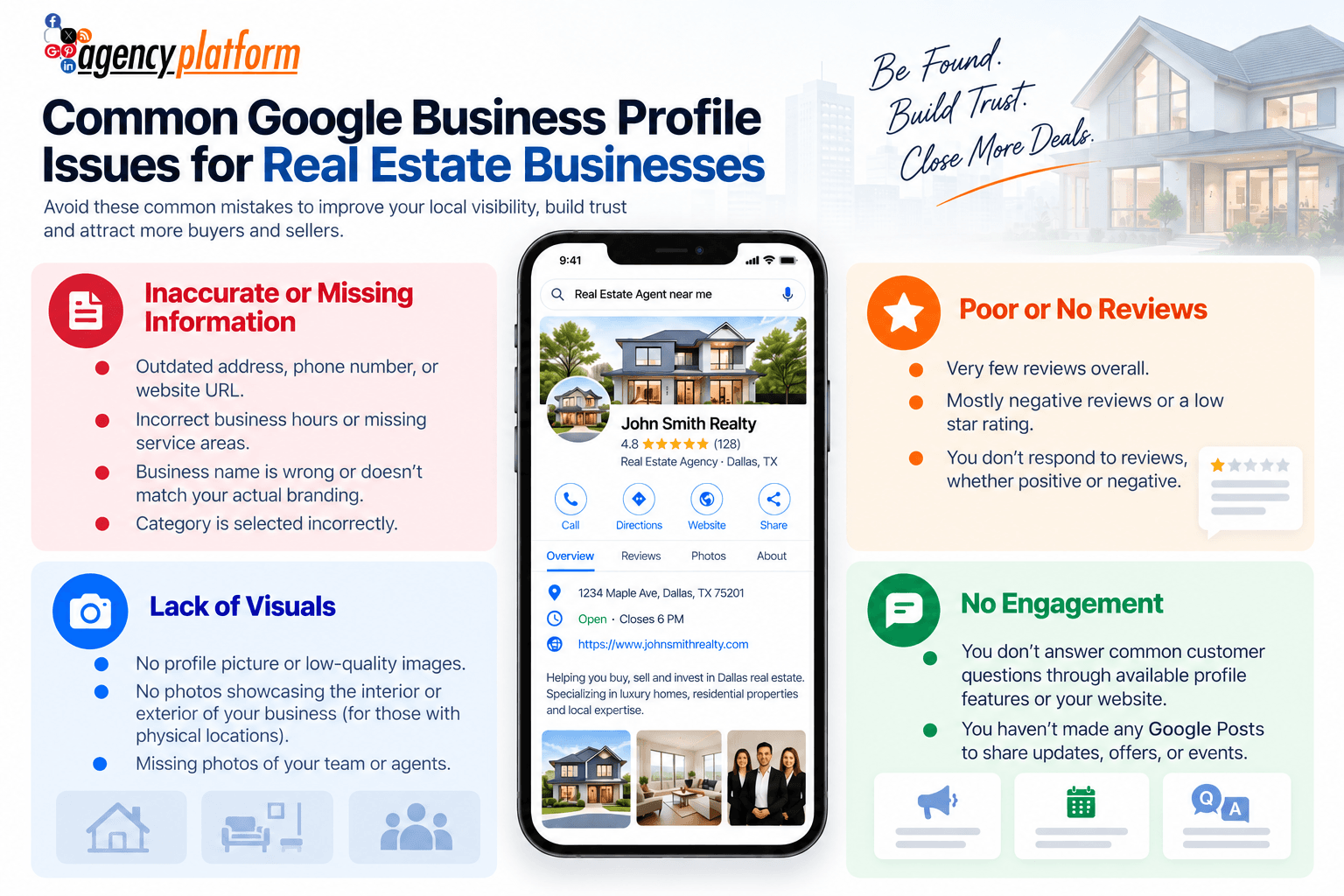
The original comparison below illustrates an unoptimized and a well-optimized listing. The interface shown is an example from the original document, not a current screenshot.
Add image – listing_comparison.png
- List your business in other local search engines and directories
List your business on relevant search engines and local directories, including Apple Maps, Bing Places and Yelp. Keeping these profiles accurate gives potential customers more ways to discover and contact you.
- Ensure your NAP is consistent across the local ecosystem
Keep your business’s Name, Address and Phone number (NAP) consistent across relevant online platforms. Conflicting contact details can confuse prospective clients, so check and update the information wherever it appears.
- Encourage clients to leave honest reviews online
Genuine reviews help prospective clients evaluate your business. Invite clients to share honest feedback on your Google Business Profile and other review sites without incentives or positive-only screening. Respond professionally to both positive and negative reviews to show that you value customer feedback.
- Technical SEO
- Ensure your site is secure
Use HTTPS to encrypt data sent between a visitor’s browser and your website. This helps protect information in transit and supports trust, but it does not replace other website-security measures. Keep your certificate and website software up to date.

- Fix duplicate content and broken links
Address duplicate content and broken links to maintain a clear site structure and a smooth user experience. Consolidate unnecessary duplicate pages, identify the preferred URLs and fix links that no longer work. Regular audits help visitors and search engines reach the right content.
- Interlink your content via relevant keywords
Link related pages using descriptive, relevant anchor text. This helps visitors find useful information and makes the site’s structure clearer to search engines. Google’s AI search guidance also recommends making important content easy to find through internal links.
- Submit your XML sitemap to search engines
Submit an XML sitemap containing the pages you want search engines to discover. Keep it current and use Search Console to investigate crawling and indexing issues. A sitemap helps with discovery but does not guarantee that every page will be indexed.
- Backlink Strategy
- High-Quality, Informative Content: Create useful market analysis, home buying or selling guides and local real estate resources. Content that answers a genuine need gives other websites a reason to reference and link to it.
- Guest Blogging: Contribute informative articles to reputable real estate or local business websites. Focus on sharing relevant expertise and reaching a useful audience, rather than securing a link at any cost. Paid or sponsored links should be appropriately qualified.
- Infographics and Videos: Create engaging visuals that explain real estate tips, trends and data. Include clear sources so publishers and readers can verify the information when sharing it.
- Local Directories and Listings: Add your business to relevant local directories and real estate platforms, including an accurate website URL.
- Press Releases: Share genuine news about significant events, achievements or services through appropriate local outlets and distribution channels. Focus on news value rather than using press-release links to manipulate rankings.
- Improve Site Speed
- Compress images without losing quality to ensure fast loading times.
High-quality images are important for showcasing properties, but unnecessarily large files can slow the site. Compress and resize images while preserving the detail buyers need.
- Minimize the use of heavy scripts and plugins.
Scripts and plugins add useful functionality, but too many can slow your website. Keep the tools you need, remove redundant ones and check their effect on loading and responsiveness.
- Use a content delivery network (CDN) to speed up content delivery.
A CDN distributes content through servers in different locations, helping deliver files from a server closer to the visitor. It can improve the delivery of suitable assets, especially larger files.
- Optimize for Smaller Screens
- Ensure your website is responsive and provides a good user experience on mobile devices.
A responsive website adapts to different screen sizes, making pages easier to read and navigate. Keep essential property information available on mobile as well as desktop, so visitors can continue their research on either device.

- Consider the layout, font sizes, and button sizes for touch navigation.
Use readable font sizes, clear layouts and comfortably sized touch controls. Test property filters, image galleries and inquiry buttons on smaller screens to reduce accidental taps and make the next step straightforward.
- Performance Monitoring and Analysis
- Use Google Analytics and Google Search Console to track website performance and identify improvements. Include AI-search visibility alongside traditional search traffic, using Search Console’s Generative AI performance report where available. Review identifiable AI referrals and inquiries, rather than treating every impression as a visit or a lead.
Together, these practices support a more visible, useful real estate website and make it easier for prospective clients to find information and contact you.
STEER CLEAR: TOP SEO TACTICS YOU MUST AVOID
SEO tactics that violate Google’s spam policies can harm search visibility. Avoid the practices below, whether the content is written manually or produced with AI assistance.
- Keyword Stuffing: Repeating target keywords unnaturally instead of writing useful content. For example:
- Link Buying: Purchasing backlinks to pass ranking credit rather than earning relevant editorial links.
- Duplicate Content: Replicating entire articles with only the location keyword changed, without adding meaningful local information. AI-generated city pages need the same scrutiny. For example:
- Sneaky Redirects: Deceptively sending visitors to unrelated content or showing search engines something different. This is not the same as a legitimate redirect when a page moves.
- Hidden Text: Concealing keyword-heavy text with matching background colors, off-screen placement or images to manipulate search rankings.
SUMMARY
Real estate SEO helps make your website easier for prospective buyers and sellers to find and use. The same foundations remain relevant as search expands to include AI-generated answers. Here is a summary:
- What is Real Estate SEO? Techniques that improve your website’s visibility for relevant searches and help attract prospective clients.
- Why is SEO Important in Real Estate? Buyers research homes online, making a visible digital presence an important part of reaching potential clients.
- The Challenge: Major aggregators such as Zillow compete for prominent search positions, making it harder for individual brokers to stand out.
Creating a Strong SEO Strategy Includes:
- Using SEO Best Practices: Research the keywords and questions prospective clients use, then align your titles, descriptions and content with those needs.
- Generating High-Quality Content: Publish useful blog posts and guides that demonstrate local knowledge and answer clients’ questions clearly.
- Dominating Local Search: Claim and optimize your Google Business Profile and maintain accurate information across relevant directories.
- Implement Technical SEO: Keep your website secure, mobile-friendly and fast-loading, and address broken links and unnecessary duplicate content.
- Developing a Backlink Strategy: Earn relevant links by creating valuable resources and contributing useful expertise to reputable websites.
- Monitor Performance: Use Analytics and Search Console to assess traditional and AI-search visibility, website visits and inquiries.
- Avoiding these SEO Tactics: Stay clear of keyword stuffing, manipulative links, low-value duplicate pages, deceptive redirects and hidden text.
READY TO BOOST YOUR REAL ESTATE BUSINESS?
Ready to strengthen your real estate offering? Start with your market, website, Business Profile and lead journey. Identify the gaps, agree on a practical scope and define how progress will be measured.
AgencyPlatform provides white-label local SEO services and branded client reporting for agencies. Contact us to discuss a real estate client’s needs and the right delivery approach under your brand.