Dave Thompson May 14, 2026 1022 Views
A white label PPC agency is a specialized provider that runs pay per click campaigns for another agency, which then delivers the work under its own brand. This model is already mainstream: 73% of digital marketing agencies worldwide have integrated white-label services, and 60% specifically outsource PPC to improve ROI and avoid the $100K+ annual cost of an in-house expert.
If your agency keeps hearing, “Can you handle Google Ads too?” this is the fork in the road. You either hire slowly, train expensively, and absorb delivery risk, or you build a delivery model that lets you sell PPC now without adding fixed overhead. That’s why a white label PPC agency isn’t just outsourced fulfillment. It’s an operating decision that changes how fast you can scale, what margins you keep, and how much complexity your team can handle without breaking.
What Is a White Label PPC Agency and Why Is It Essential for Growth
A white label PPC agency works behind the scenes. Your agency owns the client relationship, pricing, positioning, and strategy at the account level. The fulfillment partner handles campaign build, optimization, tracking setup, reporting, and ongoing management under your brand.
Why agencies turn to this model
Most agencies hit the same ceiling. Clients want PPC, but the internal team is built for SEO, web, content, or account management. Hiring a dedicated PPC specialist solves one problem and creates three more: recruitment, utilization, and quality control.
That’s why the market moved. According to Amra & Elma’s white-label marketing statistics, 73% of digital marketing agencies worldwide have integrated white-label services, and 60% specifically outsource PPC. The same source notes that this shift is tied to better ROI and avoiding the $100K+ annual cost of an in-house expert.
What the agency keeps control over
White label doesn’t mean giving up the account. In a well-run setup, your agency still controls:
-
Client communication through your own account managers
-
Brand presentation across reports, dashboards, and recommendations
-
Commercial terms including markup and scope
-
Strategic oversight on offers, landing pages, local targeting, and business goals
Practical rule: If the partner makes you feel less informed about the account than your client, the model is broken.
The agencies that benefit most are the ones that treat white label PPC as a delivery layer, not as a substitute for client leadership. You still need strong discovery, clear KPIs, and disciplined account reviews. What you remove is the need to build specialist capacity before the revenue is stable.
The Business Case Boosting Profitability and Scalability
The strongest argument for a white label PPC agency is operational math. In-house PPC is expensive because labor, tools, management time, and utilization risk all sit on your books. White label shifts those costs into a variable delivery model.
Where the margin improvement comes from
According to InvisiblePPC’s analysis of white label PPC for agencies, white label providers can have account managers handle 30-50+ accounts, while in-house staff often handle 10-15. That specialization reduces operational overhead by 25-40%, which is tied to 20% higher profit margins and 2.3 times faster growth.
That difference matters because agencies rarely fail from lack of demand. They fail from delivery drag. PPC is especially sensitive to this because campaign management requires constant tuning, platform familiarity, and clean reporting.
Why scale looks different with a specialist partner
Here’s the practical contrast:
| Model | Typical pressure point | Business effect |
|---|---|---|
| In-house PPC team | Hiring before demand is stable | Fixed cost rises faster than revenue |
| Freelance patchwork | Inconsistent process and reporting | Margin and quality fluctuate |
| White label PPC agency | Process standardization | Capacity expands without staff sprawl |
A specialist provider also gives you pricing predictability. You know your fulfillment cost, you set your markup, and you can package services around strategy, landing pages, local SEO, or reporting without rebuilding your org chart.
For agencies that want a clearer sense of packaging structure, reviewing PPC search packages is useful because it forces a practical question: are you selling deliverables, platform access, or business outcomes?
The real gain isn’t only lower cost. It’s the ability to add revenue without adding managerial chaos.
What doesn’t work
What fails is using white label only as a cheap labor source. If your pricing is thin, your scope is vague, and your account team can’t translate campaign performance into client language, your margins disappear in revisions and hand-holding.
Profitable agencies use white label PPC to protect three things at once:
-
Capacity so sales doesn’t outrun fulfillment
-
Consistency so client experience doesn’t depend on one employee
-
Cash flow so growth doesn’t require new payroll every time you add accounts
How the White Label Partnership Model Works in Practice
A good white label relationship should feel boring in the best way. Clear inputs go in, execution happens quietly, and your client sees a smooth branded service.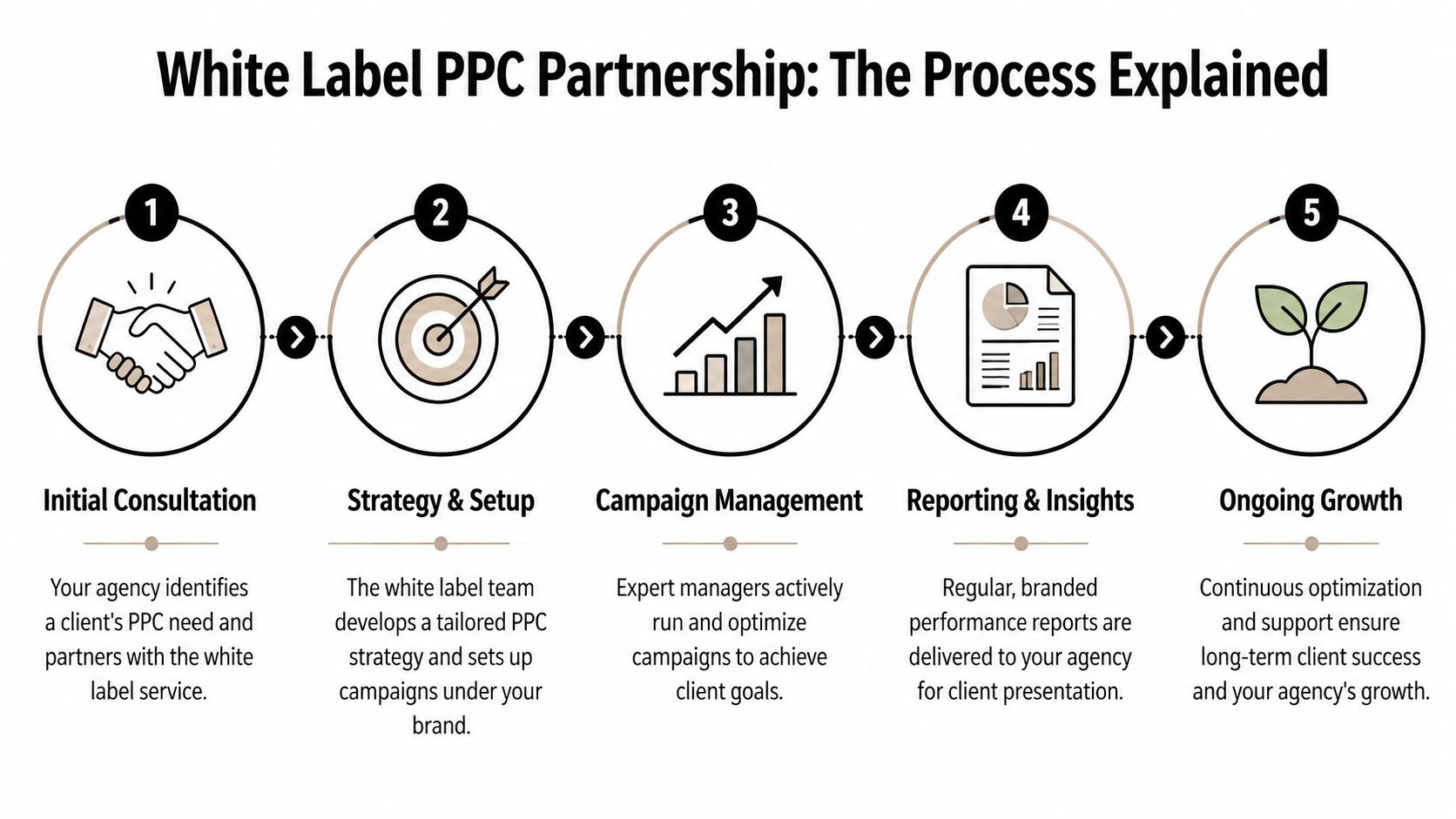
The workflow from sale to reporting
Most partnerships follow a sequence like this:
-
Client brief comes first
Your team gathers goals, locations, budget context, offers, landing pages, conversion actions, and historical account access. -
The partner reviews and scopes the account
At this point, smart providers push back. If the offer is weak or tracking is missing, they should say so early. -
Technical setup gets handled behind the scenes
Accounts, tags, pixels, analytics links, and CRM connections are configured before serious optimization starts. -
Campaigns launch under your brand
Your client sees your agency’s process, not the underlying vendor. -
Reporting cycles stay client-ready
The partner sends branded deliverables that your team can present without rewriting everything.
What smooth collaboration looks like
The operational detail that matters most is handoff discipline. Weak partnerships create rework because nobody defined approval rules, turnaround times, or who owns which decisions.
A mature process usually includes:
-
One intake standard so every client brief captures the same essentials
-
One reporting cadence so account managers don’t improvise updates
-
One source of truth through a branded dashboard clients can access
If you want that visibility layer, a white label dashboard helps keep reporting, branding, and account oversight in one place instead of scattered across ad platforms and spreadsheets.
Agencies lose control when fulfillment is invisible to them. They gain leverage when fulfillment is invisible only to the client.
What your team should still own
Even when the partner runs execution, your agency should keep control of positioning and business context. That includes local market nuance, sales seasonality, lead quality feedback, and client communication.
Many agencies often stumble on this point: They assume a white label PPC agency can replace account strategy. It can’t. The partner can optimize media buying. Your agency still needs to connect campaigns to the client’s offer, sales process, and broader growth plan.
The Technical Edge Gained from Specialized PPC Management
The technical advantage is where white label PPC often pays for itself. Most underperforming accounts don’t fail because nobody touched the bids. They fail because the data feeding those bids is wrong.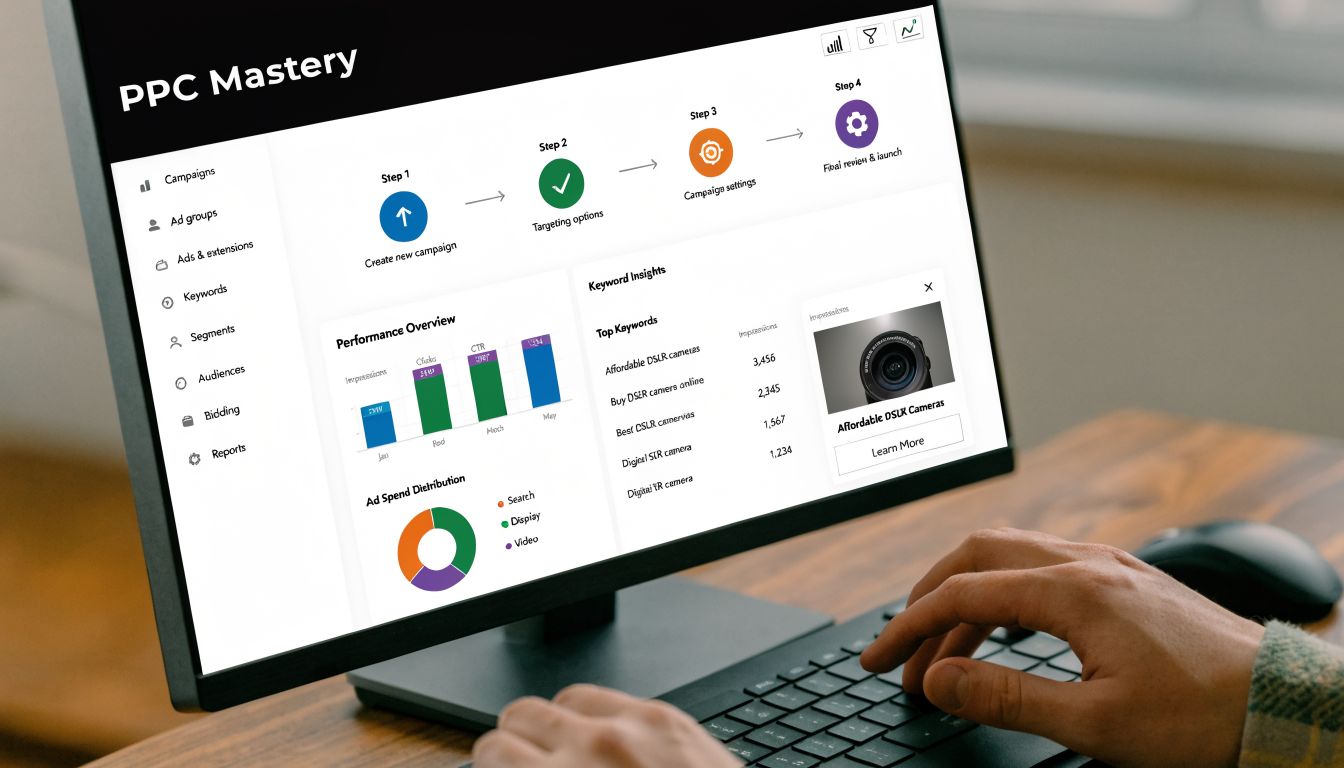
What specialists do better
According to ALM Corp’s guide to white label PPC management, proper setup of Google Tag Manager and conversion pixels can reduce attribution data loss by 20-30%, help agencies launch campaigns 2-3 times faster, and lead to 15-25% higher ROAS.
That result comes from doing foundational work correctly:
-
Tracking implementation through Google Tag Manager, conversion pixels, and validation tools
-
CRM and analytics integration with systems like HubSpot and GA4
-
Bid strategy alignment so automation tools optimize for actual conversions, not weak proxy metrics
-
Account hygiene such as negative keyword pruning, audience exclusions, and structured testing
Why this matters more in AI-driven PPC
Google Ads automation is powerful, but it’s only as good as the conversion data you feed it. If a form submission doesn’t fire, calls aren’t tracked, or offline outcomes never sync back, automated bidding learns from bad signals.
That’s why technical setup is not admin work. It’s performance work.
A specialized team is also more likely to handle account architecture cleanly enough for scale. That means naming conventions, conversion mapping, GA4 alignment, and reporting integrity. If your agency wants to offer this under your own brand, paid campaign fulfillment is one example of a service model built around that invisible execution layer.
Bad tracking creates fake confidence. Clean tracking gives you permission to scale spend.
What generalists usually miss
A general digital marketer can launch ads. That’s not the same as building a durable PPC operation. The misses tend to be predictable:
-
Conversion actions configured inconsistently
-
Platform recommendations accepted without validation
-
Reports focused on clicks instead of business outcomes
-
No process for QA before launch
Clients don’t see those mistakes immediately. They feel them later as inflated CPA, unclear attribution, and awkward retention conversations.
Choosing Your Partner Criteria for a Successful PPC Partnership
Most agencies evaluate a white label PPC agency on price first. That’s backwards. Cheap fulfillment gets expensive when you’re fixing reporting, calming clients, and rewriting strategy every month.
The non-negotiables
Ask these questions before you sign anything:
-
Who owns the data and ad accounts
Your agency should retain access and control. If the provider insists on account ownership that lives entirely on their side, walk away. -
What does reporting look like
Ask to see the client-facing output. It should be readable, branded, and useful for a non-technical stakeholder. -
How do they communicate when performance slips
A real partner explains what changed, what they tested, and what happens next. Silence is a red flag. -
Is the workflow standardized
You want repeatable onboarding, technical QA, launch procedures, and escalation paths.
What separates a partner from a vendor
The strongest providers aren’t just good at Google Ads. They’re good at fitting into an agency business model. That means they understand turnaround expectations, brand protection, and how to support account managers who need clean talking points for clients.
A practical checklist looks like this:
| Evaluation area | What to look for |
|---|---|
| Brand control | White-labeled dashboards, reports, and client-safe deliverables |
| Operational fit | Defined onboarding, SLAs, revision process, and response expectations |
| Technical depth | GTM, conversion tracking, GA4, CRM integration, and audit discipline |
| Strategic support | Clear recommendations, not just task completion |
One option agencies evaluate in this category is Agency Platform, which provides a brandable dashboard, fulfillment across PPC and other channels, and tool integrations that support reseller delivery under the agency’s own identity.
Common Pitfalls and Ensuring Seamless Brand Integration
The biggest fear with a white label PPC agency is loss of control. That fear is justified when the partner is opaque, reactive, or careless with your brand. It’s manageable when the operating model is tight.
Pitfalls that create client friction
The common problems are familiar:
-
Cookie-cutter campaigns that ignore the client’s offer or local market
-
Weak communication that leaves your account team guessing
-
Data lock-in where the provider controls access
-
Generic reporting that looks outsourced
Each one has a fix. Standardize intake. Require account access. Review reporting before client delivery. Put response times and ownership terms into the agreement.
If the dashboard, emails, and reports don’t match your brand, clients will eventually notice the seams.
How brand integration should work
A white label service should feel native to your agency. That usually means your logo, your colors, your reporting cadence, and a client experience that doesn’t expose the backend provider.
A few practices help:
-
Use a custom-branded reporting environment so clients stay inside your ecosystem
-
Keep communication routed through your team unless a specific exception is agreed
-
Define approval boundaries early for ad copy, budget changes, and landing page recommendations
The mistake is assuming white label automatically feels effortless. It doesn’t. Such effortlessness is built through process, presentation, and discipline.
The Future is Integrated PPC, SEO, and Your Brand in One Platform
The next version of white label PPC isn’t standalone campaign management. It’s integrated delivery across paid and organic channels.
According to Propellant Media’s review of white label PPC agency trends, Google’s 2025 updates penalized non-integrated campaigns by 18% in visibility, while agencies using unified dashboards for PPC and SEO saw 25-35% higher client retention. That matters because AI-driven ad automation keeps narrowing the gap on basic execution. Agencies need a broader service model than bid management alone.
Why integrated delivery wins
Clients don’t experience PPC, SEO, local visibility, and content as separate departments. They experience one brand trying to generate leads and revenue. If your reporting is siloed and your teams aren’t aligned, the client sees fragmentation.
That’s why the smarter strategic move is choosing a white label partner that can support a connected model. Paid search informs SEO keyword priorities. SEO content improves landing page relevance. Shared dashboards make retention conversations easier because the client sees one story instead of disconnected channel reports.
The agencies that hold margin over time won’t be the ones selling isolated tactics. They’ll be the ones packaging execution, visibility, and reporting into one branded operating system.
If you want to add PPC without building an internal department, Agency Platform offers a white-label model built for resellers, with branded dashboards and fulfillment that can fit into a broader agency service stack.