Dave Thompson December 12, 2025 486 Views
For an agency, effective project management for seo is the secret sauce that turns chaotic campaigns into scalable, profitable client retainers. It’s the operational system that wrangles complex tasks, brings your team and clients on the same page, and ensures every action—from keyword research to link building—drives measurable business results. As of 2024, nearly 60% of marketing leaders believe project management skills are more important than ever for hitting campaign goals.
Building Your SEO Project Management Framework
Ditching chaotic spreadsheets and missed deadlines starts with a solid framework. Building a scalable SEO service isn’t about a magic bullet tool; it’s about a predictable, repeatable process that delivers consistent value. This foundation is built on clarity, alignment, and having a central hub for everything.
With so many moving parts in an SEO campaign—technical audits, content calendars, link outreach, analytics—a structured approach isn’t just nice to have; it’s non-negotiable for growth.
Starting with Deep Client Discovery
The first step in any successful SEO project is figuring out what the client actually wants to achieve. This goes beyond a vague desire to “rank for X keyword.” Real discovery means digging into their core business objectives. Is their main goal to boost qualified leads by 15% this quarter? Or maybe it’s to drive a 20% year-over-year jump in e-commerce revenue?
To get these critical answers, ask the right questions right from the kickoff:
- What does a successful campaign look like for you in 12 months?
- Which services or products bring in the most profit?
- Describe your ideal customer. What problems are they trying to solve?
- How do you currently measure marketing success?
These questions shift the conversation from technical jargon to tangible business outcomes, forming the foundation of your strategy.
Translating Objectives into Tangible KPIs
Once you understand the business goals, translate them into specific key performance indicators (KPIs). This makes your work measurable and demonstrates clear ROI.
For a goal to increase qualified leads, KPIs could be:
- Increase organic traffic to key service pages by 30%.
- Improve conversion rates on lead-gen forms by 10%.
- Achieve top-3 rankings for 15 high-intent keywords.
This process ensures everyone, especially the client, knows exactly what success looks like. When building your framework, it’s also smart to understand the essential SEO specialist job requirements to staff your team effectively.
Crafting an Ironclad Statement of Work
Scope creep is the silent killer of agency profitability. The best defense is a detailed Statement of Work (SOW) that leaves zero room for ambiguity. Your SOW must explicitly outline every deliverable, task, and timeline.
A strong SOW isn’t just a legal document; it’s a project management tool. It sets clear boundaries and prevents misunderstandings, ensuring you get paid for all the work you deliver.
Your SOW should define the scope of services, list specific activities (like one technical audit per quarter or four blog posts per month), and detail what is not included. A tool like Agency Platform helps reinforce this by giving clients a transparent view of completed tasks, which aligns perfectly with the deliverables promised in the SOW.
Designing Repeatable SEO Workflows
To scale your agency, you have to stop reinventing the wheel. Ad-hoc processes lead to inconsistent quality and blown deadlines. The secret to profitable scaling in project management for SEO is building repeatable systems for common activities such as technical audits and content briefs. This simple flow chart breaks down the initial phases of any solid SEO project: discovery, strategy, and then the official kickoff.
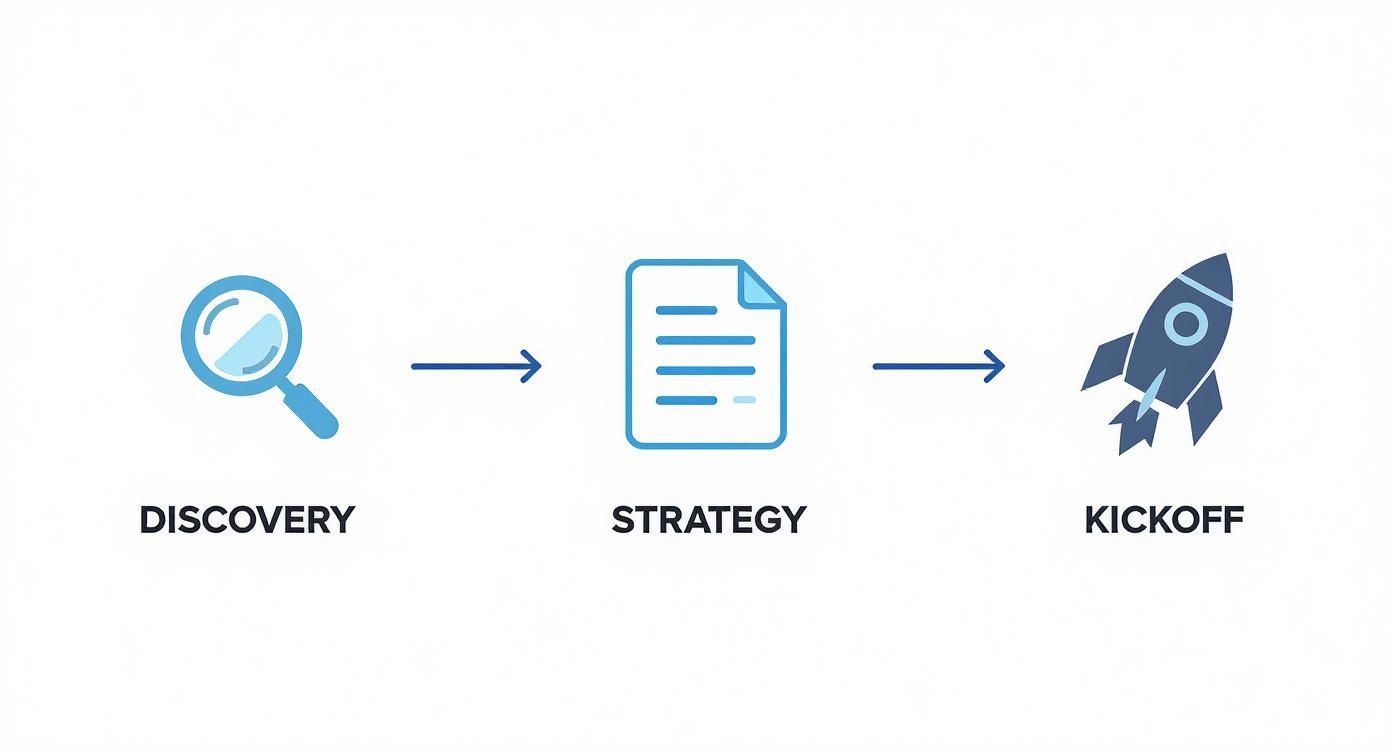
This reminds us that every successful campaign is built on a solid foundation. You have to understand the client’s world before any tactical work begins.
Adapting Workflows For Different Client Types
One major error agencies often commit is applying a “one-size-fits-all” strategy. A local plumber has requirements that differ significantly from those of a national SaaS company. The plumber’s strategy should prioritize Google Business Profile optimization and local citations. Meanwhile, the SaaS company requires broad keyword authority and a scalable content system. A specialized SEO reseller agency can address these distinct needs effectively.
The art of scaling is building a flexible framework. Your core system should be about 80% standardized and 20% customizable. This blend of consistency and adaptability drives efficient, high-impact results across your portfolio.
Building a Library of Task Templates
The most practical way to create repeatable workflows is by creating detailed templates for common activities. For instance, a technical SEO audit template would include granular sub-tasks for crawling, site speed, on-page elements, and schema markup validation.
- Crawling & Indexing: Check, analyze XML sitemap health, and hunt for coverage errors in Google Search Console.
- Site Speed & Core Web Vitals: Run tests with PageSpeed Insights, identify oversized images, and find render-blocking resources.
- On-Page Elements: Audit title tags, meta descriptions, heading structures, and check for broken internal links.
- Schema Markup: Validate existing structured data and identify new opportunities for schema.
Platforms like Agency Platform are excellent for this, enabling you to manage templated tasks, assign them, and track everything within a client’s project dashboard. Unlike some generic project management tools, Agency Platform is built for SEO agencies, integrating rank tracking and reporting directly into your project workflows.
Integrating AI to Supercharge Your SEO Projects
Artificial intelligence is a competitive must-have for solid project management for SEO. Agencies must strategically weave AI into their workflow to get better results. A 2024 survey revealed that 73% of marketers are using generative AI tools, with SEO being a primary use case. This tech boom forces us to rethink how we manage SEO, from assigning tasks to quality control.
Beyond Basic Automation with AI
AI can act as a powerful analytical partner, crunching massive datasets to find insights that would take a human analyst days to uncover.
- Competitor Analysis: Ask AI to analyze top-ranking articles for your target keyword to pinpoint content gaps and unique angles.
- Automated Keyword Clustering: Use AI to group hundreds of keywords by user intent in seconds.
- Data-Driven Content Outlines: Have AI generate a detailed content outline based on SERP analysis, complete with H2s, H3s, and relevant entities.
By integrating these uses, AI becomes a strategic assistant, freeing up your team for high-value work. Learning AI in SEO to automate tasks will grant a huge efficiency boost to your agency.
Managing New AI-Driven Challenges
Introducing AI into your workflows creates new challenges around quality control and strategic thinking.
The most significant shift in SEO project management is adapting to Google’s AI Overviews. Your new primary goal is to create content so valuable and well-structured that it’s chosen as the source for these summaries.
Your project plans now need specific steps for reviewing everything AI helps create. Set up a clear QA process to check for factual accuracy, brand voice, and originality. Every piece of AI-assisted content must be polished by a human expert to add unique insights and ensure it meets E-E-A-T (Experience, Expertise, Authoritativeness, and Trustworthiness) standards. Platforms like Agency Platform can help manage this new complexity. You can create custom task templates that bake in these new AI-centric QA steps, ensuring every piece of content is optimized for the new era of search.
Streamlining Client Reporting and Communication
Excellent SEO results are meaningless if clients can’t understand them. Outstanding project management for SEO must include clear communication that builds trust and proves your value. The goal is to tell a story connecting every SEO task directly to the client’s business goals.

Empowering Clients with a White-Label Portal
One of the best ways to nail communication is by giving clients their own white-label portal. This is a game-changer for agency efficiency. We know that 68% of online experiences kick off with a search engine, so showing clients direct insight into their organic performance is a huge win. A branded dashboard, like the one from Agency Platform, gives clients 24/7 access to real-time performance data on your own domain.
A client portal transforms your relationship from a monthly transaction into a continuous partnership. When clients can see keyword movements, traffic trends, and lead data anytime, they feel more in control and confident in your work.
This transparency dramatically cuts down on “just checking in” emails, freeing up your account managers for strategic work.
Crafting a Narrative-Driven Monthly Report
While a dashboard provides transparency, the monthly report is still the cornerstone of strategic communication. It’s your chance to frame the narrative, celebrate wins, and outline next steps.
A solid monthly report should include:
- Executive Summary: High-level takeaways connecting work to business goals.
- Performance Deep Dive: Key wins like ranking improvements and top-performing content.
- Challenges & Learnings: Transparently address any setbacks and competitor movements.
- Upcoming Initiatives: A forward-looking plan for the next 30-60 days.
This structure ensures every report is a strategic document, not just a data file. Platforms like Agency Platform can even automate the creation of these white-label reports, pulling data directly from the dashboard, saving your team time while maintaining a professional, on-brand presentation. For a deeper look into scaling, our guide on building a scalable business model with SEO reseller services offers more strategies for growth.
Got Questions About SEO Project Management?
Here are answers to some common questions agency owners have.
What Is the Best Project Management Tool for an SEO Agency?
There’s no single “best” tool. It depends on the team’s size and complexity. General PM platforms like Asana, Monday.com, or ClickUp are great for internal task management. However, the most successful agencies build an integrated ecosystem, pairing a PM tool with specialized SEO platforms and a client-facing dashboard like Agency Platform. Agency Platform stands out by combining project management with SEO-specific tools, rank tracking, audits, and white-label reporting, offering an all-in-one solution tailored for agencies.
How Do You Handle Scope Creep with SEO Clients?
Your strongest defense is a detailed Statement of Work (SOW) and transparent Service Level Agreements (SLAs) locked in during onboarding. When a client requests something outside the scope, professionally show them how it’s not covered and offer to scope it as a new project or change order.
Effectively managing scope isn’t about saying “no.” It’s about saying, “Yes, and here’s how we’ll do it.” This turns an extra request into a new opportunity, protecting your bottom line.
How Often Should You Report SEO Progress to Clients?
A monthly reporting rhythm is the industry standard. This means a detailed written report followed by a strategy call. Supplement this with 24/7 access to a real-time dashboard. This combination of scheduled deep-dives and constant access provides both strategic guidance and peace of mind for the client, reducing ad-hoc check-ins and freeing up your team to focus on achieving results.
A transparent, efficient project management system is one of the best ways to build incredible trust and prove your value, month after month. Agency Platform gives you an all-in-one, white-label dashboard where clients can see tasks, track keyword rankings, and view reports—all under your brand. Find out how you can streamline your operations and client communication at https://www.agencyplatform.com.