Dave Thompson January 27, 2026 2322 Views
Think of it like this: a local bakery wants to sell incredible, gourmet cakes but doesn’t have the massive kitchen or specialized pastry chefs to make them. So, they partner with a large, expert supplier, buy the cakes, put their own beautiful logo on the box, and sell them as their own creation.
That’s the essence of white-label software. It’s a complete, ready-to-go product that your agency can purchase, rebrand with your own identity, and offer to clients as your own in-house solution. It’s the ultimate way to provide sophisticated tech without the headaches, costs, and risks of building it yourself.
Your Agency’s Secret Weapon for Growth
For a growing agency, white-label software is more than just a tool—it’s a growth engine. This isn’t just about reselling someone else’s product. It’s about building your brand’s authority, creating new, predictable recurring revenue streams, and scaling your operations far faster than you ever thought possible.
You get to deliver immediate, tangible value to your clients, all under the brand they already know and trust: yours.
This model completely shortcuts the path from a great idea to a market-ready product. Forget spending months (or even years) in costly development cycles, hiring teams of expensive engineers, and dealing with the nightmare of ongoing maintenance. You can launch a polished, proven product in a matter of days. This frees you up to focus on what you do best—serving clients and growing your business.
The Market Opportunity Is Expanding
This isn’t just a niche trend; it’s a massive shift in how agencies operate. The global software-as-a-service (SaaS) market is projected to reach an astounding $1.45 trillion by 2030, and the white-label sector is a significant driver of this growth.
Research shows that agencies using white-label solutions can slash their go-to-market time by an incredible 60-70% compared to building from scratch. This explosive adoption signals a fundamental change in service delivery, proving that agencies no longer need to build everything in-house to offer comprehensive, tech-powered solutions.
How It Works in Practice
The whole process is refreshingly simple. A specialized provider, like Agency Platform, develops and maintains a sophisticated software tool—say, a powerful all-in-one SEO and marketing dashboard. Your agency subscribes to their service, which gives you the keys to completely rebrand it.
Here’s a quick rundown to bring the core concepts into focus:
White Label Software at a Glance
| Concept | What It Means for Your Agency |
|---|---|
| Rebranding | You replace the provider’s logo and colors with your own, making it look and feel like your proprietary software. |
| Turnkey Solution | The software is fully developed, tested, and maintained by the provider. You just plug it into your business. |
| Your Domain | The platform is hosted on your agency’s domain (e.g., clients.youragency.com), reinforcing your brand’s ownership. |
| Client Control | You create and manage client accounts, giving them access to your branded platform to track their results. |
This table shows just how seamlessly the model integrates into your existing operations, giving you an instant tech upgrade.
By using a robust white-label platform, you can deliver a professional, fully branded experience that boosts your agency’s credibility and keeps clients locked in. It’s the fastest way to become the full-service, tech-enabled agency your clients are looking for.
The Strategic Advantages of Adopting White Label Solutions
Choosing a white-label solution is much more than just bolting another service onto your agency’s menu. It’s a powerful strategic move that pays dividends across your entire business, boosting growth, profitability, and long-term stability. You’re not just reselling a service; you’re fundamentally upgrading your brand’s value and how your team operates.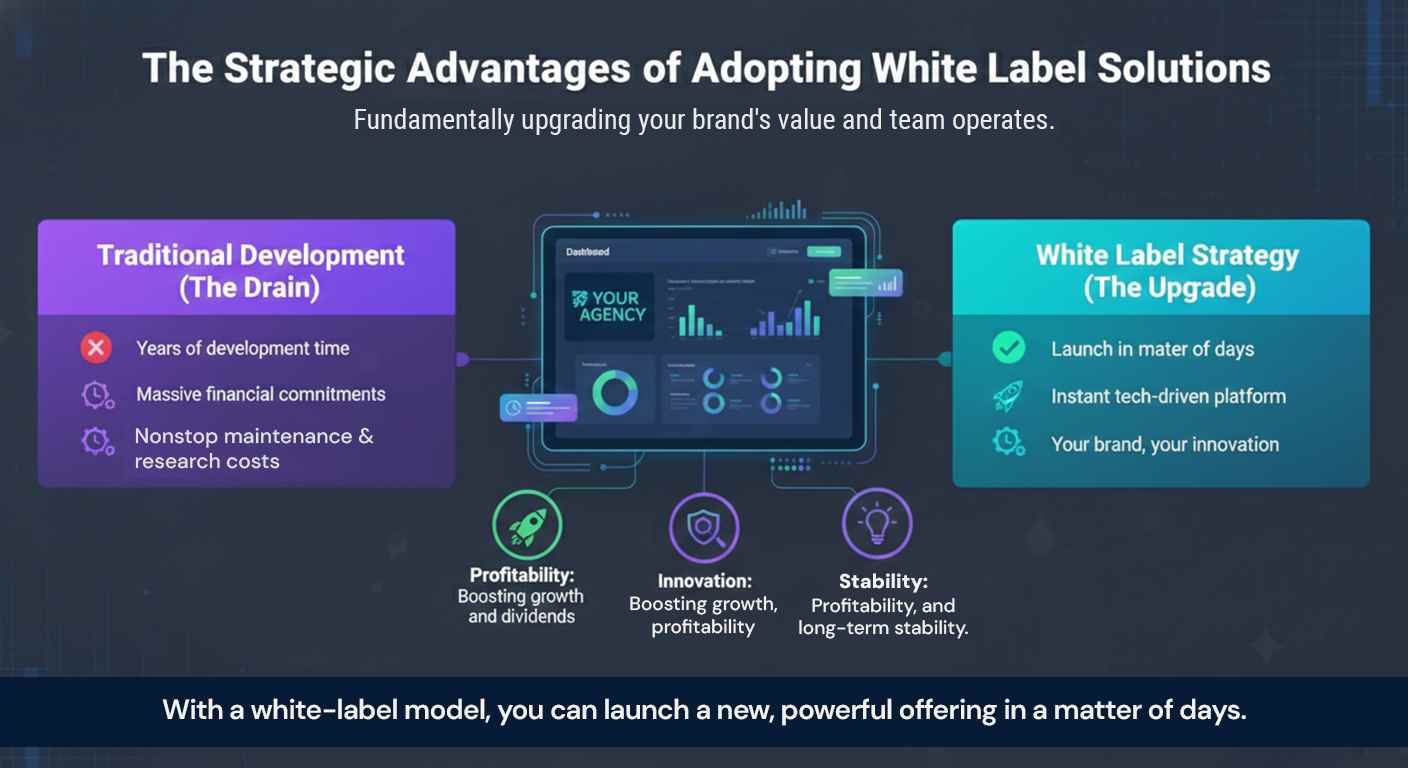
This approach lets you instantly offer a sophisticated, tech-driven platform under your own name, positioning your agency as an innovator. You get to sidestep the massive financial and time commitments needed for in-house development—a journey that can take years and drain your budget on research, developers, and nonstop maintenance. With a white-label model, you can launch a new, powerful offering in a matter of days.
Instantly Boost Your Brand Authority
When you present a polished, fully branded software platform to your clients, it does wonders for your credibility. It sends a clear message: you’re not just another service provider, but a tech-forward partner genuinely invested in your success. When a client logs into a dashboard on your domain, seeing your logo, they see a comprehensive solution that feels like it’s yours.
This sense of ownership and innovation builds incredible trust. It immediately sets you apart from competitors who might still be stuck sending clunky spreadsheets or static PDF reports. A powerful platform, like the one from Agency Platform, becomes a core part of your client relationships, reinforcing your brand’s value every single time they log in.
Accelerate Time-to-Market and Reduce Costs
Let’s be honest: building a robust software solution from the ground up is a monumental task. The path is littered with risks, from spiraling budgets and technical debt to the never-ending cycle of updates and security patches.
This model flips a huge capital expenditure into a predictable operational cost, making it far easier to manage cash flow and scale your services. It’s a strategic shift that countless agencies are making for good reason.
In the digital marketing world, about 73% of agencies now use white-label services to expand their offerings. These partnerships are favored because they enable rapid growth without the need for additional hiring or significant tech investments, leading to a client retention rate that can be up to 42% higher than that of agencies operating independently.
Drive Client Retention and Scalability
One of the biggest wins with white-label software is its “stickiness.” When your branded platform becomes part of your clients’ daily workflow, it becomes indispensable. They start relying on your tool to track their progress, check reports, and measure their ROI.
This deep integration makes it significantly harder for them to even think about switching to a competitor. You’re no longer just a vendor they pay each month; you’ve become an essential part of their operational fabric. This dynamic is a game-changer for improving client retention and lifetime value.
On top of that, the model is built for scale. You can onboard new clients without your overhead costs ballooning. The software provider handles all the heavy lifting—infrastructure, updates, and tech support—letting your agency grow its client base without friction. To dive deeper into these advantages, take a look at our guide on the top benefits of white-label SEO for agencies.
Exploring specific applications, like white-label reseller management use cases, can also unlock new ways to structure partnerships and expand your reach. By leaning on a proven platform, your agency can confidently manage a growing roster of clients, ensure consistent quality, and achieve true, sustainable growth.
White Label vs Private Label vs OEM
When you start exploring software partnerships, it can feel like you’re learning a new language. You’ll hear terms like white label, private label, and OEM thrown around, often interchangeably. But they’re not the same thing—and picking the right one is a make-or-break decision for your agency.
Let’s clear things up with a simple analogy everyone can understand: a coffee shop.
Imagine white-label software as a fantastic, high-quality coffee bean blend created by a large roaster. This roaster sells the exact same blend to hundreds of independent cafes. Each cafe then bags those beans, slaps its own logo on them, and sells them as its unique house roast. The coffee inside is identical, but the branding is all theirs. It’s a model built for speed and scale, letting tons of cafes offer a premium product right away.
Deeper Dive Into Private Label
Now, picture that same roaster creating a completely custom, one-of-a-kind blend exclusively for a huge chain like Starbucks. Nobody else can buy it, and Starbucks likely had a say in its exact flavor profile.
That’s private label software. It’s a solution built by one company for the exclusive use of a single client. The keywords here are exclusivity and customization. A white label product is a one-to-many deal, while a private label product is strictly one-to-one. This route almost always involves a much bigger budget and a deeper, more hands-on partnership.
Understanding the OEM Model
Finally, think about the powerful espresso machine humming away behind the counter. The cafe didn’t design or build that machine, but it’s an absolutely critical piece of the final product they sell—the espresso shot. A specialized manufacturer makes that machine, and it gets integrated into the cafe’s daily operations.
This is the Original Equipment Manufacturer (OEM) model. An OEM provides a single component or piece of tech that gets baked into another company’s final product. You see this everywhere, from an Intel processor inside a Dell laptop to a mapping API built into a food delivery app. The OEM part is essential, but it isn’t the whole customer-facing product.
This simple flowchart shows how white-label software helps an agency quickly build authority, deliver services faster, and keep clients around longer.
The big takeaway? The white label route gives you a ready-made, balanced path to market that strengthens your brand without needing a massive upfront investment.
White Label vs Private Label vs OEM Models Compared
To really nail down the differences, here’s a side-by-side comparison. Think of this as your cheat sheet for understanding which model fits your agency’s goals.
| Attribute | White Label | Private Label | OEM |
|---|---|---|---|
| Exclusivity | Non-exclusive; sold to many resellers. | Exclusive; sold to only one client. | Non-exclusive; component sold to multiple companies. |
| Customization | Low (branding and logo changes only). | High (features and specs can be customized). | None (it’s a standardized part). |
| Cost | Low entry cost, typically a subscription. | Very high upfront investment and ongoing costs. | Varies, but cheaper than building from scratch. |
| Time to Market | Fast; ready to go almost immediately. | Very slow; requires a long development cycle. | Moderate; depends on integration complexity. |
| Branding | Your brand is on the entire product. | Your brand is on the entire product. | The component is usually unbranded or co-branded. |
| Best For | Agencies needing a proven, scalable solution. | Large enterprises with unique needs and deep pockets. | Companies needing a specific function for a larger product. |
As you can see, each model serves a very different purpose. For most marketing agencies, the choice is pretty clear.
The white label model just hits that sweet spot. It gives you the speed and affordability you need to scale services without the crippling financial burden and lengthy contracts of private label development. Platforms like Agency Platform are built for this exact scenario, offering a polished, feature-packed dashboard that an agency can rebrand and roll out in days, not years. It’s truly the best of both worlds: a powerful, proven product under your own trusted brand name.
Choosing the Right White Label Software Partner
Picking the right white-label software partner is one of the most important decisions you’ll make for your agency. This isn’t just about finding a tool with a slick interface; you’re choosing the technology, reliability, and support team that will represent your brand to every single client.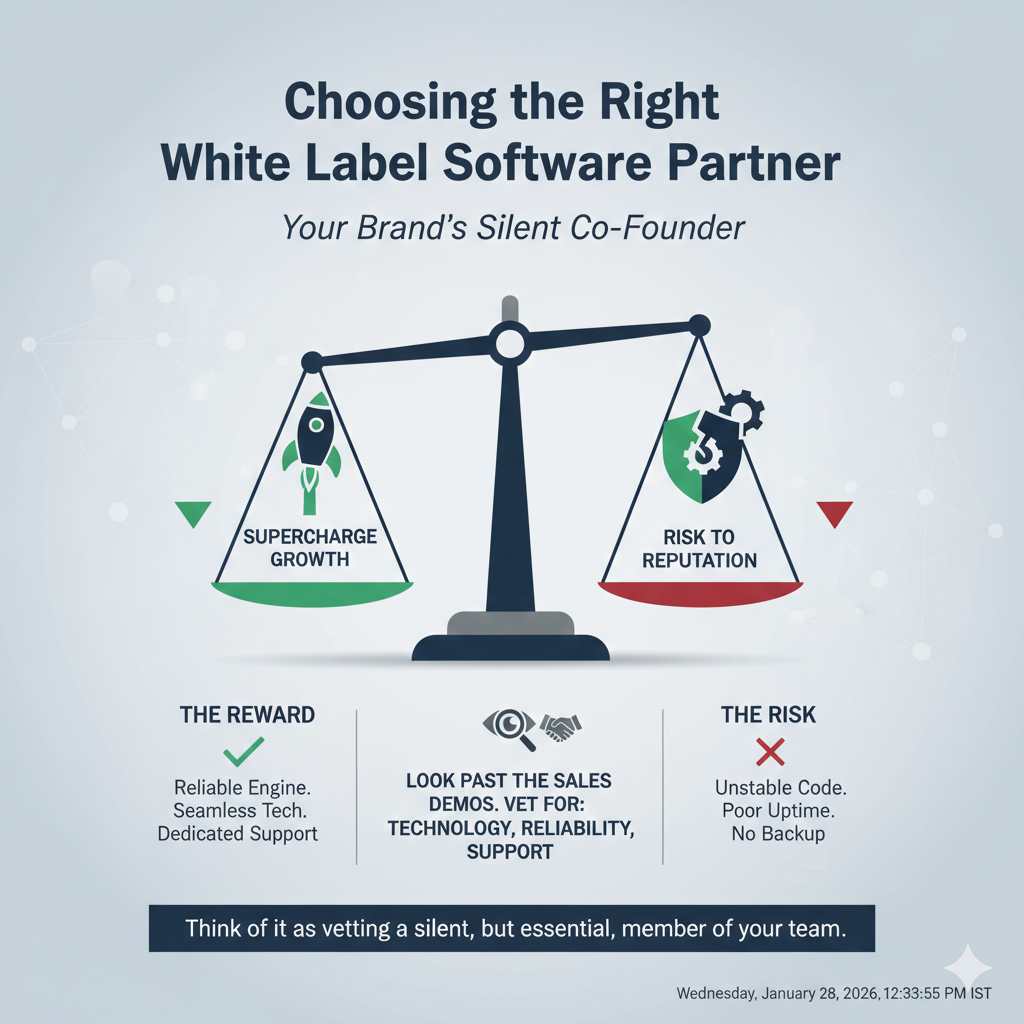
Get it right, and you’ll supercharge your growth. Get it wrong, and you risk damaging the reputation you’ve worked so hard to build. You have to look past the sales demos and really dig into what makes a platform a true long-term partner. Think of it as vetting a silent, but essential, member of your team.
Evaluate Comprehensive Rebranding Capabilities
The whole point of white labeling is to make the software completely your own. If your client ever sees the provider’s branding, the illusion is shattered, and your credibility takes a massive hit. Real white labeling goes way beyond just sticking your logo on the login page.
A top-tier partner gives you deep customization, letting you create a totally seamless brand experience.
-
Custom Domain: This is non-negotiable. The platform has to live on your domain (like
portal.youragency.com) to maintain brand consistency. -
Complete Logo Integration: Your logo needs to be everywhere, from the dashboard header to the footer of every automated report.
-
Branded Email Notifications: Every email the system sends out—whether it’s a report summary or a password reset—must come from your email address and feature your branding.
-
Customizable Color Schemes: The ability to tweak the platform’s colors to match your brand’s palette is the final touch that makes it feel truly in-house.
Platforms like Agency Platform are built from the ground up for this, giving you a fully brandable environment that keeps your agency front and center. When done right, your clients will have no idea another company is powering the tech.
Scrutinize the Feature Set for Client Value
A great-looking dashboard is worthless if it doesn’t deliver real, tangible results for your clients. The software you choose has to solve actual problems and provide undeniable value. It should make your team more efficient and give your clients insights they can’t get anywhere else.
When you’re looking at features, focus on the outcomes. It’s easy to get lost in a long list of minor functions. Instead, keep asking yourself: Does this feature help us achieve our clients’ goals and prove our worth?
You need a robust set of features that supports both your internal workflows and your clients’ needs. Here are the essentials:
-
Automated, Branded Reporting: The power to schedule and automatically send professional, branded reports is a massive time-saver and constantly reinforces your value.
-
Accurate Rank Tracking: Clients want to see progress. Dependable, up-to-date keyword tracking is a cornerstone of any SEO service.
-
Lead Management and Tracking: Proving ROI is everything. You need to connect your marketing efforts to actual leads and sales.
-
Integrations: A platform that plays nicely with other essential tools like Google Analytics and social media gives you and your clients a much more complete picture.
A partner that invests heavily in a results-driven feature set is a partner committed to helping you deliver what clients care about most: measurable success.
Assess Infrastructure and Reliability
Every minute your software is down, your brand is down. An unreliable platform doesn’t just frustrate clients; it creates a support nightmare for your team and slowly erodes the trust you’ve built. This is why you have to get serious about vetting the provider’s technical infrastructure.
Ask potential partners the tough questions. What are their uptime guarantees? What are their security protocols? How does the platform perform when you scale from 10 clients to 1,000? A provider that’s transparent about its infrastructure is a huge green flag. You need a partner who can ensure the platform stays fast and responsive, no matter how much your agency grows.
Prioritize Partner Support and Training
Finally, never forget that your provider’s support team is an extension of yours. When you run into a technical snag you can’t fix, you need a responsive, knowledgeable, and genuinely helpful team to have your back. If you get poor support from your partner, you’re left hanging—and unable to support your own clients.
Look for a partner that offers dedicated support specifically for agencies. A company like Agency Platform, for example, offers U.S.-based support because they understand the unique pressures agencies are under and can provide the expertise to solve problems quickly. Before you sign anything, test their support. Send a few technical questions and see how fast and how well they respond. A partner who invests in great support is a partner who is truly invested in your success.
How to Implement Your White Label Solution
So, you’ve found a white-label partner you’re excited about. Now what? Turning that potential into a profitable reality takes a clear, actionable plan. Launching your white-label software isn’t just about flipping a switch; it’s a strategic move that can completely reshape your agency’s service offerings and future growth.
With the right roadmap, you can weave this new, software-powered service into your agency with confidence. It’s all about connecting the technology to your business goals, getting your team ready, and building an offer your clients can’t refuse. This process will cut through the uncertainty and set you up for a killer launch.
Step 1: Define Your Objectives and Ideal Client
Before you touch a single setting, take a step back and figure out what success actually looks like. What do you really want this new service to accomplish for your agency? Maybe your goal is to bump up client retention by 15%, add a significant chunk of monthly recurring revenue, or just save your team 10 hours a week on mind-numbing manual reporting.
Once you have clear goals, you can zero in on the perfect client for this new offering. Who among your current or future clients will get the most out of this software? Answering that question will guide everything from your pricing structure to the marketing copy you write.
Step 2: Navigate the Technical Setup
This is where your branded platform truly comes to life. A good partner will make this phase painless, but you’ll still need to pay attention to the details to get that seamless, professional finish. The end goal is to make the platform look and feel like you built it from the ground up.
This stage usually breaks down into a few key technical tasks:
-
Custom Domain Configuration: This is non-negotiable. You’ll set up the platform on a subdomain, which instantly reinforces your brand’s ownership.
-
Applying Your Branding: Time to make it yours. You’ll upload your logo, plug in your brand colors, and tweak other visual elements to create a consistent user experience.
-
Email Sender Setup: To make sure every system notification—like report alerts or password resets—comes straight from your agency, you’ll configure branded email settings.
Any solid white-label provider will walk you through this with clear instructions and a support team that actually responds, turning what could be a headache into a simple checklist.
Step 3: Craft Your Go-to-Market Strategy
With the platform ready to roll, it’s time to decide how you’ll introduce it to the world. A well-thought-out strategy ensures your launch has impact. You need to package your new software-enabled service in a way that’s irresistible to clients and profitable for you.
Here are the core pieces of your launch plan:
-
Pricing and Packaging: Are you going to bundle the software with your current services? Offer it as a premium add-on? Or maybe create entirely new service tiers built around it? Your pricing needs to reflect the value it delivers.
-
Marketing Your New Offering: Get your marketing assets in order. We’re talking sales decks, dedicated landing pages, and email campaigns that hammer home the benefits of your new platform. Focus on solving client pain points, like giving them 24/7 access to their performance data.
-
Client Onboarding Process: Don’t just give them a login and hope for the best. Create a simple, repeatable process for introducing new and existing clients to the platform. A smooth onboarding can make or break client adoption and happiness.
Step 4: Train and Empower Your Team
Your team is on the front lines of this new service. Their confidence is contagious, and it’s absolutely critical for a successful rollout. They need to know more than just how to use the software; they need to know how to sell it and support clients like pros.
Set aside real time for training. Give your sales team the talking points they need to clearly explain the platform’s value in a pitch. Make sure your account managers are ready to handle client questions and can confidently walk them through key features. An empowered team is the engine that drives client adoption and long-term success.
For example, platforms like Agency Platform often provide a powerful and intuitive white-label dashboard that makes team training much simpler, helping everyone get up to speed in no time.
Common Questions About White Label Software
Thinking about bringing white-label software into your agency? It’s a big step, and naturally, a few questions pop up. Before anyone commits to a new platform, they need some straight answers. Let’s tackle the most common questions we hear from agency owners just like you.
How Does Pricing Work?
This is usually the first thing on everyone’s mind. Most white-label providers, including us, operate on a subscription model. You’re not looking at a massive upfront investment. Instead, it’s a predictable operational expense.
This could be a simple flat monthly fee for the whole platform, or it might be a tiered system that grows with you, based on how many client accounts you’re managing. The goal is to make it affordable and scalable.
What About Support and Branding?
Another big one is support. How does that work without your client knowing about us? It’s simple, really. You are always the hero. Your agency handles all the day-to-day, client-facing questions, which positions you as the expert.
But when a tricky technical issue comes up, you have a direct line to our expert team. You just escalate the problem to your white label partner, and we act as your silent, behind-the-scenes support crew.
And what about branding? A real white-label solution goes way beyond just slapping your logo on a dashboard. We’re talking about deep customization. The platform should live on your own custom domain. All the automated system emails should come from your agency’s address. You should even be able to tweak the color schemes to perfectly match your brand’s look and feel.
This is the critical difference between a simple reseller deal and a true white-label partnership. Platforms like Agency Platform are built from the ground up to provide this deep level of brand immersion. Every single client touchpoint is designed to strengthen your relationships and showcase your agency as a tech-savvy industry leader.
Ready to see how a fully branded platform can transform your agency? Agency Platform offers a comprehensive, all-in-one dashboard designed to help you scale. Start your 15-day free trial today!