Dave Thompson February 25, 2026 66 Views
Let’s be honest. Every agency owner hits a wall. You’re juggling clients, managing projects, and trying to grow, but you’re stretched thin. You start turning away good clients because you just don’t have the in-house chops for something specialized, like advanced SEO or a complex PPC campaign. It’s a frustrating growth ceiling, and it costs you revenue.
But what if you could smash right through it?
This is where understanding white-label marketing becomes a total game-changer for your agency.
The Secret Engine Scaling Today’s Top Agencies
Think of it like a fantastic local bakery, the one everyone raves about. Their cakes are incredible, but here’s the secret: they don’t actually bake them. An expert wholesale supplier, a master of the craft, creates the cakes. The bakery just puts them in its own beautiful, branded box and sells them.
The customer is happy—they get a top-tier cake from their favorite local spot. The bakery is happy—it just expanded its menu and profits without hiring a team of pastry chefs.
That’s white-label marketing in a nutshell.
A Partnership Built for Growth
In the marketing world, this model lets you instantly bolt on new, expert-level services to your agency’s offerings. Your white-label provider is your silent partner, your behind-the-scenes fulfillment team that does all the heavy lifting.
Here’s what that partnership looks like:
-
Expert Execution: The provider handles all the technical work. Whether it’s a deep-dive SEO audit or a targeted content strategy, their specialists get it done.
-
Your Branding: Every single thing the client sees—from performance reports to dashboards—is decked out in your agency’s name and logo.
-
Seamless Client Experience: Your client’s world remains simple. They only ever deal with you. This strengthens your relationship and positions your agency as their indispensable, all-in-one solution.
This isn’t a niche strategy. It’s how modern agencies scale efficiently. A 2023 survey found that more than 60% of marketing agencies outsource certain services to fill expertise gaps, with white-label partnerships being one of the primary growth methods.
By integrating external expertise into your brand, you can focus on strategy and client relationships instead of building multiple in-house departments.
And while a white-label partner becomes your external fulfillment engine, internal systems still matter. Pairing outsourced execution with strong internal workflows—like using structured workflow diagrams to scale your agency—creates a powerful formula for sustainable growth.
How a White Label Partnership Actually Works
On paper, white labeling sounds simple. In practice, it’s even smoother.
The entire process is designed to be invisible to your client. From their perspective, your agency is delivering everything.
Imagine a carefully choreographed dance between you and your silent partner.
A client requests something outside your expertise—perhaps a technical PPC audit or a local SEO campaign. Instead of saying “no,” you act as the bridge. You gather the client’s objectives and translate them into a detailed brief for your white-label provider. Their specialists handle execution behind the scenes while you manage the client relationship.
The Step-by-Step White Label Workflow
You stay in control from start to finish. The workflow typically looks like this:
-
Project Kickoff: You collect client details and submit the project through your partner’s portal.
-
Expert Execution: The provider completes the work—content creation, SEO optimization, PPC management—entirely behind the scenes.
-
Branded Reporting: Deliverables and performance reports are returned to you, fully branded with your agency’s identity.
-
Client Presentation: You present the results to your client as part of your services.
The separation between fulfillment and presentation remains clean and professional.
Think of it this way:
-
The provider is the “factory.”
-
Your agency is the “storefront.”
-
The client sees only a trusted brand delivering exceptional results.
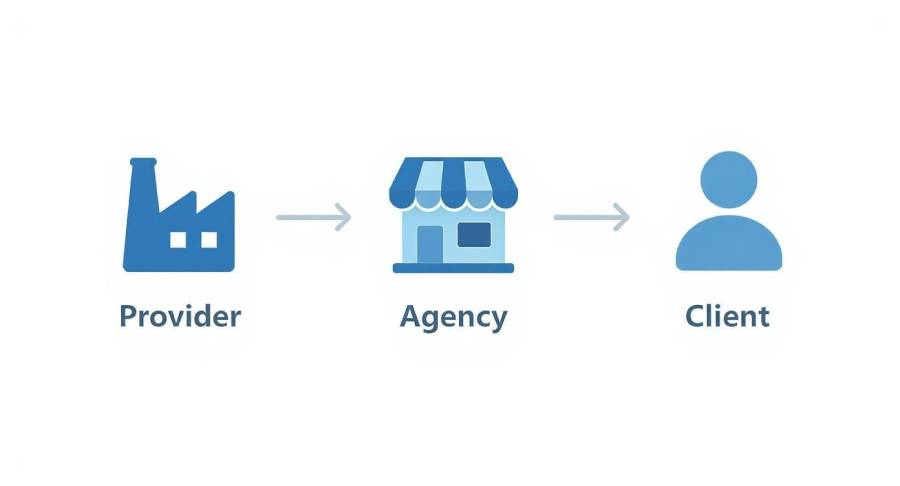
This diagram breaks it down perfectly. The provider is the “factory” creating the product. Your agency is the “storefront” that puts your brand on it. And the client just sees a great product from a store they trust.
Streamlining the Entire Process
As your agency grows, managing multiple outsourced projects can become complex. That’s where having a dedicated platform becomes essential.
A solution like Agency Platform centralizes everything—from submitting orders to generating client-ready reports—into one dashboard. Instead of juggling spreadsheets and emails, you oversee dozens of projects in real time.
You maintain quality control.
You monitor progress.
You protect your brand.
The core principle never changes: your client interacts only with your agency. They receive high-quality results, reinforcing their trust in you as a full-service partner.
Unlock Growth with a White Label Strategy
Adopting a white-label model isn’t just about outsourcing tasks. It’s a strategic shift that unlocks three pillars of agency growth:
-
Instant profitability
-
On-demand scalability
-
Stronger brand authority
Together, these pillars create a more resilient, competitive business model.
Boost Profitability Instantly
Hiring a full-time specialist isn’t cheap. Between salary, benefits, training, and tools, the costs add up quickly—often before you’ve secured a single new client.
White labeling changes the equation entirely.
Instead of absorbing high fixed costs, you pay only for services you sell. Your expenses become variable and tied directly to revenue. You set your retail pricing. You control your margins.
Many agencies can begin offering a new service almost immediately, avoiding the $70,000+ annual cost of hiring a specialist.
White Label Model vs In-House Team Cost Comparison
| Expense Category | In-House Specialist (Annual Cost) | White Label Partner (Annual Cost) |
|---|---|---|
| Salary | $60,000 | $0 (Pay-per-project) |
| Benefits (Insurance, 401k) | $12,000 | $0 |
| Training & Development | $2,500 | $0 (Expertise included) |
| Software & Tools | $3,000 | $0 (Included in service fee) |
| Recruitment Costs | $5,000 (One-time) | $0 |
| Total Annual Cost | ~$82,500 | $0 (Costs are variable per client) |
With an in-house hire, you invest heavily upfront. With white labeling, your costs scale alongside revenue, reducing risk and improving profitability.
Scale Your Services on Demand
Have you ever lost a promising client because they needed services you don’t offer?
White labeling eliminates that limitation.
Instead of spending months recruiting and training, you can instantly expand your service offerings. SEO, PPC, content marketing—your service menu grows overnight.
This flexibility allows you to:
-
Take on larger contracts
-
Close higher-value clients
-
Deliver comprehensive marketing strategies
-
Stop referring revenue elsewhere
It’s like having an entire expert team ready when you need them—without adding payroll.
Build Unshakeable Brand Authority
When you provide a full suite of services under your own brand, you shift from vendor to strategic partner.
Clients prefer simplicity. They want one trusted agency that manages everything. By becoming that all-in-one solution, you deepen client loyalty and improve retention.
You also elevate your brand positioning. Instead of being known as “the web design shop,” you become a “full-service digital growth partner.”
That authority makes it easier to attract higher-value clients and retain them long-term.
White Label vs. Private Label vs. Reseller
These partnership models often get confused, but the differences matter.
All three involve selling something created by another provider. The distinction lies in branding, exclusivity, and control.
Defining the Partnership Models
White Label
A provider creates a high-quality service and sells it to multiple agencies. Each agency brands it as its own.
Example: A wholesale bakery supplies identical cakes to multiple coffee shops, each packaging them under its own brand.
Private Label
A provider creates a product exclusively for one company, often customized.
Example: A grocery chain sells a signature coffee blend produced only for its brand.
Reseller
An agency sells another company’s product under the original brand name.
Example: An electronics store sells Sony televisions; the brand remains Sony.
Comparing the Key Differences
| Feature | White Label | Private Label | Reseller |
|---|---|---|---|
| Branding | Your agency’s brand | Your agency’s brand | Original provider’s brand |
| Exclusivity | Non-exclusive product | Exclusive product for you | Non-exclusive product |
| Client Relationship | You own the relationship | You own the relationship | Often co-managed or referral |
| Customization | Low to moderate | High customization | None |
| Best For | Agencies wanting to quickly scale a wide range of proven, expert services under their own brand. | Companies wanting a unique, proprietary product without building it from scratch. | Agencies looking to earn referral income without managing service delivery. |
For most marketing agencies, white labeling strikes the ideal balance between control and simplicity.
How to Choose the Right White Label Partner
Choosing a provider is not just vendor selection—it’s choosing an extension of your team.
A strong partner strengthens your brand. A poor one risks damaging client relationships.
A thorough vetting process is essential.
Key Evaluation Criteria
Proven Expertise
Ask for case studies, performance data, or anonymized results. A reputable provider should demonstrate clear outcomes.
Communication Standards
How are updates handled? Is there a dedicated account manager? Clear communication prevents surprises.
Robust Reporting
High-quality, branded reporting reinforces your value to clients. Agencies that provide 24/7 dashboard access often see up to 20% higher retention rates.
The Power of a Unified Platform
Technology matters. A unified, white-labeled dashboard simplifies both internal management and client experience.
Instead of juggling spreadsheets and logins, you centralize everything into one professional portal.
This improves transparency.
It strengthens professionalism.
It reinforces trust.
Red Flags to Watch Out For
Be cautious if a provider:
-
Cannot share case studies
-
Avoids direct answers
-
Offers pricing that seems unrealistically low
-
Lacks structured processes
White labeling should strengthen your reputation, not jeopardize it.
So, What’s Your Next Move?
White-label marketing isn’t just a tactic—it’s a strategy for breaking through growth barriers.
It allows you to:
-
Scale faster
-
Increase profitability
-
Expand expertise instantly
The starting point is simple. Identify one service you consistently turn away or one your clients frequently request.
That’s your opportunity.
Putting This into Action
Here’s how to move forward:
-
Identify Your Opportunity
What service do clients ask for most that you don’t currently provide? -
Research Providers
Look for transparent partners with proven results and strong reporting. -
Start Conversations
Ask detailed questions about process, pricing, and support structure.
For agencies ready to accelerate without managing multiple vendors, a centralized solution like Agency Platform offers turnkey fulfillment across SEO, PPC, and content—all managed from a single dashboard under your brand.
Your Top Questions About White Label Marketing, Answered
Is White Label Marketing Legal and Ethical?
Absolutely. White labeling is a widely accepted business model built on clear agreements between agencies and providers. Clients receive seamless service through a single point of contact—you.
How Do I Handle Client Communication?
You remain the face of the operation. Your partner supplies branded reports and updates. You present the results and maintain the relationship.
What Are the Typical Pricing Models?
Most providers use one of these structures:
-
Flat-Fee Per Project: Fixed cost for one-time work.
-
Monthly Retainer: Ongoing service management.
-
Wholesale Rates: Discounted pricing that allows you to set your own margins.
Each model supports profitability while maintaining flexibility.
Ready to Scale?
White-label marketing gives your agency the ability to grow without the burden of expanding payroll, infrastructure, or internal complexity.
Agency Platform offers a centralized dashboard with turnkey fulfillment for SEO, PPC, and more—all under your brand.
If you’re ready to break through your agency’s growth ceiling, the next move is yours.
Ready to scale your agency without all the overhead? Agency Platform gives you a complete, all-in-one dashboard with turnkey fulfillment for SEO, PPC, and more—all under your brand. See how we can help you grow at https://www.agencyplatform.com.