Dave Thompson December 2, 2025 338 Views
In the world of Search Engine Optimization (SEO), backlinks are simply hyperlinks that point from one website to another. You can think of them as digital word-of-mouth recommendations. When a credible site links to your page, it’s essentially giving a vote of confidence, signaling to search engines like Google that your content is valuable and worth paying attention to.
Why Backlinks Are A Cornerstone Of SEO
Backlinks are not just a nice-to-have; they are a fundamental part of how search engines figure out a website’s authority and relevance. Every quality link acts as a signal of credibility, which directly impacts how high your pages can climb in the search results. A healthy backlink profile can help boost your visibility, bring more qualified organic traffic, and cement your reputation in a crowded market.
Imagine your website is an island. Without any bridges connecting it to the mainland, it doesn’t matter if your content is highly engaging—search engines will struggle to find it and have no way to gauge its importance. That’s why building a strong profile isn’t just beneficial; it’s essential for long-term SEO success.
A strong backlink profile tells search engines that your website is a respected authority in its field, making it more likely to be shown to users searching for relevant topics.
This isn’t just theory—the numbers back it up. A study found that the #1 ranking page in Google typically has 3.8 times more backlinks than the pages ranking in positions two through ten. Even more telling is that a staggering 91% of all web pages receive zero organic traffic from Google, often because they have no backlinks pointing to them. You can delve into these SEO statistics to see just how much of an impact they have.
Understanding The Different Types Of Backlinks
Not all backlinks are created equal. Some are powerful endorsements that can send your client’s rankings soaring, while others are essentially digital dead ends. If you want to build a link-building strategy that actually works, you have to know the difference.
The undisputed champion of the link world is the natural, editorial backlink. These are the links you don’t ask for. They happen organically when another creator, blogger, or journalist finds your content so valuable that they willingly link to it. Think of it as a genuine recommendation—the kind of endorsement that search engines love to see.
Dofollow vs. Nofollow Links
Beyond those organic gems, you’ll find links acquired through more tactical efforts, like guest blogging or directory listings. The real difference in their SEO power often boils down to a tiny snippet of HTML code known as the link attribute.
This is where the classic “dofollow vs. nofollow” conversation comes in.
- Dofollow Links: This is the default setting for any hyperlink. It’s a green light for search engines to inform them to follow the link and pass authority— called “link equity”—from the linking site to the destination. These are the links that have the most direct impact on search rankings.
- Nofollow Links: Adding a rel=”nofollow” attribute to a link is like putting up a “do not enter” sign for search engine crawlers. It tells them not to pass any authority through that link. This was introduced to fight comment spam, but its use has expanded.
Over the years, Google rolled out more specific tags to add context. A
rel="sponsored"tag is now the standard for paid links or advertisements, whilerel="ugc"(User-Generated Content) is used for links in forums, comments, and other public platforms.
This infographic breaks down how a quality backlink profile contributes to a site’s overall health and visibility.
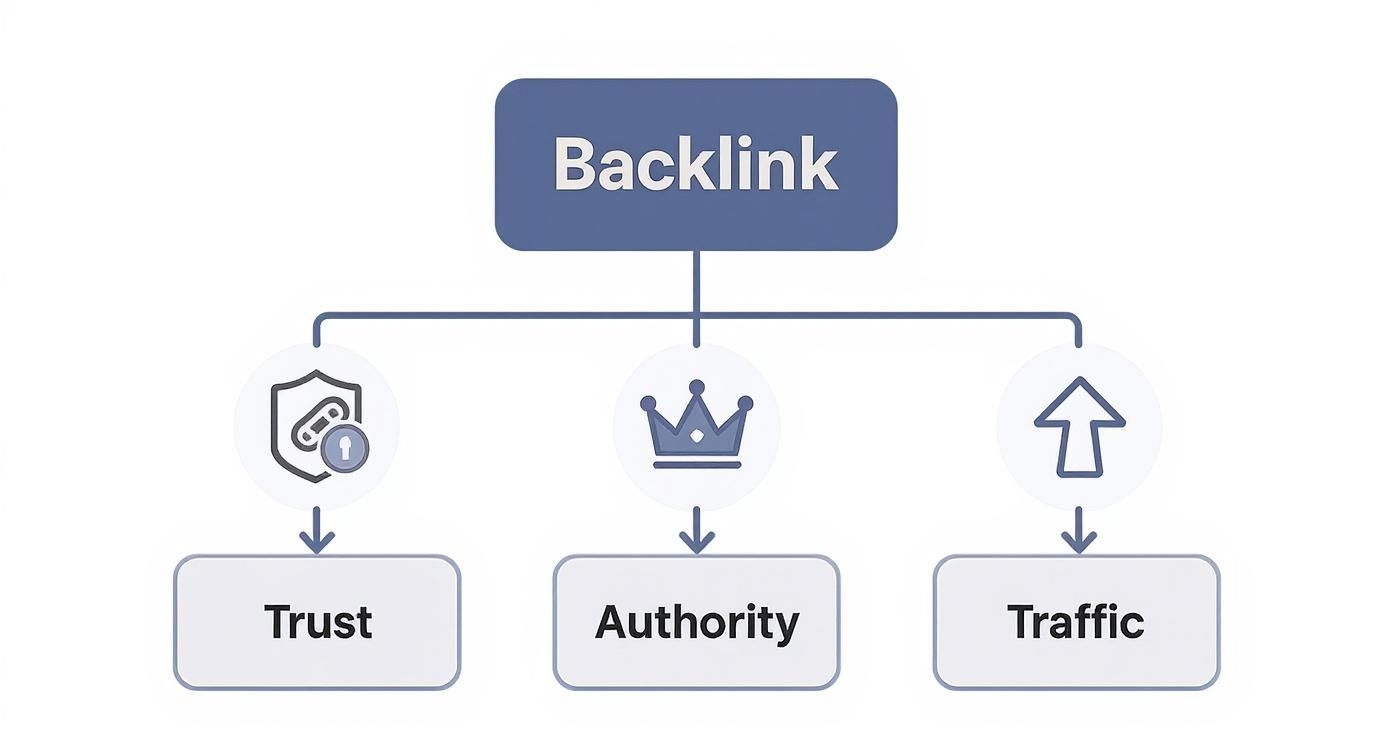
As you can see, a strong backlink not only improves rankings but builds trust, establishes authority, and can even become a source of valuable referral traffic.
For agencies, understanding these nuances is what separates a successful campaign from a failed one. This is why services like the white-label link building from Agency Platform are so valuable—they focus on securing the powerful, dofollow links that deliver a lasting impact for your clients.
A Comparison Of Common Backlink Types
To help clarify the landscape, let’s break down some of the most common types of backlinks you’ll encounter. Each one has a different origin story and brings a different level of value to the table.
| Backlink Type | How It’s Acquired | Primary SEO Value | Key Consideration |
|---|---|---|---|
| Natural Editorial | Earned organically when others link to your high-quality content. | Very High. Seen as a genuine vote of confidence by search engines. | Extremely difficult to get consistently. Requires top-tier content. |
| Guest Blogging | Earned by writing content for another website in your niche. | High. Creates relevant, contextual links from authoritative sites. | Quality is key. Avoid low-quality sites just for the sake of a link. |
| Directory/Citation | Manually submitted to business directories or citation sites. | Moderate. Good for local SEO and establishing brand presence. | Focus on high-quality, industry-specific directories. Avoid spammy ones. |
| Sponsored/Paid | Purchased through advertisements, advertorials, or sponsorships. | Variable. Should be marked rel=”sponsored” to avoid penalties. | Value is more in traffic and branding than in direct link equity. |
| User-Generated | Added by users in forums, comments, or public profiles. | Low. Almost always rel=”nofollow” or rel=”ugc”. Little direct SEO impact. | Can drive some referral traffic, but is often associated with spam. |
Knowing these distinctions is crucial. A strategy built on earning editorial links and high-quality guest posts will always outperform one that relies on low-value directory or user-generated links. It’s about quality, not just quantity.
How To Evaluate Backlink Quality
As we move past counting links, it’s critical to understand that not all backlinks are created equal. A single, high-quality backlink from an authoritative website can pack several more punches than hundreds of low-quality ones. This value that gets passed from one site to another is often called link equity, and learning how to evaluate it is what separates amateur efforts from professional, high-impact SEO.
This whole evaluation process really boils down to a few core pillars. Think of them as a quality control checklist you should run through for every potential link-building opportunity you consider for a client.
Authority: The Credibility Of The Linking Site
First and foremost is the authority of the website linking out. Search engines place too much weight on links from trusted, well-established sites. It just makes sense: a link from a major industry publication or a top university is a much stronger endorsement than one from some brand-new blog with no track record.
This concept is often measured using third-party metrics. While these aren’t official scores from Google, they offer a pretty reliable estimate of a site’s overall strength. Major platforms like Ahrefs and Moz offer industry-standard metrics, but it’s crucial to choose a provider that aligns with your specific needs. The Agency Platform dashboard, for instance, provides comprehensive metrics that allow agencies to track link quality and campaign progress seamlessly under their own brand.
- Domain Rating (DR) or Domain Authority (DA): These scores predict a website’s ability to rank high. The higher the number, the more authoritative the site.
- Website Traffic: A site that pulls in substantial and consistent organic traffic is almost always a healthy and valuable source for a backlink website.
A site with high authority has earned its reputation, and a link from it is like receiving a powerful recommendation from a respected expert. This is why a single link from a DR 80+ site can move the needle more than dozens of links from DR 20 sites.
Relevance: The Topical Connection
Next, you have to consider relevance. Google wants to see a logical, topical connection between the site linking to you and your own. A link from a popular fitness blog to your client’s new article on marathon training? That’s a perfect match and sends a strong, relevant signal.
But a link from that same fitness blog to a website about cryptocurrency would feel random and out of place, carrying far less weight in Google’s eyes.
This idea extends all the way down to the specific page and even the text surrounding the link. The most valuable links are those naturally embedded within relevant content, using descriptive anchor text—the clickable words in the hyperlink itself. An anchor like “advanced marathon training techniques” is infinitely more valuable than a generic “click here.”
To get a better handle on this, check out our guide on the essential link-building tools for successful off-page SEO, which can help you analyze all these metrics.
Building A Strategic Backlink Portfolio
Knowing what makes a good backlink is one thing. Actually getting them consistently is a completely different ballgame. This is where a real strategy comes into play—you can’t just sit back and hope links appear. You have to actively create opportunities for them.
A fantastic starting point? Check out what your competitors are doing.
By digging into the backlink profiles of the top-ranking sites in your space, you can essentially reverse-engineer their success. This process uncovers high-value opportunities, such as popular industry blogs, resource pages, or directories, that are already linking to content just like yours. A competitor analysis gives you a proven roadmap of link targets that work in your market.
Creating Linkable Assets
Another core part of a strategic link-building strategy is creating linkable assets. Think of these as link magnets. They are pieces of content so valuable, unique, or useful that other sites want to link to them naturally.
Some of the most powerful linkable assets include:
- Original Research & Data: Publishing unique studies or data-driven reports that people in your industry will be eager to cite.
- Comprehensive Guides: Creating the absolute go-to resource on a complex topic, making it the standard reference point for others.
- Free Tools & Calculators: Building a simple, useful online tool that solves a common headache for your audience.
- Expert Roundups: Gathering insights from multiple industry experts into one high-value article.
A single, well-crafted linkable asset, like an in-depth industry report, can generate dozens of high-authority backlinks over time. It’s a massive return on investment and a cornerstone of any long-term SEO success.
Ultimately, the goal is to build a backlink portfolio that looks diverse and natural. Putting all your eggs in one basket is like taking a risk. A healthy profile has a mix of link types coming from a variety of authoritative sources. This approach builds a resilient foundation that can handle algorithm updates and drive real and sustainable growth.
For agencies trying to scale these efforts without breaking the bank on an in-house team, partnering with a specialist can be a game-changer. Exploring custom link-building plans from a white-label provider like Agency Platform ensures your clients get expert-level results and clean, professional reporting, all under your own brand.
Navigating Link Building Risks And Penalties
While building a strong backlink profile is a cornerstone of good SEO, the world of link acquisition definitely has its dark side. Venturing into risky tactics can do far more harm than good, and in the worst cases, can lead to severe search engine penalties that entirely tank a client’s rankings. It’s absolutely critical to understand what not to do.
Steer clear of black-hat SEO tactics at all costs. These are the shady shortcuts designed to manipulate search rankings, and they never end well. This includes things like Private Blog Networks (PBNs)—entire webs of low-quality sites built for linking—and participating in paid link schemes that fly in the face of Google’s guidelines. Sure, they might offer a fleeting boost, but they almost always end in a penalty. You can learn more about why to avoid these dangerous methods in our guide on what is black-hat SEO.
Identifying And Removing Toxic Backlinks
A toxic backlink is any link from a spammy, low-quality, or totally irrelevant website that can actively damage your SEO efforts. Regularly running a backlink audit using tools like those in the Agency Platform dashboard helps you spot these harmful links before they become a real headache.
If you do find toxic backlinks pointing to a client’s site, Google’s Disavow Tool is your go-to solution. It allows you to essentially ask the search engine to ignore those specific links when it assesses the site. This is a crucial cleanup step, whether you’re fixing past mistakes or defending against a negative SEO attack.
Maintaining a clean backlink profile isn’t a one-and-done task; it’s an ongoing job. In fact, research tells that around 66% of links to top-ranking pages are broken due to a phenomenon called “link rot,” highlighting the need for constant monitoring to preserve hard-earned link equity.
Let’s be honest: link building is really tough. So tough, in fact, that 41% of SEO professionals call it the single most challenging part of their job. This difficulty is what tempts some to take risks, but ethical, white-hat strategies are the only reliable path to sustainable growth. You can get more insights into the state of SEO today and see exactly why a careful, deliberate approach always wins in the long run.
Got Questions About Backlinks? We’ve Got Answers.
Even after you get the hang of what backlinks are and why they matter for SEO, some questions always seem to pop up. Let’s manage a few of the most common questions we hear from agencies and their clients, clearing up the confusion so you can build a strategy that actually works.
How Many Backlinks Do I Need To Rank?
This is the million-dollar question, but unfortunately, there’s no magic number. Success isn’t about hitting some arbitrary link quota; it’s about the quality of your links and how challenged your industry is. Your focus should always be on earning high-authority, relevant links over time.
Think of it this way: one powerful link from a major player in your industry is worth more than hundreds of junk links from random, irrelevant websites. It’s all about impact, not just volume.
Are Internal Links Also Backlinks?
Nope, but they’re both crucial players on the same team. Internal links are the ones that connect pages within your own website. They’re fantastic for spreading link equity around your site and helping both users and search engines discover their way around.
Backlinks, on the other hand, are strictly external. They’re links coming from other websites to yours. You need a solid strategy for both, but they are two completely different things.
How Long Does It Take For Backlinks To Work?
Seeing the results from a new backlink is rarely an overnight thing. You’re usually looking at several weeks, or sometimes even a few months, before search engines crawl the new link, index it, and fully factor its value into your rankings.
Link building is a marathon, not a sprint. The authority of the site linking to you can speed things up a bit, but real, lasting results only come from a consistent, long-term approach.
Building a backlink profile that moves the needle takes serious expertise and a lot of persistence. Instead of getting bogged down in the complexities, many agencies find it’s smarter—and more profitable—to partner with a specialist.
At Agency Platform, we’re the team behind the scenes, providing white-label link building that secures the high-quality, relevant backlinks your clients need to climb the rankings. Find out how we can help you scale your agency’s offerings and deliver results you can be proud of by checking out our SEO reseller program.