Dave Thompson February 13, 2026 1885 Views
Effective SEO reporting for agencies has changed dramatically. What used to be a simple monthly keyword-ranking spreadsheet has evolved into a high-stakes communication tool that must connect SEO work to measurable business impact. A 2023 survey cited in the blog notes that 51% of businesses now find SEO reporting more complex than ever, which makes clarity, context, and narrative more important than raw numbers. In this environment, reporting is no longer a routine deliverable—it’s a primary driver of perceived value, client trust, and long-term retention.
The New Standard in Agency SEO Reporting
Modern clients don’t just want to know whether rankings improved. They want a clear, credible line from SEO activity to outcomes like leads, sales, pipeline growth, and revenue. The blog emphasizes that clients have become more sophisticated and more demanding about transparency. Many business owners now look at marketing analytics regularly, and that behavior shifts expectations: clients want to understand return on investment, not interpret complicated spreadsheets.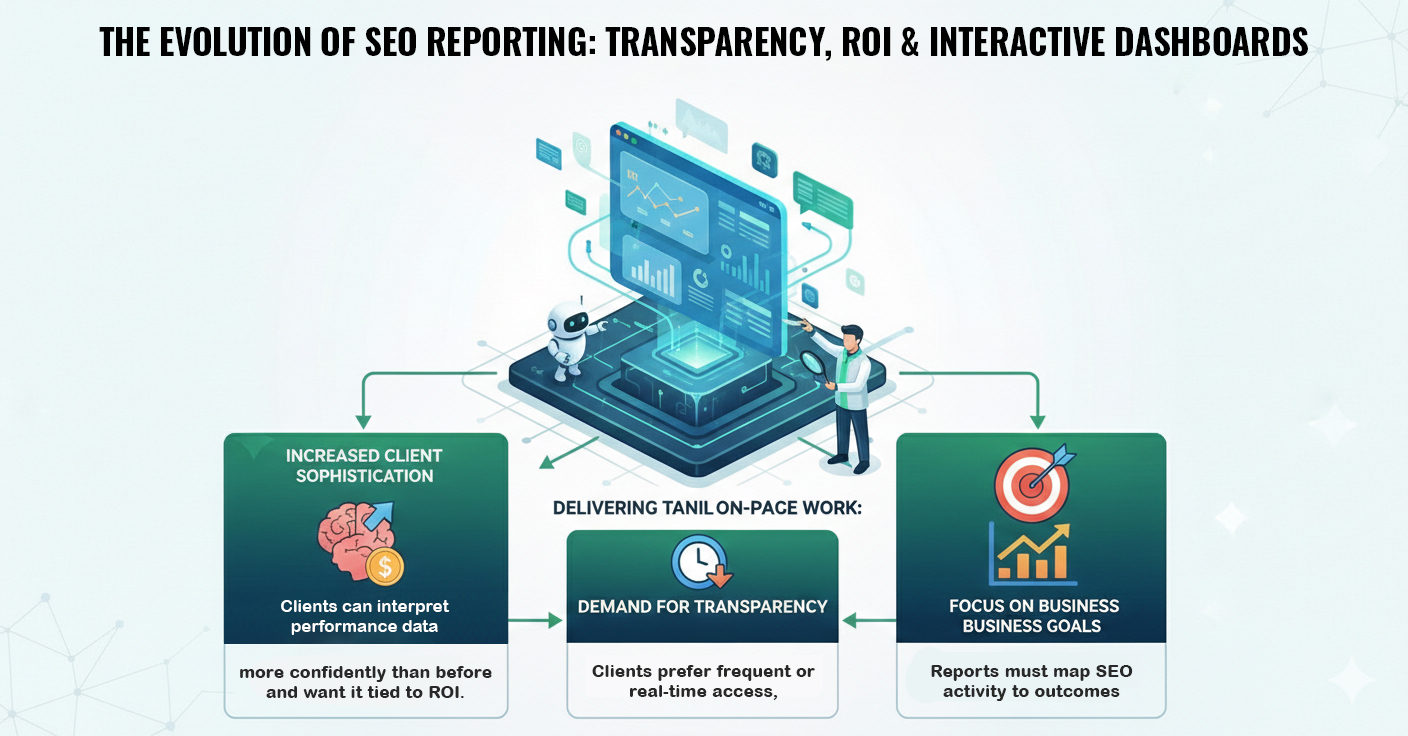
As a result, effective reporting has moved from static data dumps to dynamic dashboards that present key performance indicators in a visual, accessible way. Instead of delivering a PDF once per month, agencies are increasingly expected to provide near-real-time visibility through centralized dashboards—often white-labeled so the experience feels fully “in-house” to the client. The blog also claims that agencies and seo reseller companies using interactive dashboards see higher client satisfaction than those relying on static PDFs, reinforcing the idea that presentation and accessibility matter nearly as much as results.
This shift is driven by three main forces highlighted in the blog:
-
Increased client sophistication: Clients can interpret performance data more confidently than before and want it tied to ROI.
-
Demand for transparency: Clients prefer frequent or real-time access, rather than monthly reports that feel outdated the moment they arrive.
-
Focus on business goals: Reports must map SEO activity to outcomes that matter to each specific business model.
The Impact on Client Retention
A core message is that better reporting helps agencies keep clients. The blog argues that reporting has become more complicated as agencies track more KPIs per campaign and must synthesize more data sources. In that context, agencies that deliver detailed, multi-metric reports tend to retain clients at a much higher rate than agencies that send only basic summaries.
The underlying logic is straightforward: clients stay when they believe progress is visible, understandable, and tied to outcomes. Reporting functions as ongoing proof that the agency is moving the business forward. Without that proof, even good SEO performance can feel abstract or slow, which invites doubt—especially during volatile months or during the early stages of a campaign.
Just as importantly, the blog positions reporting as part of the agency’s “strategic partner” identity. Great reporting demonstrates competence not only in SEO execution, but also in measurement, analysis, prioritization, and business understanding. In other words, reporting is a major part of how an agency shows it is worth the retainer.
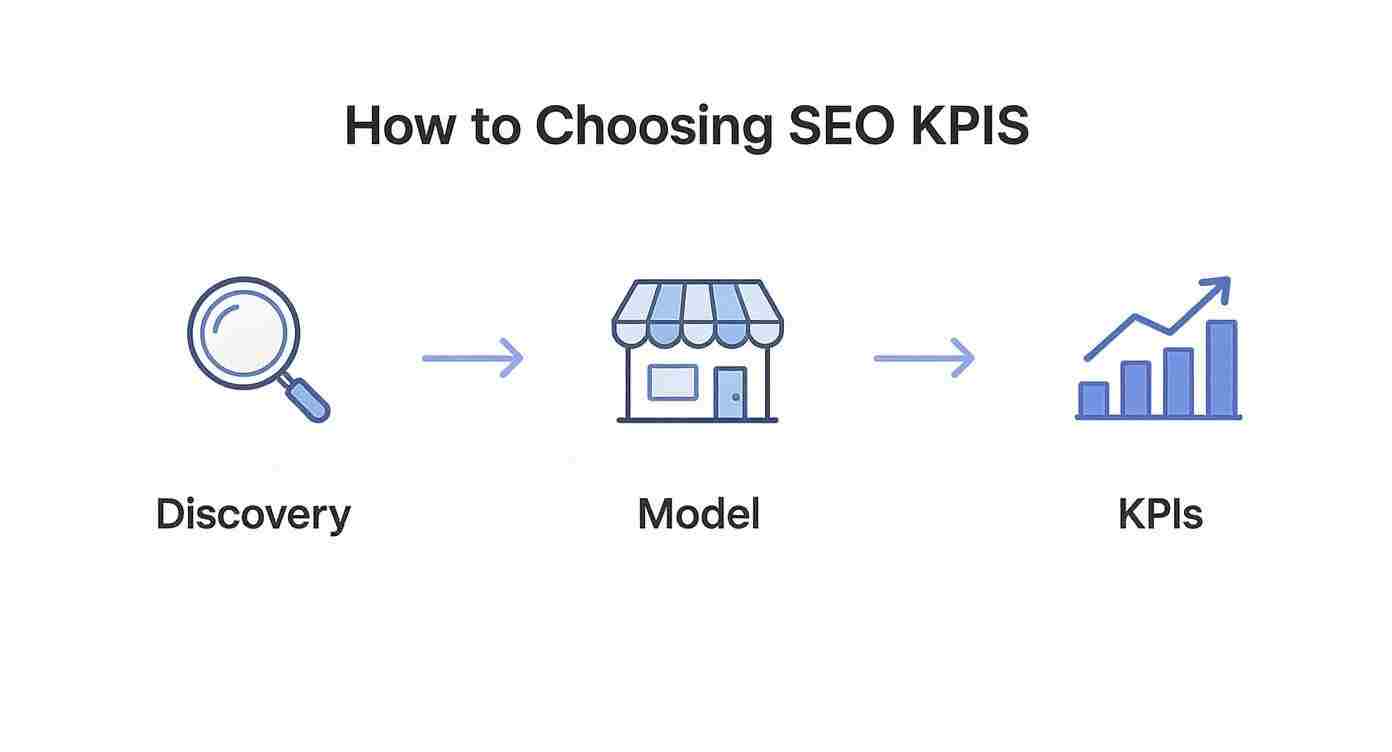
Start with the client’s definition of success
The blog stresses that effective reporting starts before dashboards, tools, or templates. It begins with understanding what the client actually values. Generic reporting that prioritizes vanity metrics (like impressions with no conversion context) signals that the agency doesn’t understand the business. To avoid this, the blog recommends a structured “goals discovery session” at the start of the relationship.
This discovery session is framed as a deep conversation about outcomes, not SEO jargon. The goal is to translate business goals into measurable KPIs. The blog suggests asking questions like:
-
What does a successful month look like?
-
What is the lifetime value of a new customer?
-
How do they currently judge marketing success?
-
If only one business metric could improve this year, what would it be?
The reason lifetime value matters is that it helps frame organic traffic and conversions in financial terms. If the agency can estimate what a lead or customer is worth, it becomes easier to show ROI from organic growth—and easier to justify investment during slow months.
Match KPIs to the client’s business model
A major section explains that KPIs should vary depending on the client type. An e-commerce store’s reporting should focus on sales and revenue metrics; a local service business needs calls and form fills; and a B2B SaaS client typically prioritizes qualified leads and pipeline activity.
The blog provides a model for aligning reporting to different business types:
| Client Business Model | Primary KPIs | Secondary KPIs | Business Goal |
|---|---|---|---|
| E-commerce Store | Online Sales, Avg. Order Value, Cart Abandonment Rate, Conversion Rate | Organic Traffic to Product Pages, Keyword Rankings for “buy now” terms | Increase Direct Revenue |
| Local Service Business | Phone Call Leads, Form Submissions, Google Business Profile Clicks-to-Call | Local Pack Rankings, Geo-targeted Organic Traffic, Service Page Views | Generate Qualified Local Leads |
| B2B SaaS Company | Demo Requests, Free Trial Sign-ups, Gated Content Downloads, Marketing Qualified Leads (MQLs) | Organic Traffic to High-Intent Blog Posts, Rankings for “solution” keywords | Fill the Sales Pipeline |
This mapping matters because it reframes SEO as a growth lever, not a visibility project. Instead of celebrating traffic increases as an end goal, the report treats traffic as a means to higher-quality leads or increased purchases.
Go beyond standard metrics using calculated insights
While baseline KPIs are essential, the blog argues that agencies can stand out by adding calculated metrics that combine data points into more meaningful signals. For example, rather than reporting traffic and conversions separately, an agency can calculate an organic conversion rate to prove traffic quality. Similarly, agencies can translate performance into cost efficiency by estimating lead value, acquisition cost trends, or revenue per organic visitor.
Calculated metrics make reports more persuasive because they answer the questions clients actually ask:
-
Is the traffic valuable?
-
Are we getting better leads?
-
Are results improving efficiency over time?
-
What changed, and why does it matter?
This is where the blog positions agency-focused platforms as helpful: they can combine data sources and surface both standard and customized metrics inside one dashboard without extensive manual work.
Automation is the key to scalable reporting
The blog makes a blunt point: manual reporting kills agency growth. Many teams still pull data from multiple systems—Google Analytics, Search Console, rank trackers, and spreadsheets—then assemble reports by hand. That process is time-consuming, error-prone, and difficult to scale. The blog cites a claim that agency professionals spend 5–10 hours per client per month building reports manually, which quickly becomes unmanageable as the client list grows.
Calculated metrics make reports more persuasive because they answer the questions clients actually ask:
-
Is the traffic valuable?
-
Are we getting better leads?
-
Are results improving efficiency over time?
This is where the blog positions agency-focused platforms as helpful: they can combine data sources and surface both standard and customized metrics inside one dashboard without extensive manual work.
Automation is the key to scalable reporting
The blog makes a blunt point: manual reporting kills agency growth. Many teams still pull data from multiple systems—Google Analytics, Search Console, rank trackers, and spreadsheets—then assemble reports by hand. That process is time-consuming, error-prone, and difficult to scale. The blog cites a claim that agency professionals spend 5–10 hours per client per month building reports manually, which quickly becomes unmanageable as the client list grows.
Automation solves two problems at once:
-
Efficiency: less time spent collecting and formatting data.
-
Reliability: fewer human errors and more consistent reporting and delivery.
Instead of treating reporting as a monthly scramble, agencies can build repeatable systems that generate insights consistently and free up time for strategy and execution.
Essential data integrations
The blog describes automated dashboards as only as strong as the data feeding them, and recommends integrating sources that reflect the full journey from search visibility to revenue. The minimum integrations it highlights include:
-
Google Analytics 4 (GA4) to show user behavior, traffic sources, and conversions.
-
Google Search Console (GSC) to show impressions, clicks, CTR, and queries driving visibility.
-
A CRM system (like HubSpot or Salesforce) to connect leads to actual customers and revenue, proving ROI beyond website metrics.
CRM integration is presented as especially valuable because it closes the loop between SEO and business outcomes. Instead of reporting “leads,” the agency can report “qualified leads,” “opportunities,” or “closed revenue,” depending on what the CRM tracks. The blog claims that tying organic traffic to CRM data can significantly increase campaign profitability by improving attribution and decision-making.
Centralized dashboards and white-label reporting
Once data is integrated, agencies need a central reporting hub. The blog contrasts general tools like Looker Studio—which can be flexible but labor-intensive—with specialized agency platforms designed for plug-and-play integrations, client-friendly dashboards, and white-label branding.
The advantage of specialized platforms, as presented, is speed and repeatability: pre-built widgets, easier configuration, and consistent dashboards across clients. This matters because clients want reports that feel polished and easy to interpret, and agencies need systems that don’t require custom engineering for each account.
Cadence and automated delivery
The blog recommends setting a clear reporting cadence that matches campaign intensity:
-
Weekly updates for new campaigns or high-stakes initiatives, focused on a few key indicators.
-
Monthly reports as the standard format for explaining trends, results, lessons, and next steps.
The key point is that delivery should also be automated. Reports scheduled to generate and send consistently—branded and on time—build credibility. Predictability becomes part of client trust: clients know when updates arrive, what they’ll include, and how to interpret them.
The real differentiator: telling a story with SEO data
Even with the best dashboard, the blog argues that numbers alone don’t retain clients. The agency’s real value is in interpretation—turning metrics into meaning and decisions. Reporting should answer “So what?” and make the client feel guided.
To do that, the blog recommends structuring reports as a narrative rather than a chart collection. It suggests a three-part flow: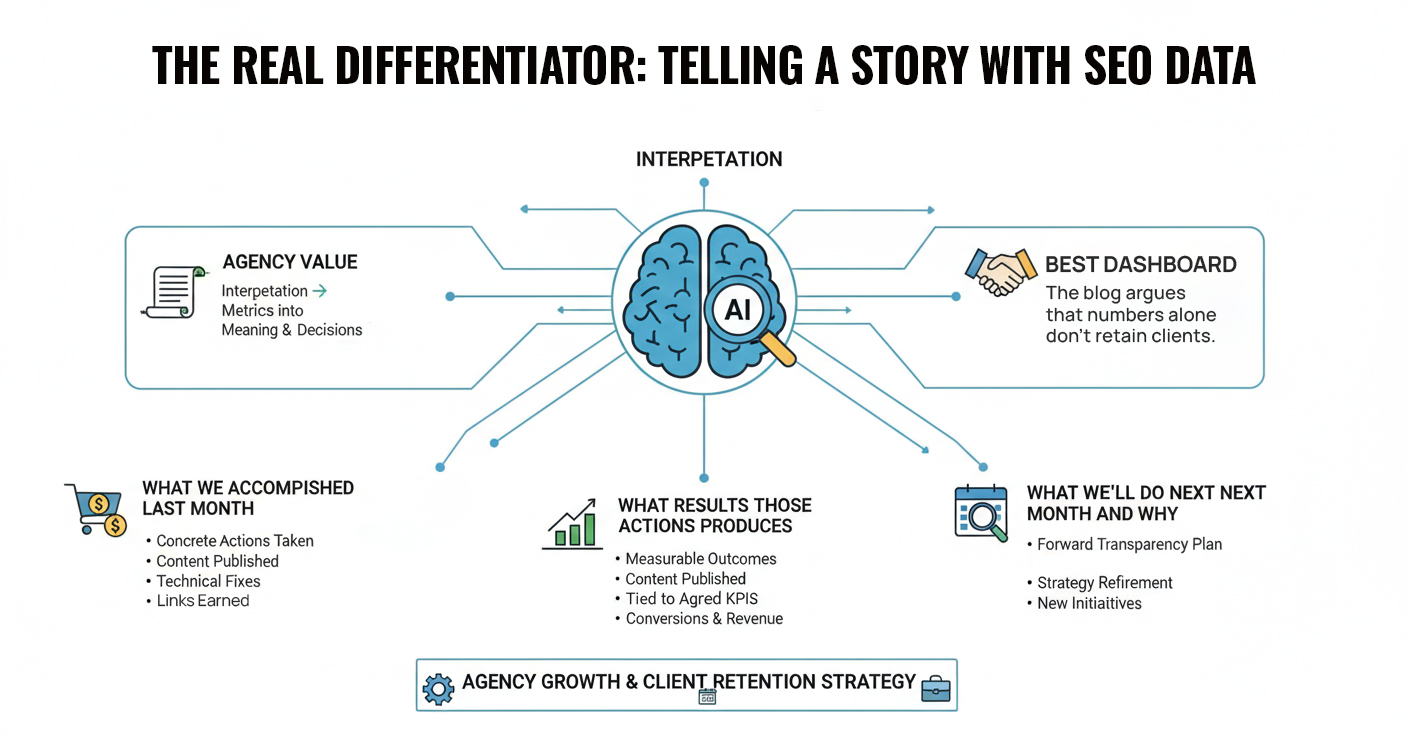
-
What we accomplished last month: concrete actions taken (content published, technical fixes, links earned).
-
What results those actions produced: measurable outcomes tied to agreed KPIs.
-
What we’ll do next month and why: a forward-looking plan based on insights.
This structure helps clients follow the logic from effort to impact to future strategy, reinforcing that the agency’s work is deliberate and outcome-driven.
Executive summaries for busy decision-makers
The blog calls the executive summary the most important part of the report. Stakeholders may not read the whole document, but they will read the top section. A strong executive summary functions like a briefing: a few bullet points that highlight wins, challenges, insights, and the next priority.
This approach also helps prevent misinterpretation. If a stakeholder sees one metric down without context, they may assume the campaign is failing. A well-written summary frames what matters most, how to interpret changes, and what the agency is doing next.
Context through annotations
The blog emphasizes that charts without explanation leave too much room for confusion. Annotations—short notes explaining spikes or drops—turn visuals into insights.
Examples include:
-
A traffic drop explained by an algorithm update.
-
A spike is tied to a successful post or campaign push.
-
A decline linked to technical issues that were quickly resolved.
Annotations also reinforce the agency’s expertise. They show that the agency isn’t simply reporting data; it understands what drives the numbers and can respond strategically.
AI’s growing role in reporting
The blog highlights the rise of AI in agency reporting, noting that many agencies now use AI-powered tools for aggregation, forecasting, and faster report production. The claimed benefits include fewer errors and faster delivery, enabling more timely updates and better insight generation. The main takeaway is not that AI replaces analysis, but that it reduces busywork so strategists can focus on interpretation and recommendations.
Turning weak months into trust-building moments
The blog acknowledges that SEO performance isn’t linear. Rankings fluctuate, competition shifts, and Google updates can disrupt progress. Great agencies don’t hide these realities—they explain them and respond with plans.
The recommended framework for negative trends is:
-
Acknowledge the issue clearly (no defensiveness or avoidance).
-
Offer a data-backed hypothesis about what caused it.
-
Present a solution and plan for the next period.
This turns a difficult moment into a demonstration of professionalism. Instead of being judged on whether every month is perfect, the agency is judged on how effectively it diagnoses and adapts.
Scaling reporting as the agency grows
As the agency adds clients, personalized reporting becomes harder to maintain. The blog argues that scaling requires systems, not longer hours. Two strategies are emphasized: internal SLAs and white-label partners.
Internal SLAs for consistent delivery
An internal Service Level Agreement is positioned as an operational playbook that ensures reports remain high quality no matter who is producing them. The blog describes SLAs as simple internal standards covering:
-
Roles: who pulls data, who writes narrative sections, who reviews.
-
Deadlines: when data must be compiled, when drafts are due, when final reports go out.
-
Quality checklists: required elements like executive summaries, KPI analysis, and next steps.
This reduces last-minute chaos and creates a predictable process, which is essential for sustainable growth.
Platforms like Agency Platform take this a step further by combining white-label services with a powerful, brandable dashboard. This gives you the best of both worlds: a fully managed fulfillment team behind the scenes and a centralized, professional system for presenting results.
White-label partners to expand capacity
Eventually, even strong internal processes hit a limit. The blog suggests that when senior strategists get bogged down with operational tasks, it may be time to partner with white-label providers. The idea is to extend capacity without hiring and training full-time staff for every growth phase.
According to the blog, white-label partners can help agencies:
-
Scale quickly and take on more clients.
-
Access specialized SEO expertise.
-
Maintain brand control by delivering everything under the agency’s branding.
This approach is framed not as outsourcing for its own sake, but as a strategic move to keep internal experts focused on strategy, relationships, and growth.
Handling difficult client conversations with confidence
The blog ends with guidance on client communication during uncertain performance periods. It notes that many businesses struggle with proving marketing ROI, and client concerns often reflect anxiety about whether the investment is paying off.
The blog recommends handling common questions with calm explanations and data-backed context:
Explaining ranking or traffic drops
When clients ask why rankings fell, agencies should quickly categorize the likely cause:
-
Algorithm updates: explain volatility and show that changes affect many sites.
-
Competitive shifts: identify new or aggressive competitors and outline a counter strategy.
-
Technical issues: own the problem, fix it quickly, and implement monitoring to prevent repeats.
This replaces panic with professional clarity.
Addressing “Why isn’t this faster??”
When clients question pace, the blog suggests shifting attention to leading indicators that predict future growth, such as:
-
A growing keyword footprint.
-
New, high-quality backlinks.
-
Improved engagement metrics indicating higher intent traffic.
By reframing progress as a compounding process and showing early signals, agencies can maintain confidence during the slower early months of SEO.
Overall takeaway
The blog’s central argument is that effective SEO reporting for agencies is no longer about delivering data—it’s about delivering meaning. Agencies must align KPIs to business goals, automate data collection, and use storytelling to explain results and drive decisions. When reporting is done well, it becomes a retention engine: clients understand what’s happening, why it matters, and what comes next. When reporting is poor, clients feel uncertain, misinterpret data, and may question the value, even if SEO performance is improving.
The final pitch positions Agency Platform – An SEO reseller agency, as a solution that combines white-label dashboards, automated reporting, and integrated data sources to help agencies streamline reporting and scale. Regardless of the tool used, the underlying message remains: agencies win when they communicate SEO as business impact, not as rankings in isolation.
Agency Platform gives you an all-in-one, fully brandable dashboard that merges real-time data with powerful, automated reporting features. Find out how to streamline your client reporting and scale your agency at https://www.agencyplatform.com.