Dave Thompson March 27, 2026 38 Views
Writing SEO-optimized content is all about creating something that works for both people and search engines. It’s a blend of in-depth keyword research, genuinely good writing, and smart on-page optimization, all working together to pull in organic traffic. At its heart, the goal is simple: provide the absolute best answer to whatever someone is searching for.
Why SEO Content Is Your Strongest Growth Lever
In a world where Google processes an estimated 16.4 billion searches every single day, creating content that actually ranks isn’t just a nice-to-have—it’s one of the most powerful engines for business growth. When you secure a top spot on the search engine results page (SERP), you get direct access to a steady stream of high-intent customers who are actively looking for the solutions you offer. This isn’t just about getting seen; it’s about connecting with your audience at the exact moment they need you most.
The data tells a compelling story. The first organic search result alone gets a massive 39.8% click-through rate (CTR), while the top paid ad barely scrapes by with 2.1%. In fact, the top three organic results pull in over half of all clicks for a given search. What does this tell us? People overwhelmingly trust and prefer organic results over ads, which makes SEO a far more sustainable and effective strategy for the long haul. You can dig into more of this data on these SEO statistics and see for yourself how it shapes a winning content plan.
Before we dive deeper, let’s establish the ground rules for writing SEO content that actually performs today. The game has changed, and sticking to these core principles is non-negotiable for success.
Core Principles of Modern SEO Content Writing
This table is your quick-reference guide to the foundational elements of effective SEO writing. Think of these as the pillars holding up every successful piece of content.
| Principle | Core Action | Why It Matters |
|---|---|---|
| User Intent First | Answer the user’s question completely and clearly. | Google’s main goal is to satisfy its users. If you do that, Google will reward you with higher rankings. |
| Topical Authority | Create comprehensive, expert-level content that covers a subject from all angles. | Demonstrating deep knowledge on a topic builds trust with both users and search engines, making you the go-to source. |
| Readability & Experience | Structure content for easy scanning with clear headings, short paragraphs, and visuals. | If users can’t easily find what they need, they’ll leave. A great user experience keeps them on the page longer. |
| E-E-A-T | Showcase your Experience, Expertise, Authoritativeness, and Trustworthiness. | These are key signals Google uses to evaluate content quality, especially for important topics (Your Money or Your Life). |
| Strategic Optimization | Naturally integrate keywords, add internal links, and optimize titles and meta descriptions. | This helps search engines understand what your content is about and who it’s for, improving its chances of ranking. |
By keeping these principles in mind, you’re not just writing for an algorithm; you’re creating a genuinely valuable resource for your audience—which is exactly what search engines are designed to find and promote.
The Shift from Tactics to User-Centricity
Old-school SEO was a game of trying to outsmart the system. It was all about tactics—keyword stuffing, shady link schemes, and other technical tricks designed to fool the algorithms. But those days are long gone. Today, Google’s algorithms are incredibly sophisticated, and they prioritize one thing above all else: user satisfaction. This means the new foundation for writing SEO content is all about understanding and fulfilling user intent.
The goal is no longer just to rank, but to become the most helpful, authoritative, and trustworthy answer to a user’s question. When you achieve this, high rankings become a natural byproduct of providing genuine value.
This shift demands a much deeper approach. Instead of asking, “How can I cram this keyword in one more time?” the right question is, “What does someone searching this keyword really want to know?” This user-centric mindset is what separates content that just sits there from content that consistently drives traffic, leads, and revenue. It’s about creating a resource so thorough and helpful that your visitors have no reason to hit the back button.
Building Your Content Foundation
To really succeed, you need to start thinking like a publisher, not just a marketer. This means taking a strategic approach where every single piece of content has a clear purpose. Here are the core elements we’ll be building on:
-
Keyword Research as a Compass: We’ll go beyond just finding keywords and learn how to decode the intent behind them.
-
Comprehensive Content Creation: Your content needs to be the definitive resource on a topic, leaving no questions unanswered.
-
Technical and On-Page Excellence: We’ll make sure search engines can easily find, crawl, and understand all the valuable content you’re creating.
For marketing agencies juggling multiple clients, trying to manage all of this at scale can get chaotic fast. This is where a centralized solution like Agency Platform comes in. It streamlines the entire workflow—from keyword discovery and content planning to performance tracking—letting you deliver consistent, high-quality results under your own brand.
Find Your Keywords and Uncover User Intent
Great SEO content doesn’t start with writing. It starts long before you type a single word, with the critical first step of understanding what your audience is actually searching for. This is where you move beyond just grabbing a list of terms and start digging into the user intent behind them.
Honestly, getting this part right is non-negotiable. If you target the wrong keywords or completely misread what a searcher wants, your content is dead on arrival. It will never connect with the right people.
This research phase truly sets the stage for everything else you do. The graphic below breaks down why this is so important, showing the direct line from a user’s search query to a high-ranking spot and, ultimately, more business for you.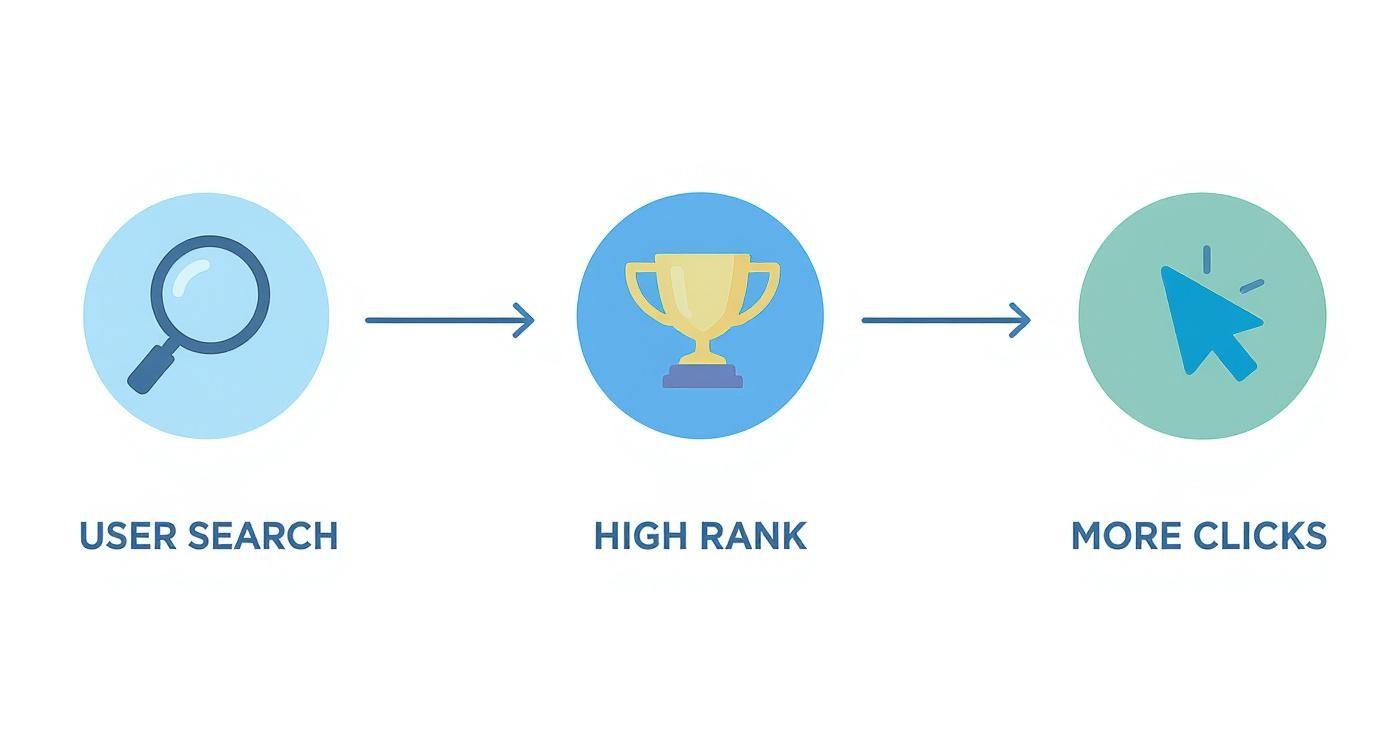
It’s a simple workflow, but it highlights a fundamental SEO truth: your visibility hinges on satisfying that initial search. And you can only do that if you understand the user’s goal from the very beginning.
Decoding the Four Types of User Intent
User intent is just a fancy way of saying “the why behind the search.” Every single person who types something into Google is trying to accomplish something specific. Your content’s job is to help them do it.
For the most part, these goals fall into one of four buckets:
-
Informational Intent: The searcher just wants to learn something. Think queries like “how to write seo optimized content,” “what is a keyword,” or “why is my site slow.” They’re looking for answers and guides, not a sales pitch.
-
Navigational Intent: The user already knows where they want to go and is just using Google as a shortcut. Searches like “Agency Platform login” or “HubSpot blog” fit here.
-
Commercial Intent: These users are in the consideration stage, doing their homework before they buy. They’re comparing options with searches like “best seo tools for agencies” or “Agency Platform vs Semrush.”
-
Transactional Intent: This is the money-maker. The user is ready to pull the trigger and take action right now. Their queries are direct and specific: “Agency Platform pricing” or “sign up for a white-label seo dashboard.”
Matching your content type to the correct intent is everything. You wouldn’t write a “how-to” guide to rank for a transactional term, and you wouldn’t push a sales page on someone who just wants information. To see how this directly impacts your bottom line, check out this deep dive on the role of user intent in content optimization.
Finding the Right Keywords to Target
Once you’ve wrapped your head around intent, it’s time to start finding the actual keywords that will lead the right people to your doorstep. The best strategy involves a healthy mix of different keyword types that map to various stages of your customer’s journey.
-
Primary Keywords: These are the big, broad terms that define your topic (e.g., “seo content”). They usually have high search volume and, as you’d expect, tons of competition.
-
Secondary Keywords: These are related terms that give your content more context and depth (e.g., “seo writing tips,” “on-page optimization”). They help you build out your topical authority and show Google you know your stuff.
-
Long-Tail Keywords: These are longer, more specific phrases that are absolute gold (e.g., “how to write seo content for a local business”). While they have lower search volume, their conversion rates are often much higher because the intent is so clear. In fact, research shows long-tail keywords can see a click-through rate that’s 3% to 5% higher than generic searches.
Pro Tip: Don’t get blinded by search volume. A keyword with 100 searches a month that perfectly matches what you sell is infinitely more valuable than a generic term with 10,000 searches that’s only loosely related.
Leveraging Competitor Analysis for Keyword Gaps
One of the smartest ways to build out your keyword list is to see what’s already working for your competitors. I’m not talking about blindly copying their strategy—this is about strategic espionage to find their strengths and, more importantly, their weaknesses.
Tools like Ahrefs or SEMrush are perfect for this. They let you plug in a competitor’s domain and see the exact keywords driving traffic to their site. You’re looking for “keyword gaps”—terms they rank for that you don’t. This can uncover some incredible opportunities they’ve missed. For agencies managing multiple clients, an all-in-one solution like Agency Platform offers a more streamlined alternative. It integrates powerful white-label SEO tools to handle keyword research and competitor analysis, consolidating data into a single, brandable dashboard, which simplifies reporting and strategy for your clients.
Create Comprehensive Content People Actually Want to Read
So, you’ve done the hard work of meticulous keyword research and figured out what your audience is really looking for. What’s next? This is where the magic happens: crafting the content itself. In the world of SEO, value and depth are king. Google’s entire mission is to find and reward the single best answer to a user’s question, which means your content needs to be the most thorough, authoritative, and satisfying resource out there.
This is exactly why chasing a specific word count is a losing game. The real goal is to create something so complete that it completely ends the user’s search. When someone lands on your page, they should find everything they need, with zero reason to hit the back button and see what else Google has to offer.
This mindset often leads to creating what we call pillar pages or cornerstone content. These are the big, in-depth articles that cover a topic from every conceivable angle. Think of them as the definitive resource that your other, smaller articles link back to, which in turn builds your site’s overall topical authority.
The Power of Comprehensive Content
Why does it seem like longer, more detailed content always performs better? It’s not about the word count itself, but what that word count represents. A longer article simply has more room to explore subtopics, answer follow-up questions, and provide the depth needed to fully satisfy a curious reader.
The data consistently backs this up. One study showed the average word count for a #1 Google result is around 2,416 words, while the tenth spot averages just 2,032 words. While you want to avoid Google’s “thin content” penalty by having at least 300 words, for your most important topics, aiming for 900 words or more is a much smarter play. This meets both user expectations and Google’s quality standards. You can dig into more of these SEO statistics and content length insights.
Of course, this isn’t an invitation to add fluff. Every single sentence has to add value. It just so happens that when you truly cover a topic well, it naturally requires more detail.
Structuring Your Content for Readability
A brilliant 2,500-word article is totally useless if it’s just an intimidating wall of text. The structure of your content is every bit as important as the information inside it. Your job is to make all that in-depth content easy to navigate and digest.
Here’s a practical framework I use to structure my writing:
-
Write a Killer Intro: Your first few sentences have to hook the reader and prove they’re in the right place. State the problem you’re solving or the question you’re answering, and give them a compelling reason to stick around.
-
Use Headings to Guide the Way: Break up your content into logical chunks with H2s and H3s. These act like signposts, letting readers scan the article and jump to the sections most relevant to them. It’s a massive win for user experience.
-
Keep Paragraphs Short and Sweet: I aim for paragraphs of no more than three sentences. This creates crucial white space, making the content feel less dense and way easier to read—especially on mobile, where most people are browsing anyway.
-
Incorporate Visual Breaks: Use bullet points, numbered lists, blockquotes, and images to chop up the text. These elements are great for drawing the eye and making complex information more digestible.
-
End with a Strong Call to Action (CTA): Never leave your reader hanging. Summarize the key takeaways and then tell them what to do next. This could be anything from leaving a comment to downloading a freebie or getting in touch with your team.
Writing comprehensive content isn’t about hitting a word count; it’s about exhaustively answering a user’s query. Your goal is to provide so much value in one place that they have no reason to return to the search results.
This structured approach is a lifesaver, especially for agencies managing content creation at scale. Creating templates and standardized outlines for different content formats (like a listicle vs. a how-to guide) ensures you maintain consistency and quality across all your client work. A tool like Agency Platform can centralize this whole process, providing a single hub to manage content workflows from the initial brief to final publication, all under your own brand. It keeps your team organized and your clients seriously impressed.
Nail Your On-Page and Technical SEO
You could write the most brilliant, in-depth article the world has ever seen, but it will never rank if search engines can’t find, crawl, and understand it. This is where the real work begins. We need to shift gears from content creation to the nitty-gritty of on-page and technical SEO that gets your content seen.
Think of it this way: your amazing content is the engine, but technical SEO is the chassis, wheels, and steering. Without that solid foundation, your powerful engine is just spinning its wheels, going nowhere. Things like page speed, mobile-friendliness, and clean code aren’t just nice-to-haves; they are non-negotiable signals that tell search engines your site offers a great user experience.
Optimizing Your Core On-Page Elements
On-page SEO is all about optimizing the elements on your page to improve its ranking potential. Years ago, this was a simple game of keyword density, but that’s ancient history now. Today, it’s about semantic relevance and, most importantly, user experience.
The key is to weave your primary and secondary keywords into the page naturally, where they make sense for a human reader.
-
Title Tag: This is arguably the single most important on-page factor. Your primary keyword should be as close to the beginning as possible, but the title also needs to be compelling enough to actually earn a click from a real person.
-
Meta Description: While it’s not a direct ranking factor, a well-crafted meta description is your ad copy in the search results. Make sure it includes your keyword and a strong hook to convince users to click on your link.
-
Headings (H1, H2, H3): Your H1 tag is your main headline and should contain your primary keyword. Use H2s and H3s to break up your content into logical sections and target secondary keywords. This creates a clear hierarchy for both readers and search engine crawlers.
-
Image Alt Text: This text is crucial for accessibility, describing an image for visually impaired users, but it’s also a signal for search engines. Writing descriptive alt text that includes relevant keywords helps your images rank in Google Images and adds more contextual relevance to the page.
The Growing Importance of Technical Signals
Technical SEO has firmly moved from a “nice-to-have” to an absolute must. Factors like page speed are direct ranking signals because they have a massive impact on user satisfaction. A slow-loading page is frustrating, and when users click the back button, it sends a huge negative signal to Google.
Beyond just speed, structured data (also called Schema markup) is a game-changer. This is a specific type of code you add to your website to help search engines understand your content on a deeper level. For instance, you can use Schema to tell Google that your content is an article, a recipe, a product review, or an FAQ page.
Implementing the right Schema markup is one of the most effective ways to earn rich snippets—those enhanced search results with star ratings, images, and FAQs. These eye-catching listings can dramatically increase your click-through rate.
Before you hit publish, it’s a good idea to run through a quick checklist to make sure all your on-page and technical ducks are in a row. A systematic review catches the small mistakes that can hold your content back.
On-Page SEO Optimization Checklist
Here’s a practical checklist to run through before any piece of content goes live.
| Element | Optimization Focus | Best Practice |
|---|---|---|
| Title Tag | Keyword & Clickability | Primary keyword near the front; under 60 characters. |
| Meta Description | CTR & Relevance | Include keyword and CTA; under 160 characters. |
| URL Slug | Simplicity & Keywords | Short, descriptive, and includes the primary keyword. |
| Headings (H1-H3) | Hierarchy & Keywords | One H1 with primary keyword; H2s/H3s for subtopics. |
| Image Alt Text | Accessibility & Context | Descriptive text with relevant keywords. |
| Internal Links | Authority & Navigation | 2-3 relevant internal links to other site pages. |
| External Links | Credibility | Link to at least one authoritative, non-competing source. |
| Page Speed | User Experience | Ensure page loads in under 3 seconds. |
| Mobile-Friendliness | Accessibility | Confirm the page displays correctly on all devices. |
| Schema Markup | Rich Snippets | Add relevant Schema (Article, FAQ, etc.) if applicable. |
This checklist isn’t exhaustive, but it covers the fundamentals that will give your content the best possible chance to perform well in search.
For agencies juggling multiple client sites, keeping track of every single technical and on-page element can feel impossible. This is where a centralized dashboard, like the one from Agency Platform, becomes invaluable. It streamlines technical audits and on-page management, letting you monitor site health and track optimizations across all your projects—all under your own brand. You can learn more about how to specifically target those enhanced search results in our guide on how to optimize your blog posts for featured snippets.
Navigating Modern SEO Challenges
The world of on-page optimization never stands still. For example, Google’s algorithm now rewrites a staggering 76% of titles it shows in search results, a huge jump from 61% just a few years back. This forces us to prioritize absolute clarity and relevance in our metadata.
At the same time, top-ranking pages today have 50% lower keyword density than they did two years ago. This is the clearest signal yet that Google has moved definitively away from keyword stuffing and is rewarding natural, helpful, information-rich content.
Promote Your Content and Earn Valuable Backlinks
Hitting “publish” is a great feeling, but in reality, it’s just the starting line. If you want your SEO-optimized content to actually perform, you have to get out there and promote it. Just creating something great and hoping people find it isn’t a strategy—it’s a recipe for getting lost in the digital noise.
Smart distribution is what separates pages that steadily climb the rankings from those that never see the light of day. A solid promotion plan gets your hard work in front of the right audience and starts earning the positive signals Google loves to see. This means going beyond a few social media posts and adopting a multi-channel approach that builds real momentum.
Building a Multi-Channel Promotion Strategy
Your promotion should kick off the second your article goes live. The idea is to create an immediate surge of traffic and engagement, which signals to search engines that your new content is valuable and worth paying attention to. This initial push can come from a few key places.
-
Social Media Amplification: Don’t just drop a link. Share your content across all your relevant social channels, but tailor the message for each platform. Use compelling visuals, ask questions, and do whatever it takes to spark a conversation.
-
Email Marketing: Your email list is gold. Send a broadcast to your subscribers letting them know about the new content. Briefly explain why it’s worth their time and encourage them to not only read it but share it, too.
-
Content Repurposing: Get more mileage out of your work by turning your article into other formats. You could pull key stats for an infographic, shoot a short video summarizing the main points, or create a slide deck for LinkedIn. This simple step helps you reach entirely new audiences on different platforms.
This approach creates a powerful flywheel effect. Every share, click, and comment builds on the last, pushing your content’s reach far beyond what any single channel could ever achieve on its own.
The Art and Science of Earning Backlinks
While promotion drives that crucial initial traffic, backlinks are still one of the heaviest hitters when it comes to ranking factors. Think of a backlink as a vote of confidence from one website to another. When other authoritative sites link to your page, they’re essentially telling search engines that your content is a credible, valuable resource. This can give your rankings a massive boost.
But it’s not a numbers game. The focus has to be on earning high-quality links from relevant, authoritative websites in your niche.
A single, editorially placed link from a trusted industry blog is worth more than a hundred low-quality links from irrelevant directories. Quality will always trump quantity in modern link building.
Building these links is a proactive job that requires both strategy and persistence. A few of the most effective and ethical tactics include:
-
Broken Link Building: This classic technique involves finding broken links on other relevant websites and reaching out to offer your content as a perfect replacement. It’s a true win-win: you help the site owner fix an error on their page, and you get a valuable backlink in return.
-
Strategic Guest Posting: Writing for other reputable blogs in your industry is a time-tested way to build authority and earn links. The key is to genuinely provide value to their audience, not just shoehorn in a promotion for your own site.
At the heart of all successful link building is one thing: genuine relationships. For a deep dive into a powerful method for acquiring these kinds of links, check out our guide on building authority links with the Skyscraper content strategy.
For marketing agencies, managing these outreach campaigns for clients can be incredibly time-consuming. That’s why the tools inside Agency Platform are designed to help manage and track outreach efforts from start to finish. You can simplify reporting on link acquisition and show its direct impact on keyword rankings, helping you efficiently scale your link-building services and prove clear ROI—all under your own brand.
Measure What Matters to Improve Your Strategy
Hitting “publish” isn’t the finish line. It’s actually the starting gun for a crucial feedback loop that tells you what’s working and what’s not. You simply can’t improve what you don’t measure. Data is what turns your content from a guessing game into a predictable engine for organic growth.
The trick is to ignore the noise from vanity metrics. Sure, a spike in page views feels good, but it doesn’t really tell you much. Instead, you need to lock in on the Key Performance Indicators (KPIs) that signal genuine SEO success and, more importantly, prove the value of your work.
Tracking the Right SEO KPIs
To get a clear picture of how your content is really doing, you need to track a few core metrics. These KPIs are your direct line to actionable insights, showing you how your content is resonating with both search engines and actual humans.
-
Organic Traffic: This one’s the big one—the total number of visits you’re getting from search engines. If this number is steadily climbing, it’s the clearest sign your overall strategy is on the right track.
-
Keyword Ranking Improvements: Are you moving up the SERPs for the keywords you’re targeting? Tracking your keyword positions shows which articles are gaining traction and which ones might need a little help.
-
Click-Through Rate (CTR): You’ll find this metric in Google Search Console, and it reveals the percentage of people who see your result and actually click on it. A low CTR could mean your title tag or meta description just isn’t compelling enough to grab their attention.
-
Conversions: This is the ultimate measure of success. Are visitors doing what you want them to do, like signing up for a newsletter or requesting a demo? This is the KPI that ties your content directly to real business goals.
The Power of Content Audits
Every so often, you need to step back and conduct a content audit to find your underperforming articles. Hunt for pages with declining traffic, weak keyword rankings, or low engagement. These are prime candidates for a content refresh or even consolidation.
You’d be surprised how often updating an old post with fresh data, better visuals, and more current information can give you a significant ranking boost—often much faster than creating something brand new from scratch.
Your published content is a living asset. A data-driven feedback loop allows you to continuously refine your strategy, update what’s not working, and double down on what is.
For agencies juggling a dozen client campaigns, trying to track these KPIs across different dashboards is a massive headache. This is where a white-label solution like Agency Platform becomes a lifesaver. It pulls all this critical data into a single, brandable client portal, making it dead simple to monitor organic traffic, keyword rankings, and conversions. It turns complex data into clear, automated reports that demonstrate tangible ROI without the manual effort.
Common Questions About SEO Content Writing
Even with the best playbook in hand, you’re bound to run into some specific questions once you’re deep in the trenches of writing SEO content. Getting these nuances right is what separates good content from great content.
Let’s clear up a few of the most common questions we hear from agencies and their writers.
How Often Should I Update Old Content?
This is a big one. For your most important, high-traffic pieces, you should plan on giving them a thorough review every 6-12 months. It’s not just about a quick once-over, either.
You’re hunting for outdated stats, broken links, and—most importantly—opportunities to add new, relevant details that make the content even more valuable. A major refresh tells Google your page is still the best, most up-to-date answer out there, which can lead to a nice little bump in the rankings.
SEO Content vs. SEO Copywriting: What’s the Difference?
People use these terms interchangeably all the time, but they have distinct goals. While they definitely overlap, the core purpose is different.
-
SEO Content Writing is all about informing, educating, or entertaining. The goal is to pull in organic traffic from search engines. Think blog posts, comprehensive guides, and articles that answer a user’s questions.
-
SEO Copywriting is built to persuade. It’s laser-focused on getting the reader to take a specific action, like buying a product or signing up for a newsletter. You’ll find it on sales pages, product descriptions, and ad copy where conversion is the name of the game.
Can I Use AI to Write SEO Content?
Absolutely, but with a major caveat. AI tools are fantastic for getting you off the starting blocks. They can help with brainstorming, generating outlines, and even speeding up the research phase. But they should never fully replace a human expert.
Google’s E-E-A-T guidelines (Experience, Expertise, Authoritativeness, Trustworthiness) are all about rewarding content that provides real, first-hand insight. AI, by its nature, can’t fake genuine experience.
Think of AI as a talented junior assistant. Let it handle the groundwork, but always have a human expert step in to add unique perspectives, fact-check everything, and make sure the final piece is genuinely helpful and trustworthy.
That human touch is what turns a generic article into a go-to resource that builds real authority. For agencies producing content at scale, striking this balance between AI efficiency and expert oversight is non-negotiable.
From keyword research and content creation to tracking performance and reporting back to clients, managing the entire content lifecycle is a heavy lift. Agency Platform gives you a centralized, white-label dashboard that streamlines the whole workflow for you and your clients.
Schedule a demo and see how you can deliver incredible SEO results, all under your own brand.